
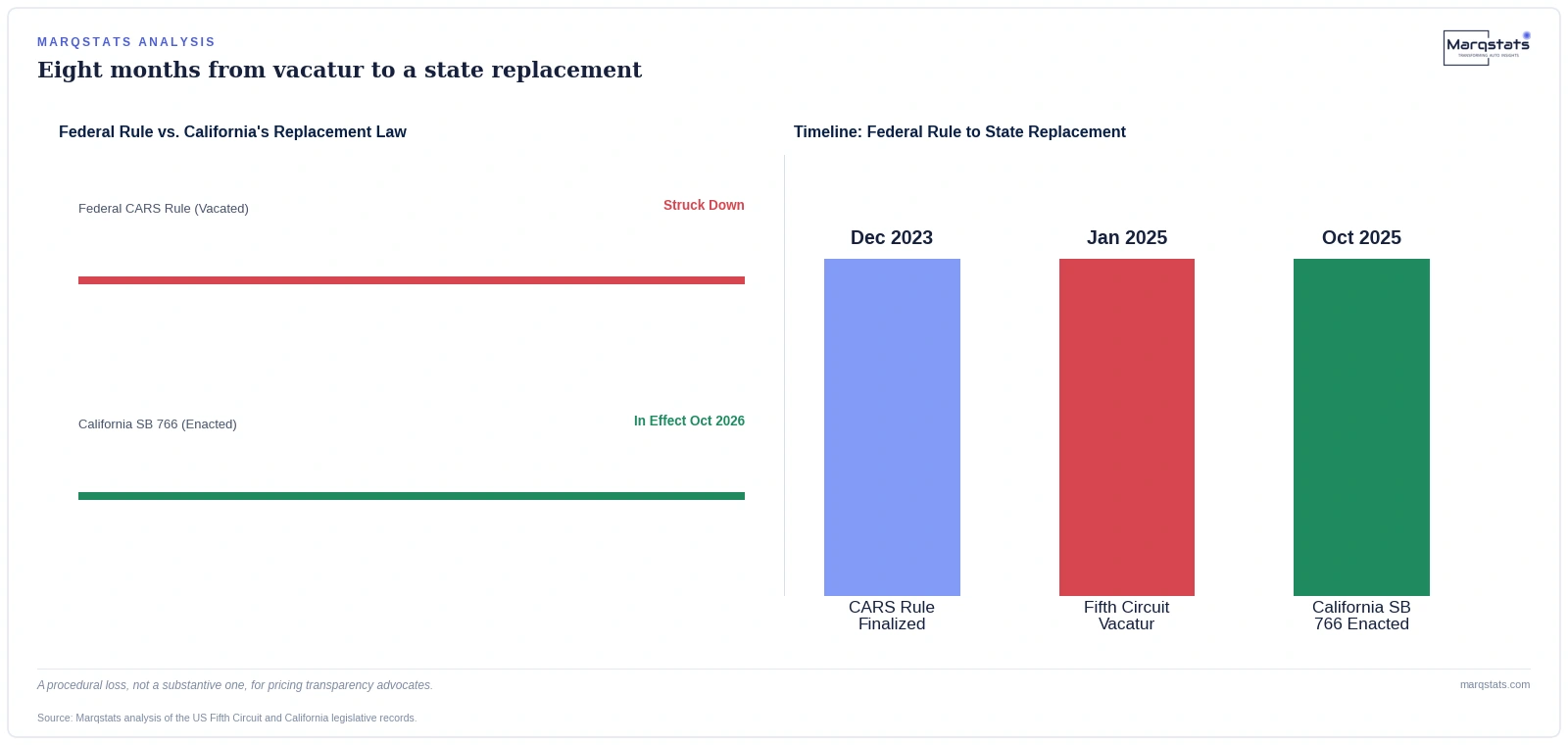
A federal court struck down the auto pricing rule on a technicality. Eight months later, California passed nearly the same law.
In brief:
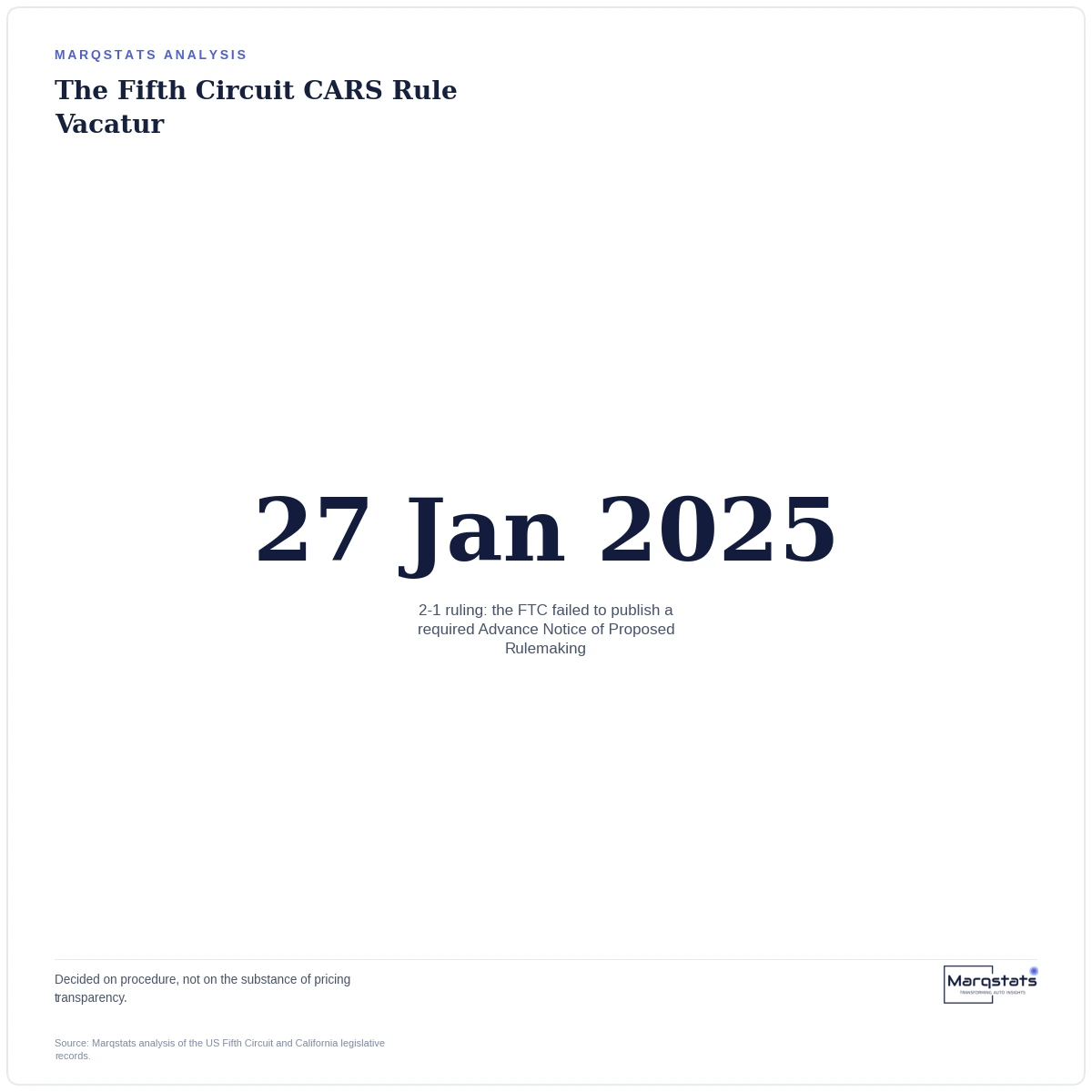
- On 27 January 2025, the Fifth Circuit vacated the FTC's Combating Auto Retail Scams Rule by a 2-1 margin, entirely on procedural grounds.
- The court did not rule on whether the underlying pricing transparency requirements were substantively justified.
- On 6 October 2025, California enacted Senate Bill 766, establishing state-level pricing mandates that mirror and in some areas exceed the vacated federal rule.
It would be easy to read the death of a federal regulation as the end of the story. In this case, it was closer to the opening chapter. The Federal Trade Commission's Combating Auto Retail Scams Rule, finalized in December 2023, was struck down in January 2025 - and then, less than a year later, one of the country's largest auto markets passed a law that does much of what the federal rule would have done anyway.
Why the federal rule actually died
The Fifth Circuit's ruling is worth reading carefully, because what it says matters as much as what it did. A three-judge panel vacated the CARS Rule in its entirety, by a 2-1 margin, in National Automobile Dealers Association v. Federal Trade Commission. The court's stated reason: the Commission committed a procedural error by failing to publish an Advance Notice of Proposed Rulemaking, a required preliminary step under Section 18(a)(1)(B) of the Federal Trade Commission Act, before issuing the final rule.
That's a technical, process-based objection. The panel did not rule that mandatory upfront pricing disclosure, prohibitions on charging for worthless add-ons, or required documentation of consumer consent were bad policy, unnecessary, or beyond the Commission's authority. It ruled that the Commission skipped a required procedural step on the way to imposing them. The rule's substantive requirements, in other words, were never actually evaluated and rejected on their merits.
The rule didn't lose the argument. It lost on a technicality before the argument even started.
— Marqstats Analyst Team
Why that distinction mattered for what happened next
Because the vacatur turned on process rather than substance, the underlying policy question, whether dealerships should be required to disclose comprehensive out-the-door pricing upfront, remained genuinely unresolved. And unresolved policy questions with public support don't simply disappear when one procedural pathway to addressing them gets closed off. They tend to resurface somewhere else.
California is where that resurfacing happened first, and decisively. On 6 October 2025, the state enacted Senate Bill 766, the California Combating Auto Retail Scams Act, operative 1 October 2026. The statute requires dealers to clearly display a comprehensive Total Price across all digital advertising and written communications, disclose the terms of any optional add-ons, maintain advertising compliance records for two years, and provide a mandatory three-calendar-day cancellation option for used vehicles sold at $50,000 or less. In several specific respects, the California law actually goes further than the vacated federal rule did.
What this means for dealerships operating in multiple states
For a dealership group operating only in California, this creates a straightforward, if demanding, compliance obligation. For a group operating across multiple states, it creates something more complicated: a patchwork. California now has its own binding statutory pricing transparency regime. Other states, for now, do not have an equivalent state-level requirement, and the federal requirement that would once have created a single nationwide standard no longer exists. A multi-state dealership group must now potentially comply with meaningfully different disclosure standards depending on which state a given rooftop operates in, rather than a single federal baseline applying uniformly everywhere.
The counter-argument: is a single state's law really evidence of a national trend?
A fair objection is that one state enacting pricing transparency legislation doesn't necessarily indicate a broader national pattern is forming - California has a long history of enacting consumer protection legislation more aggressive than federal baselines across many industries, and its specific regulatory culture may not generalize to other states with different political and regulatory environments. This is a reasonable caution against overreading a single data point. What supports treating California's move as more than an isolated event is the underlying mechanism connecting pricing transparency directly to a dealership's generative search visibility: as this market's own analysis demonstrates, generative retrieval systems evaluate pricing consistency across multiple online sources and treat discrepancies as a trust signal that suppresses recommendation eligibility, meaning the commercial incentive toward accurate, structured pricing disclosure exists independent of whether any particular state passes a law requiring it. That commercial incentive, not just regulatory copycatting, is what makes continued movement toward pricing transparency a reasonably foreseeable trend regardless of which specific states act first.
What this means for dealership groups and compliance teams
- Multi-state dealership groups should map their compliance obligations state by state going forward, rather than assuming a single national standard applies uniformly, given the current absence of a federal baseline.
- Compliance teams should monitor other state legislatures for copycat pricing transparency proposals specifically, since California's law establishes a concrete legislative template other states can adapt quickly.
- Dealerships should treat structured, accurate pricing disclosure as serving both regulatory compliance and generative search visibility simultaneously, since both systems penalize the same underlying behavior: inconsistent or concealed pricing.
What the federal rule would actually have required
It's worth being specific about what disappeared when the CARS Rule was vacated, since the practical stakes matter for understanding why California moved to replace it. The federal rule would have mandated upfront disclosure of a true Offering Price, the full cash price a dealer would actually sell or lease a vehicle for, excluding only mandatory government taxes and registration fees. It would have prohibited charging consumers for optional add-on products conferring no genuine benefit, things like nitrogen tire fills at ambient concentrations or duplicate warranty contracts. It would have required disclosure of total payment amounts across financing and lease transactions, and required documented, express consent before assessing any charge. Violations would have carried penalties of up to $50,120 each.
These are not minor administrative requirements. They target specific, well-documented consumer complaint patterns in vehicle sales: bait-and-switch advertised pricing, hidden mandatory fees, and add-on products sold without clear disclosure that they're optional. The scale of the potential penalty, over $50,000 per violation, reflects how seriously the Commission treated the underlying conduct, even though the rule itself never survived to be enforced.
Why dealer trade associations opposed the rule in the first place
It's worth acknowledging the dealer association perspective fairly, since NADA and TADA were the parties that actually brought and won the legal challenge. Their public position was that the rule, as finalized, would have added substantial time, complexity, paperwork and cost to the car-buying and car-shopping experience for essentially every customer, not just those targeted by the deceptive practices the rule was designed to address. This is a genuine trade-off in consumer protection rulemaking generally: broad-based disclosure and documentation requirements, even when aimed at bad actors, impose compliance costs on the entire regulated population, including dealers who were never engaging in the practices the rule targeted.
The Fifth Circuit's ruling didn't resolve this underlying tension between consumer protection and compliance burden - it sidestepped it entirely by deciding the case on process grounds. That's precisely why the policy debate resumed at the state level almost immediately, with California's legislature reaching its own conclusion about where that trade-off should land.
The full market picture
Marqstats' complete United States automotive Generative Engine Optimization market analysis, including the full regulatory landscape and a two-scenario forecast through 2030, is available in the linked report below.
Related reportUnited States Automotive Generative Engine Optimization Market Size, Share & Forecast 2026 – 2030