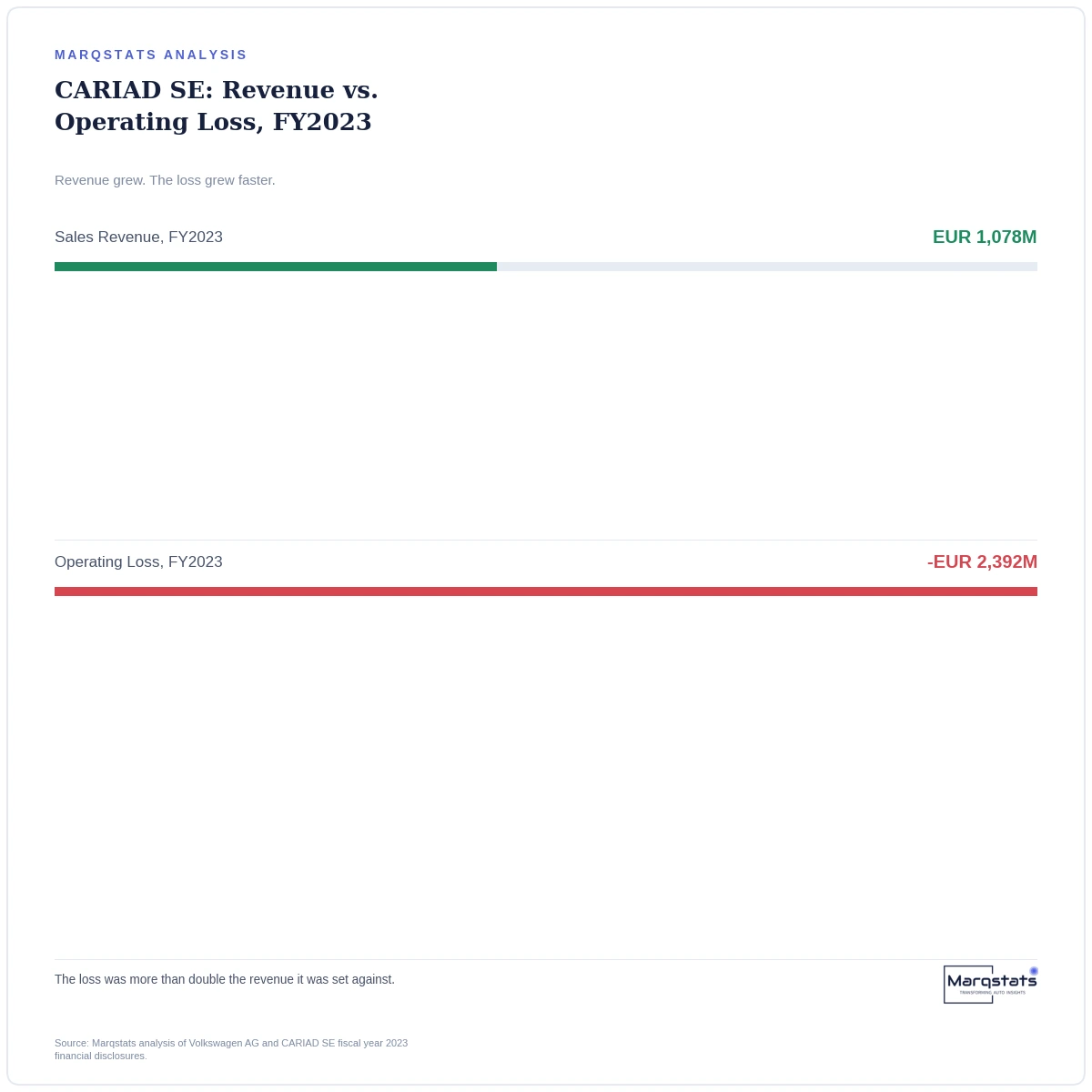
Volkswagen's software subsidiary made 1.08 billion euros in 2023. It lost 2.39 billion.
In 2020, Volkswagen Group made a genuinely ambitious bet: rather than continuing to buy software components piecemeal from outside suppliers the way the auto industry traditionally had, it would build its own unified software operating system in-house, across every brand from the mass-market Volkswagen nameplate to Porsche and Lamborghini. The subsidiary tasked with building it was called CARIAD SE. Three years later, the financial results tell a cautionary story about just how expensive that bet turned out to be.
The numbers, and what they actually mean
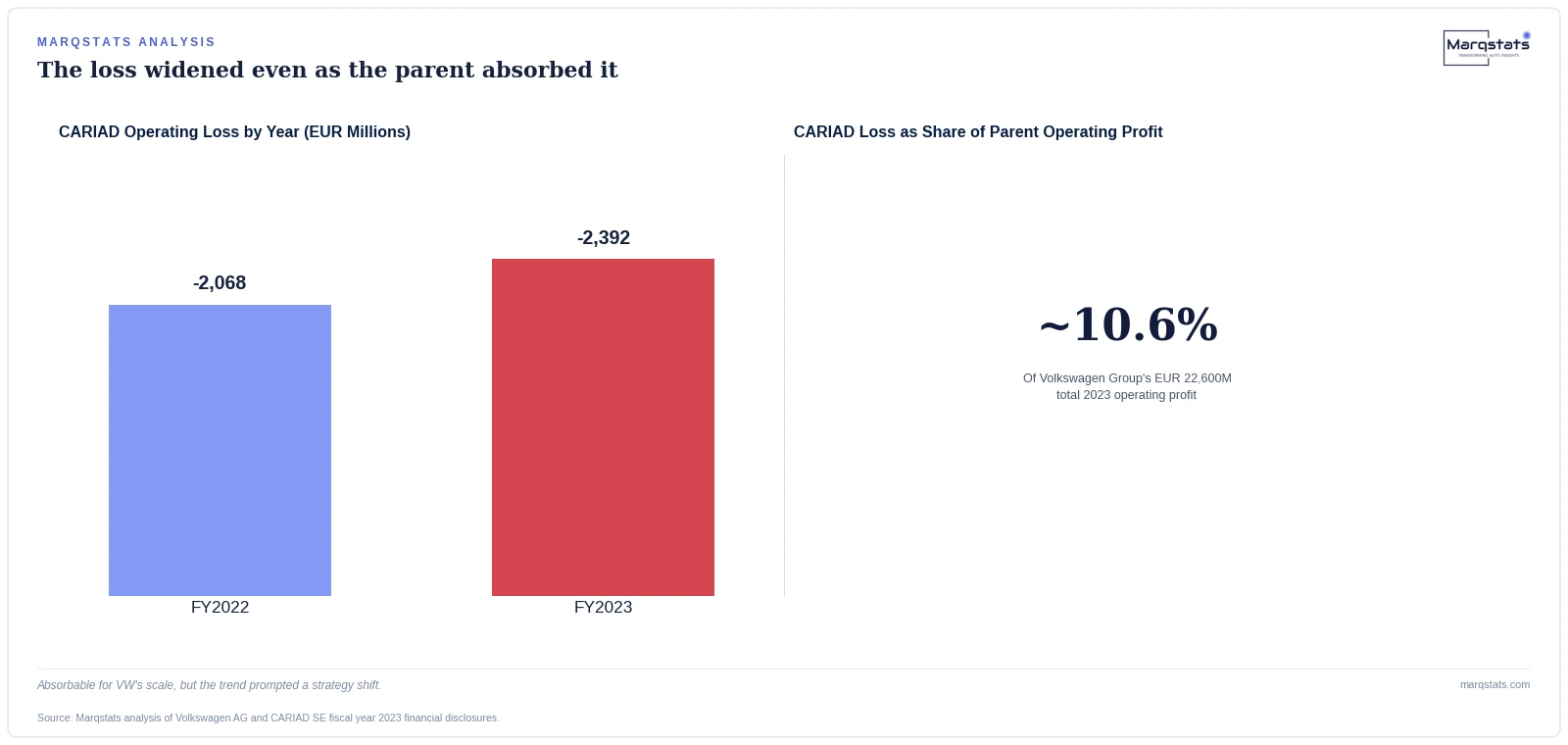
CARIAD's revenue did grow in 2023, up from 796 million euros in 2022 to 1,078 million euros - a genuinely meaningful increase. But the operating loss grew even faster, widening from negative 2,068 million euros to negative 2,392 million euros. In plain terms: for every euro of revenue CARIAD brought in during 2023, it spent more than two euros building the software that generated it, and that ratio actually got slightly worse year over year, not better.
This isn't necessarily a sign of complete failure - early-stage, capital-intensive technology platforms often run at a loss for years before reaching a scale where revenue catches up to development cost. But the scale of the loss, and the fact that the gap widened rather than narrowed in year three, is the kind of result that would prompt serious internal scrutiny at any company, let alone one operating inside a parent group answerable to public shareholders.
Revenue grew. The loss grew faster. That's the wrong direction for a bet this expensive.
— Marqstats Analyst Team
Why this matters even for a company as large as Volkswagen
It's worth putting CARIAD's loss in context against its parent company's overall scale, because the comparison cuts two ways. Volkswagen Group generated 322,284 million euros in consolidated revenue and 22,600 million euros in operating profit in 2023, on 9.362 million vehicle deliveries. Against numbers that large, CARIAD's 2,392 million euro loss is absorbable - it represents roughly 10.6% of the parent group's entire operating profit, a real number but not an existential one for a company of Volkswagen's size.
But the fact that even a company with Volkswagen's balance sheet found this level of sustained loss significant enough to change strategy is itself the informative part of this story. It suggests the challenge isn't primarily about capital availability - Volkswagen clearly could afford to keep funding CARIAD at this loss level for years if it chose to. The challenge is something harder to solve with money alone: building complex, safety-critical automotive software across multiple brands and vehicle platforms simultaneously turned out to be a genuinely difficult engineering and organizational problem, not simply an expensive one.
What Volkswagen did next
Following these results, Volkswagen shifted its approach, pursuing external software partnerships with Rivian Automotive and Mobileye rather than continuing to rely purely on in-house CARIAD development. This is a meaningful strategic reversal from the original 2020 vision of a single, unified, entirely proprietary software stack built internally across every brand. It suggests Volkswagen concluded that some combination of external expertise and existing, proven software platforms was a faster and more reliable path to software-defined vehicle capability than continuing to fund an entirely from-scratch internal build at the same pace.
The counter-argument: is this a failure of strategy, or just a normal cost of a hard technical problem?
A fair objection is that building an entirely new automotive software operating system from scratch, across multiple brands and vehicle platforms simultaneously, was always going to be an extraordinarily difficult and expensive undertaking, and CARIAD's losses may simply reflect the genuine cost of that difficulty rather than a strategic misstep. This is a reasonable read of the situation. The external partnerships with Rivian and Mobileye don't necessarily represent an admission that the original strategy was wrong in principle - they could equally represent a rational adjustment once the true scale of the technical challenge became clearer through direct experience, which is a normal part of large-scale technology development rather than evidence of poor initial judgment.
What this means for automakers and software investors
- Automakers evaluating in-house software platform investment should model multi-year operating losses explicitly into their planning, using CARIAD's trajectory as a documented benchmark for the scale and duration such losses can reach.
- Investors and analysts covering automotive software subsidiaries should track the revenue-to-loss ratio trend specifically, since a widening gap, as CARIAD experienced, is a more informative signal than the absolute loss figure alone.
- Automakers considering external software partnerships should watch how Volkswagen's Rivian and Mobileye collaborations perform relative to CARIAD's pure in-house results, since this represents a live natural experiment in build-versus-partner automotive software strategy.
What made this particular software problem so hard
It's worth being specific about why unified automotive software proved harder than Volkswagen apparently anticipated, since the difficulty wasn't simply a matter of writing more code. CARIAD's mandate spanned Volkswagen's Volume, Premium and Sport-Luxury brand groups simultaneously - meaning the same underlying software architecture needed to work across vehicles with meaningfully different engineering requirements, price points, and customer expectations, from mass-market Volkswagen models to Porsche and Lamborghini. Safety-critical automotive software also carries certification and validation requirements far beyond typical consumer software development, since a defect in vehicle control software has consequences a defect in, say, a mobile app simply does not.
Layer onto that the reality that this software needed to interface with hardware from many different suppliers, across vehicle generations built on different underlying platforms, and the scope of the technical challenge becomes clearer: CARIAD wasn't just building one product, it was attempting to build a common software foundation flexible enough to serve an entire corporate group's worth of genuinely different vehicles simultaneously.
A pattern other automakers should recognize, not dismiss as Volkswagen-specific
CARIAD's experience is the most publicly documented example of this challenge specifically because Volkswagen, as a publicly traded company, is required to disclose subsidiary financial performance in detail that privately structured software units at other automakers often are not. That disclosure requirement doesn't mean the underlying difficulty is unique to Volkswagen - it means Volkswagen's numbers happen to be the clearest publicly available window into a challenge that is very likely playing out, with less public visibility, at other automakers pursuing comparable in-house software strategies across the industry.
The full market picture
Marqstats' complete Europe automotive data management market analysis, including the full vendor and capital expenditure landscape, is available in the linked report below.
Related reportEurope Automotive Data Management Market Size, Share & Forecast 2026 – 2034