Almost the Entire Market, in Three Provinces
That kind of concentration would be unusual in most consumer product categories. For a market this closely tied to specific provincial policy instruments, though, it's a genuinely predictable outcome once you understand which levers each province actually pulled and when.
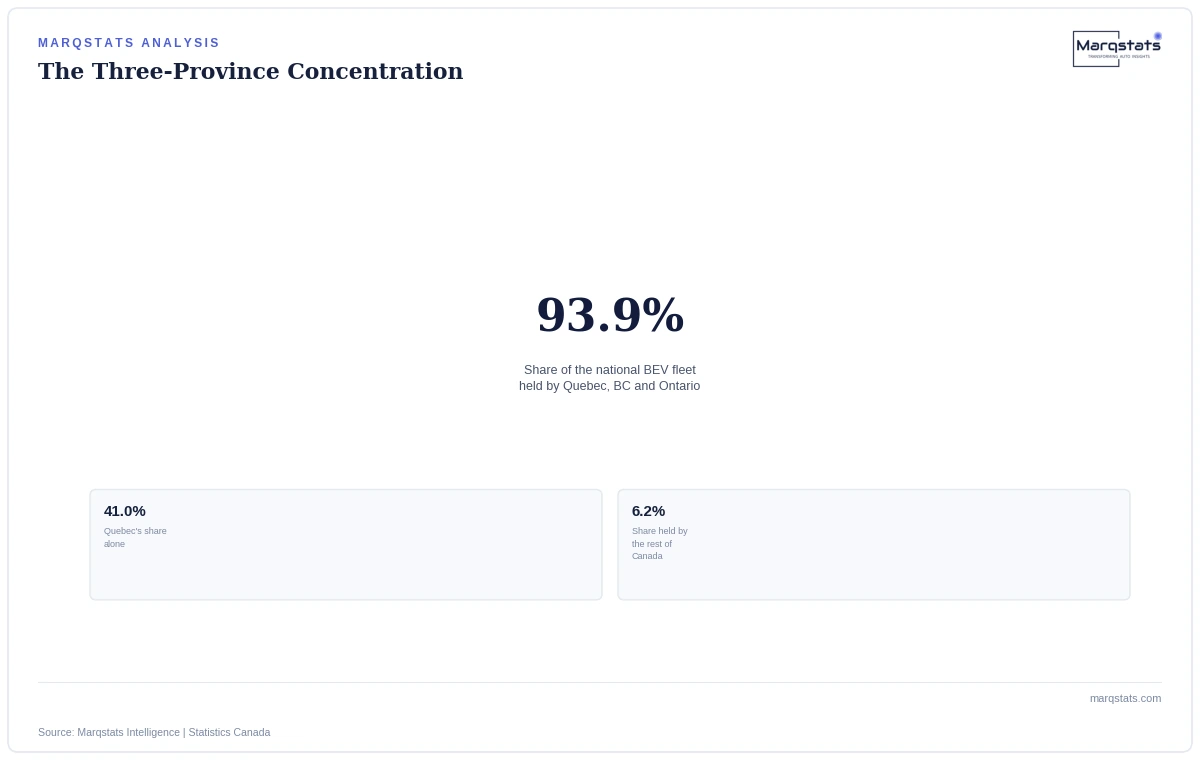
Quebec, British Columbia and Ontario together host 93.9% of Canada's active battery electric vehicle fleet and accounted for 92.2% of national new ZEV sales in 2024. Every other province and territory combined accounts for roughly one-sixteenth of the country's EV maintenance demand.
The Policy Difference That Explains It
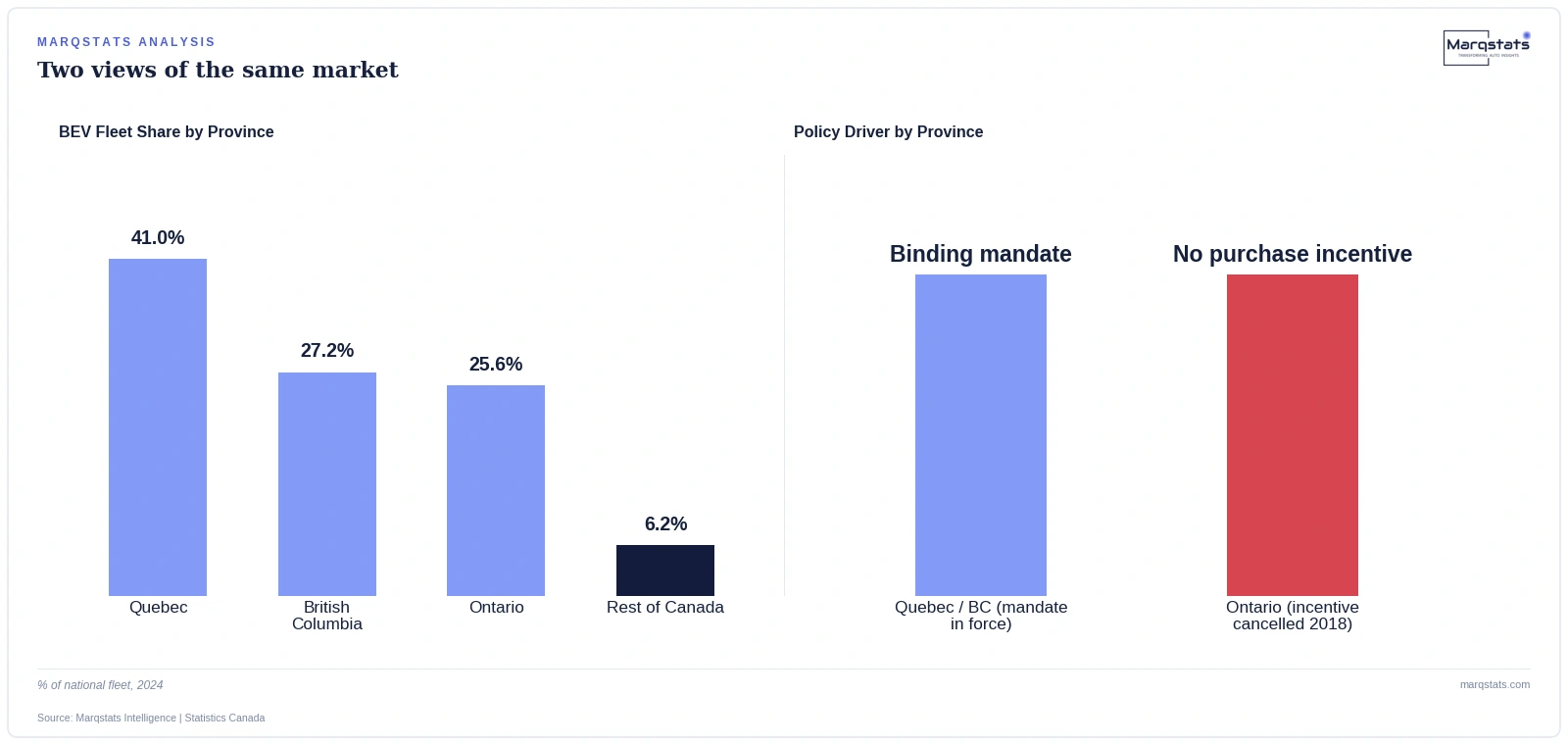
This isn't a random geographic accident. Quebec and British Columbia both have binding zero-emission vehicle sales mandates already in force — Quebec's dating to 2018, British Columbia's Zero-Emission Vehicles Act setting phased targets of 26% by 2026, 90% by 2030 and 100% by 2035. Ontario, by contrast, cancelled its provincial consumer purchase incentives in 2018, and its EV adoption has grown far more gradually as a result — a genuinely instructive natural experiment sitting right next to two provinces running the opposite policy.
What Quebec Got Right Early
Quebec's early market leadership traces to a specific combination: accessible hydroelectric power keeping charging costs low, the Roulez vert purchase rebate program, and that 2018 sales mandate working together rather than any single lever alone. The province also built workforce capacity deliberately, creating the Compétences VE technician training program specifically to make sure service capacity could keep pace with fleet growth.
A Named Comparison: Why Ontario's Experience Matters
Ontario is genuinely the most useful comparison case in this data, precisely because it isn't a policy failure — it's Canada's largest overall vehicle market, with 8.8 million light-duty vehicles nationwide, that simply chose a different incentive path in 2018. Its more gradual EV adoption curve, reaching only an 8.1% new ZEV sales share in 2024 against Quebec's much higher rate, is close to a controlled comparison for how much a purchase incentive alone can move adoption timing, independent of underlying market size or consumer interest.
Where the Remaining 6% Actually Lives
The provinces and territories outside this top three -- Alberta, Nova Scotia, Newfoundland and others -- are aggregated under combined national reporting provisions in the underlying data, reflecting both smaller absolute fleet sizes and the practical reality that detailed province-by-province breakdowns become less statistically meaningful at that scale.
What This Means for Anyone Planning Around This Market
The practical implication: workshop and parts-supplier expansion planning should weight Quebec, British Columbia and Ontario specifically, in that rough order of near-term priority, while treating the rest of Canada as a genuinely longer-horizon opportunity tied to national ZEV mandate enforcement rather than current fleet density.