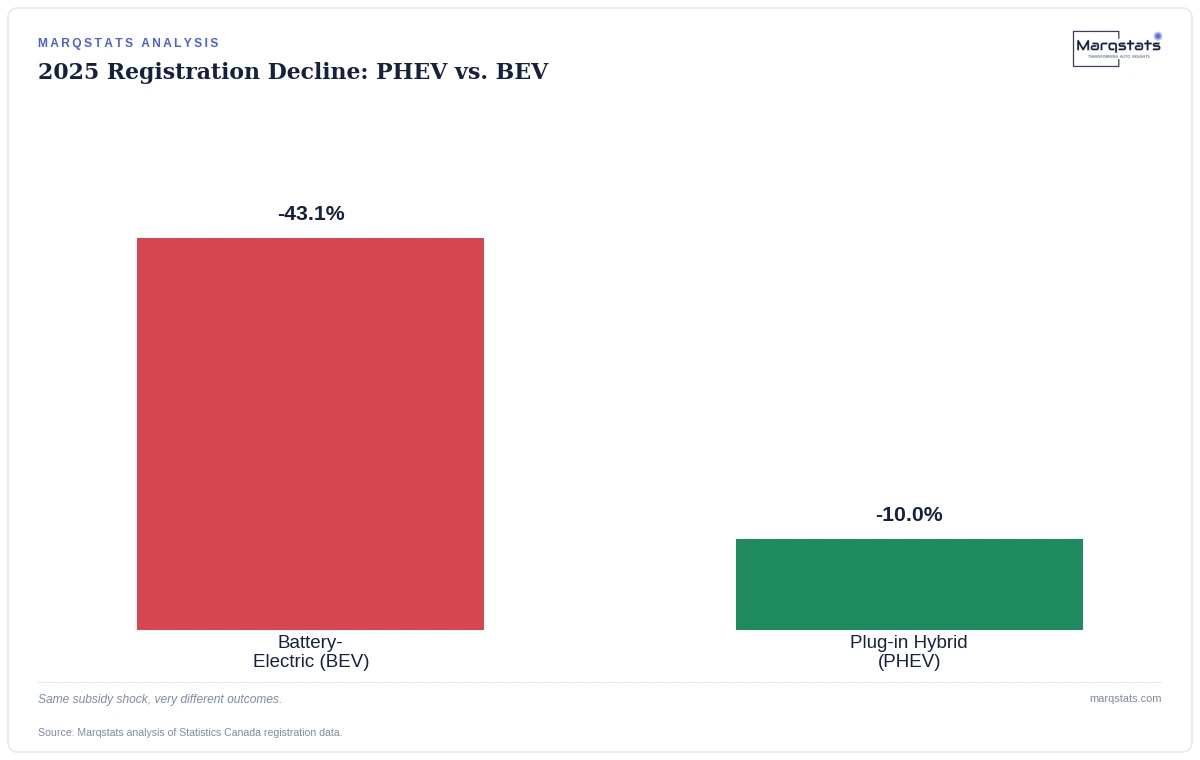
In 2025, Canada's battery-electric vehicle sales collapsed 43.1%. Plug-in hybrid sales fell just 10.0%.
In brief:
- Canada's federal iZEV rebate program was suspended on 10 January 2025 after total funds were exhausted, and major provincial programs in Quebec and British Columbia were curtailed within months.
- Battery-electric vehicle registrations fell 43.1% in 2025, from 202,103 to 115,337 units.
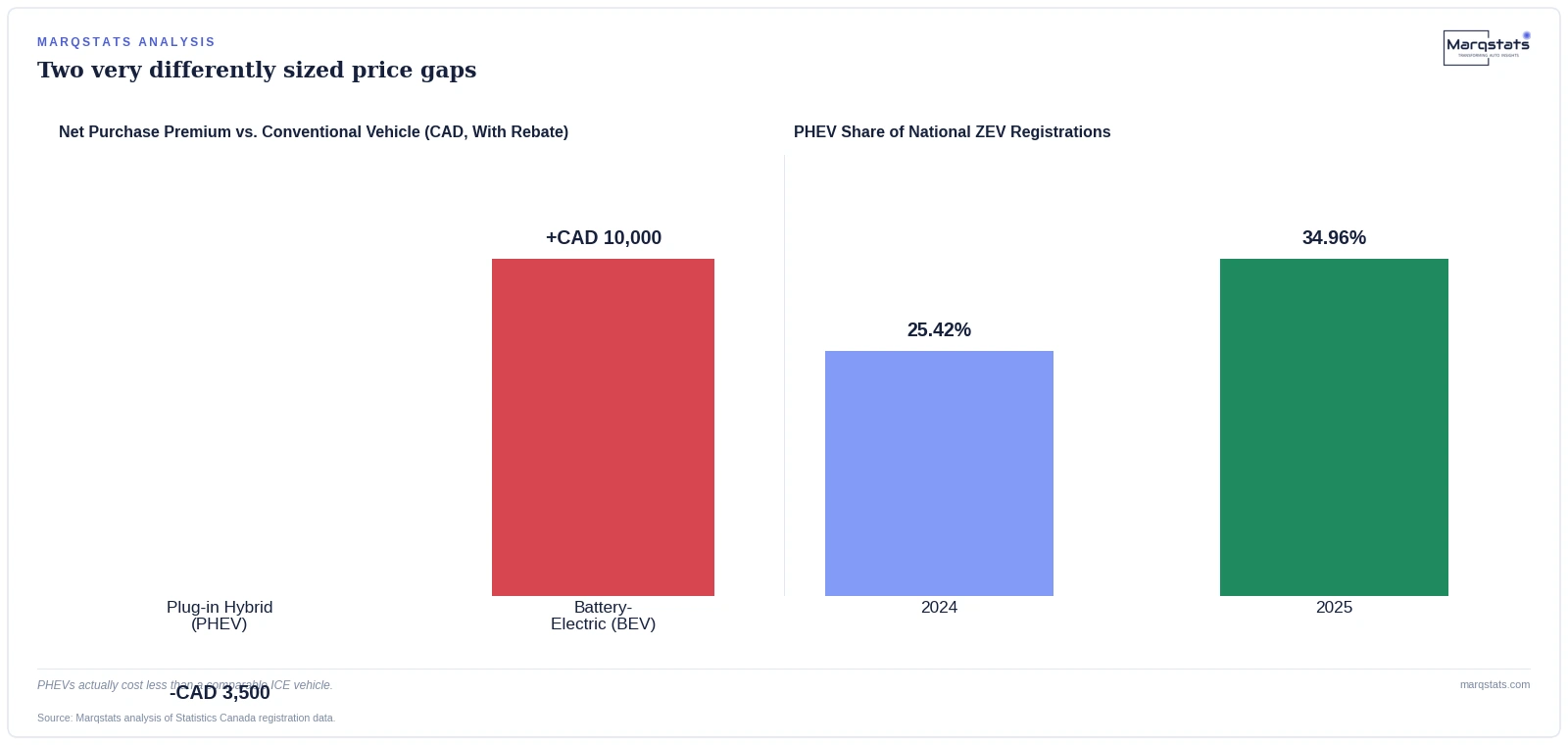
- Plug-in hybrid registrations fell only 10.0%, from 68,882 to 62,001 units, expanding PHEVs' share of national zero-emission vehicle registrations from 25.42% to 34.96% in a single year.
When Canada's fiscal support for electrified vehicles disappeared almost overnight in early 2025, the two technologies that share the zero-emission vehicle classification responded in dramatically different ways. Transport Canada's iZEV rebate program, which had provided up to CAD 5,000 toward a qualifying purchase, ran out of allocated funding and was suspended on 10 January 2025 - eleven months ahead of its scheduled sunset. Quebec's Roulez vert program, which had stacked with federal support to offer up to CAD 12,000 in combined incentives, froze its own funding weeks later. British Columbia's Go Electric program exhausted its funds by May.
Against this backdrop, a battery-electric vehicle buyer lost access to a subsidy that had been covering a substantial share of a genuine CAD 15,000 capital premium over a comparable combustion vehicle. A plug-in hybrid buyer, by contrast, lost access to a subsidy covering a premium that had already shrunk to roughly CAD 1,500 before any rebate was applied. The two powertrains were never equally exposed to the same policy shock, and the 2025 registration data shows exactly that asymmetry playing out.
The underlying economics explain most of the gap
A mainstream PHEV utility vehicle in Canada carried an average base price of roughly CAD 56,500 against CAD 55,000 for a comparable internal combustion vehicle - a modest CAD 1,500 premium that a rebate, or its absence, barely moves either way. A comparable battery-electric vehicle averaged CAD 70,000, a CAD 15,000 premium over the same combustion baseline. Even with the full CAD 5,000 federal rebate applied while it existed, the BEV buyer still faced a net CAD 10,000 premium; the PHEV buyer, with the same rebate, actually paid CAD 3,500 less than the combustion baseline.
When the rebate disappeared, the BEV buyer's premium jumped back to the full CAD 15,000 - a genuinely large swing in purchase economics. The PHEV buyer's premium swung from a CAD 3,500 advantage to a CAD 1,500 disadvantage - a far smaller shift in absolute terms, and one that still left the PHEV close to price parity with a conventional vehicle rather than meaningfully more expensive.
The subsidy withdrawal didn't just hit two technologies differently. It hit two very differently sized price gaps.
— Marqstats Analyst Team
This is not the only factor, but it may not even be the largest one
Price sensitivity to the rebate explains a meaningful share of the resilience gap, but Canada's own provincial data suggests something more is happening. Ontario, which has operated with zero provincial EV subsidy since 2018, actually saw PHEV registrations grow 14.09% in 2025 - even as the national federal rebate disappeared entirely. This is difficult to explain through price economics alone, since Ontario buyers faced the same reduced circumstances nationally as everyone else. It points instead toward a structural preference: PHEVs' winter-weather reliability, their freedom from public charging dependency in a country where 18% of the population lives in areas holding less than 7% of public charging infrastructure, and their compatibility with existing home electrical setups may all be doing real work independent of the rebate math. Neither the source data nor this analysis can cleanly separate how much of Ontario's growth traces to winter reliability specifically versus charging-infrastructure independence more broadly, since both factors point in the same direction and neither is isolated in the available registration figures.
The counter-argument: is 10% versus 43% really a fair comparison?
A reasonable objection is that BEVs and PHEVs started 2025 at very different scales and market maturity levels, and a percentage decline comparison can overstate how different the underlying stories actually are - a 43.1% decline off a larger 2024 base still left BEVs with more than 115,000 units, nearly double PHEVs' 62,001. This is a fair caveat: PHEVs remain the smaller of the two zero-emission categories in absolute volume even after 2025's divergence. What the percentage comparison captures accurately, though, is direction and magnitude of consumer response to the same policy shock in the same twelve-month window - and on that specific measure, the gap between 10.0% and 43.1% is real, large, and worth explaining rather than dismissing.
What this means for anyone forecasting Canadian electrified-vehicle demand
- Do not assume BEV and PHEV demand respond to subsidy changes at the same rate - the 2025 data shows a meaningfully different sensitivity between the two technologies.
- Weight Ontario's counter-cyclical PHEV growth heavily when modeling demand in provinces without subsidy support, since it may be a better predictor of unsubsidized PHEV demand than Quebec's subsidy-dependent pattern.
- Track the CAD 2.275 billion Electric Vehicle Affordability Program's actual disbursement pace closely, since its arrival in February 2026 already reversed some of this dynamic with a 22.9% year-on-year PHEV surge in the first quarter.
Quebec's collapse actually strengthens the structural-preference case
Quebec offers a useful counterpoint that, on close inspection, reinforces rather than undermines the structural-preference argument. Quebec's PHEV registrations fell 29.31% in 2025 - a far steeper decline than the 10.0% national figure - even though Quebec is also the province where PHEVs enjoy the strongest winter-thermodynamic rationale, given its harsh continental climate. If price sensitivity alone explained PHEV resilience, Quebec's PHEV decline should have looked similar to the national pattern once its unusually generous CAD 12,000 combined incentive disappeared. Instead, Quebec's PHEV decline tracked closer to what a pure price-shock model would predict for a market accustomed to deep subsidy stacking, while Ontario's growth pattern, in a province with no subsidy dependency to lose, looked completely different.
Read together, these two provinces suggest the resilience story has at least two separate components: a national baseline advantage from PHEVs' smaller underlying price premium, and a province-specific effect where markets accustomed to heavy subsidy stacking experience sharper corrections than markets that never depended on subsidies to begin with. Quebec's 2025 pattern looks less like evidence against PHEV resilience and more like evidence that subsidy dependency itself, regardless of powertrain, produces sharper corrections when that dependency is suddenly removed.
What the February 2026 rebound confirms
The Electric Vehicle Affordability Program's launch in February 2026, and the 22.9% year-on-year PHEV registration surge in the following quarter, offers additional evidence for how tightly PHEV demand tracks rebate availability even against a backdrop of demonstrated resilience without one. This is not a contradiction of the resilience story - a market can be more resilient than a comparable alternative to subsidy withdrawal while still responding positively and immediately to subsidy restoration. Both facts describe the same underlying dynamic: PHEV demand in Canada is price-sensitive, but less price-sensitive than battery-electric demand specifically, a distinction with real consequences for how quickly each technology's registration volume moves in either direction as fiscal policy shifts.
The full market picture
Marqstats' complete Canada PHEV market analysis, including the full fiscal mechanics and a three-scenario forecast through 2030, is available in the linked report below.
Related reportCanada Plug-in Hybrid Electric Vehicle Market Size, Share & Forecast 2026 – 2030