Canada's EV sales mandate has been announced dead three separate times. It's still technically alive.
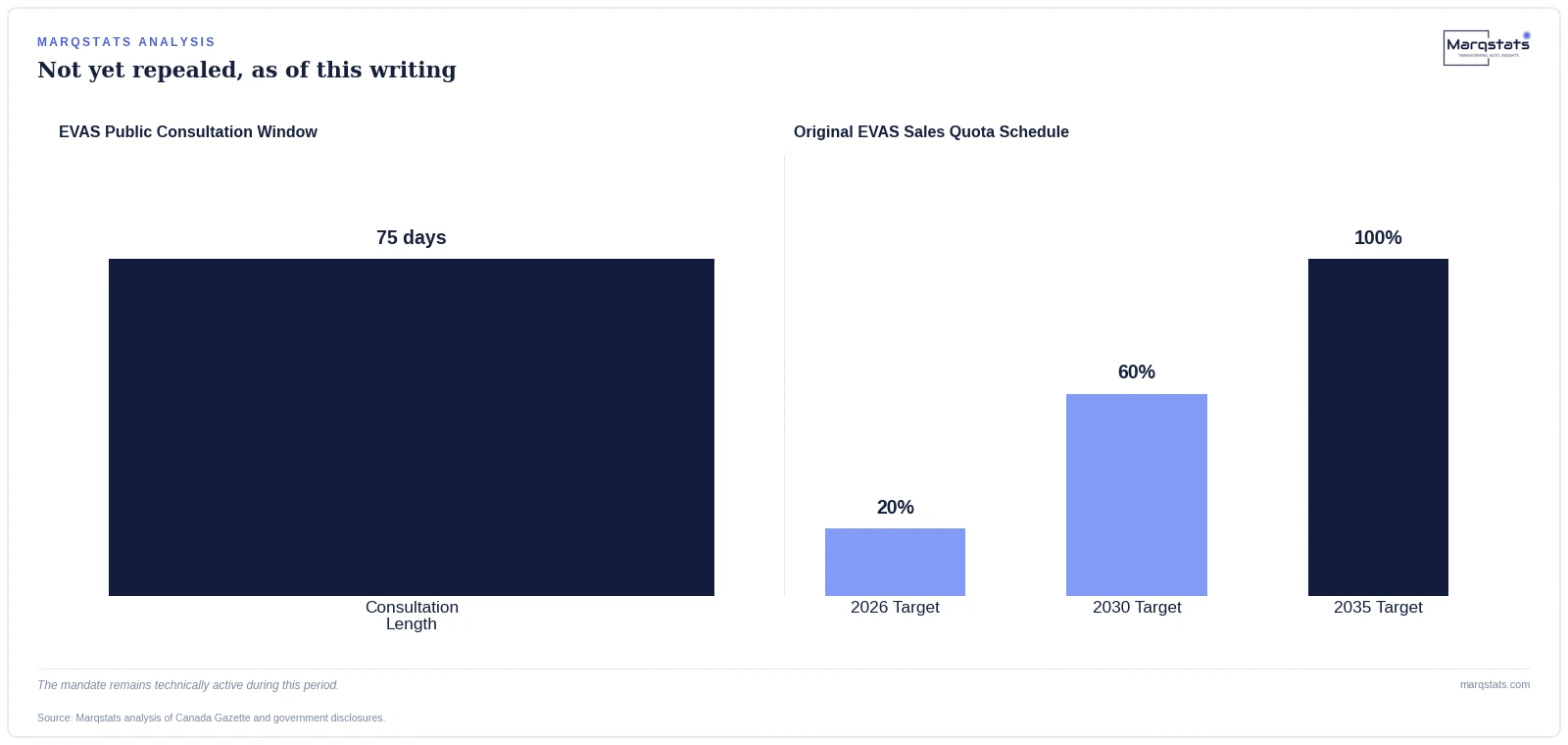
Three distinct announcements over the past year have each been widely reported as ending Canada's Electric Vehicle Availability Standard, the federal mandate requiring 20% of new light-duty vehicles sold in 2026 to be zero-emission, rising to 100% by 2035. None of them has actually done so. As of this writing, the mandate remains formally in force, suspended only by ministerial discretion rather than legally rescinded.
Three announcements, none of them a repeal
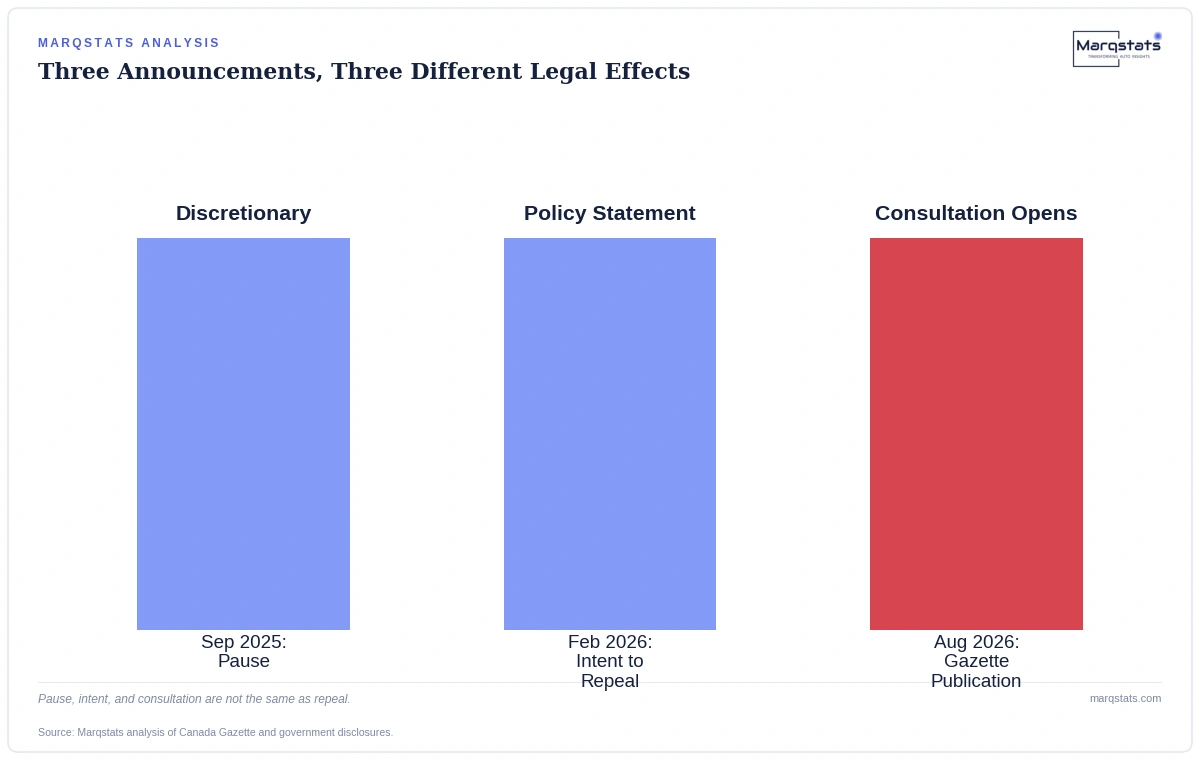
The first announcement came on 5 September 2025, when Prime Minister Mark Carney paused the incoming 2026 sales target and launched a 60-day internal review. A pause is not a repeal - it is an administrative decision not to enforce a rule that remains on the books, reversible by a future government decision without any further legislative or regulatory process.
The second announcement came on 5 February 2026, when Carney announced intent to repeal the mandate entirely, replacing it with technology-neutral greenhouse gas emissions standards for model years 2027 through 2032, targeting a 75% electric vehicle adoption equivalent by 2035. This was a statement of policy direction, not a completed regulatory action - announcing intent to repeal a regulation is a necessary first step, but it does not itself change the regulation's legal status.
The third step came on 15 August 2026, when proposed regulations formally repealing the Electric Vehicle Availability Standard's sales quotas were published in the Canada Gazette Part I. This is the actual mechanism by which Canadian federal regulations get amended or repealed - but publication in the Gazette Part I opens a mandatory public consultation period, not an immediate legal change. That consultation runs 75 days, through 29 October 2026.
Pausing a rule, announcing you'll repeal it, and actually repealing it are three different things. Canada has done the first two.
— Marqstats Analyst Team
What happens after 29 October 2026
Once the public consultation period closes, the government reviews submitted feedback and can then finalize the regulations, potentially with amendments based on that feedback, before formal registration completes the repeal. There is no fixed statutory deadline requiring the government to finalize the regulations by any specific date after the consultation closes - the process could conclude within weeks, or could extend considerably longer depending on the volume and substance of submissions received and any resulting revisions.
This means that, as of the date of this analysis, a factually accurate description of the Electric Vehicle Availability Standard's status is neither the repeal that is often described in casual coverage, nor the fully-active mandate description would technically remain true given the current legal status. It is a regulation that has been publicly announced for repeal, has an active public consultation open toward that repeal, but remains the technically governing law until that process formally concludes.
Why this distinction actually matters for manufacturers
A manufacturer's compliance planning depends on which of these descriptions is operative. If the mandate is treated as effectively dead, a manufacturer might reasonably deprioritize zero-emission-vehicle sales-mix planning for the 2026 model year. If the mandate remains legally binding pending a consultation outcome that could, in principle, modify rather than eliminate the sales targets, a more cautious manufacturer would maintain compliance readiness until the outcome is formally confirmed. Given that the consultation explicitly states it will consider amendments to the sales targets rather than a binary repeal-or-keep decision, the most defensible planning assumption is that some form of revised requirement, not a full elimination of any zero-emission-vehicle sales expectation, remains the more likely outcome.
The caveat: government intent is clear, even if the legal process is not complete
None of this should be read as suggesting the mandate is likely to survive in its original form. The Prime Minister's public statements, the Canada Gazette publication itself, and the broader policy direction toward the Electric Vehicle Affordability Program all point consistently toward replacement rather than retention of the original 20% quota. The distinction this piece draws is about legal and regulatory status specifically, not about the government's evident policy intent, which has been consistent and clearly stated across all three announcements.
What this means for anyone tracking Canadian automotive policy
- Distinguish between a paused mandate, an announced repeal intent, and a formally completed repeal when citing the Electric Vehicle Availability Standard's status - these are three legally distinct states, and Canada has only completed the first two.
- Watch for the consultation's close on 29 October 2026 and the subsequent finalization announcement, since the actual regulatory outcome could include amended sales targets rather than a complete elimination of any zero-emission requirement.
- Treat manufacturer compliance planning assumptions built on a fully repealed mandate as premature until the Gazette process formally concludes.
Why PHEVs specifically have a stake in how this resolves
The Electric Vehicle Availability Standard's compliance credit mechanism treats plug-in hybrids differently from battery-electric vehicles, and that distinction is one of the specific elements the pending consultation could revise. Under the standard as currently written, only PHEVs certifying 80 kilometers or more of electric range generate full manufacturer compliance credit, with shorter-range models receiving diminishing partial credit phasing toward 2030, and total fleet compliance generated through PHEVs capped at 20% of an automaker's aggregate credit obligation regardless of how many qualifying PHEVs it sells. If the consultation results in revised sales targets rather than outright elimination, as the government's own framing suggests is more likely than a clean repeal, these PHEV-specific technical thresholds and caps are exactly the kind of detail that could change.
This matters directly for manufacturer product planning. A company currently developing an extended-range PHEV platform specifically to qualify for full EVAS compliance credit is making that investment against a regulatory target whose survival, let alone its exact technical thresholds, is not yet confirmed. The market's own upside scenario explicitly ties accelerated 2030 growth to automakers introducing 25-to-30-kilowatt-hour extended-range PHEV platforms - a product strategy that becomes considerably more or less attractive depending on how the EVAS consultation resolves specifically for PHEV compliance credit rules, not just for the headline sales percentage.
A comparable pattern from the source material's own downside scenario
The market's own three-scenario forecast framework already anticipated a version of this uncertainty in its downside case, which is triggered partly by cross-border trade friction rather than by the EVAS process specifically. But the consultation's outcome represents a distinct, additional source of forecasting risk that sits alongside rather than fully inside that existing downside scenario - a genuinely open regulatory variable whose resolution could shift the market toward any of the three named scenarios depending on the specific technical thresholds that emerge from the 29 October 2026 consultation close.
The full market picture
Marqstats' complete Canada PHEV market analysis, including the full regulatory timeline and a three-scenario forecast through 2030, is available in the linked report below.
Related reportCanada Plug-in Hybrid Electric Vehicle Market Size, Share & Forecast 2026 – 2030