
Busan's PHEV fleet share tracks a bond rate, not a vehicle preference
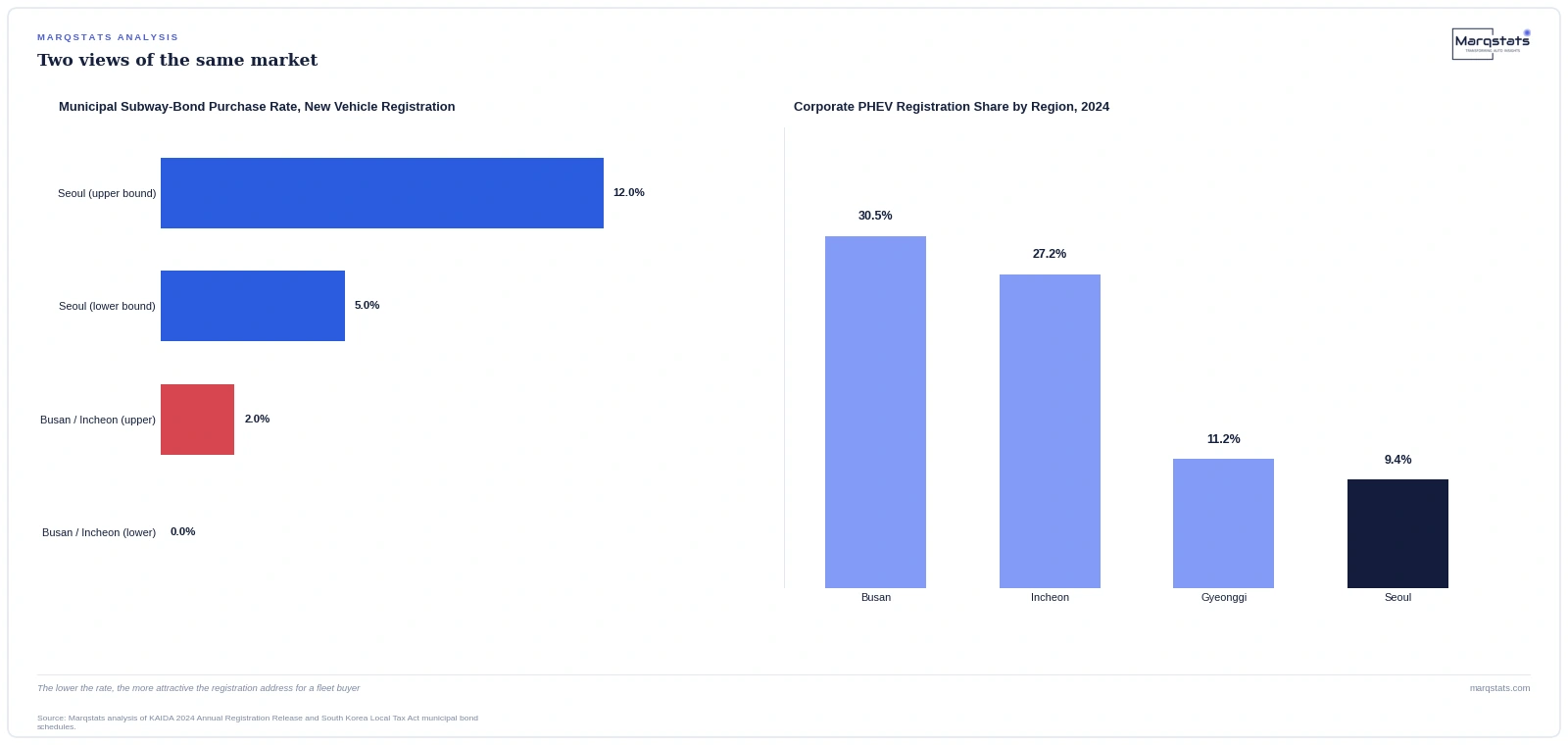
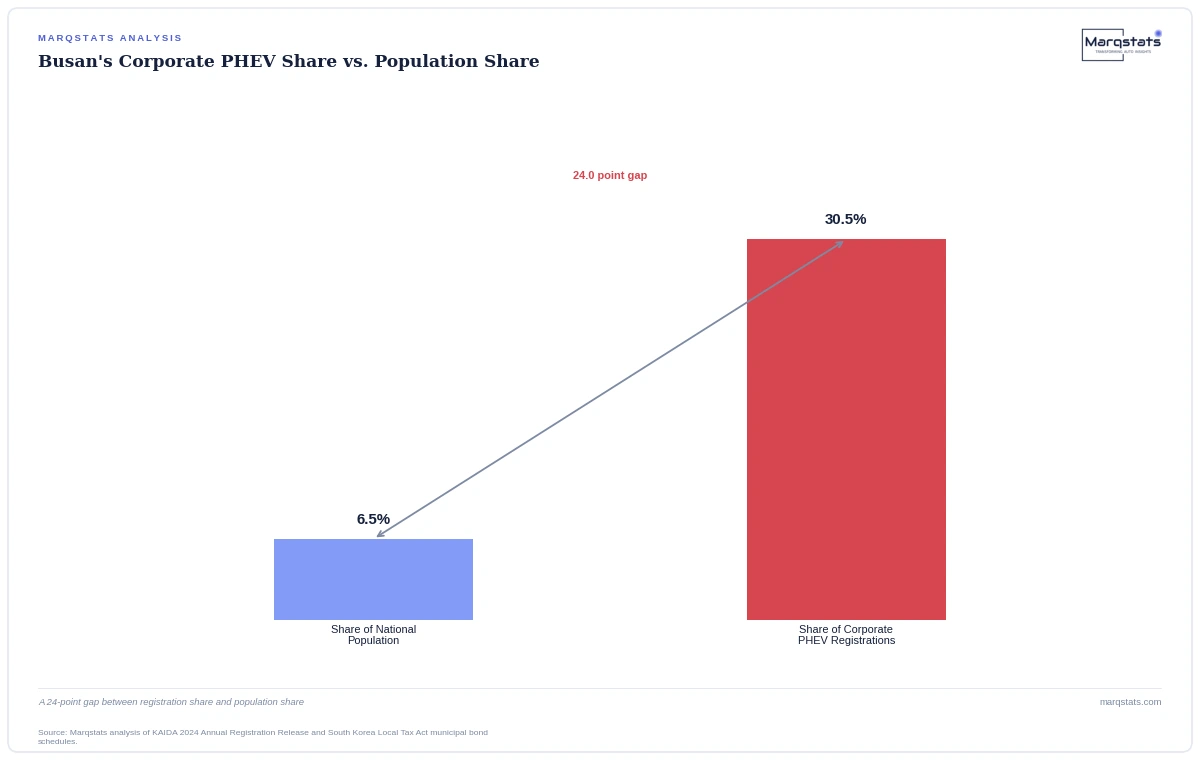
Busan Metropolitan City recorded 30.50% of South Korea's national corporate PHEV registrations in 2024, 28,362 units, while holding under 6.5% of the country's population. The gap is not a mystery once one variable is added: Busan's municipal subway-bond purchase requirement on new vehicle registrations sits at 0.0% to 2.0%, against 5.0% to 12.0% in Seoul. National leasing providers register fleet vehicles in Busan to avoid the higher bond cost, while the vehicles themselves operate primarily in Seoul and Gyeonggi.
The mechanism is a municipal bond, not a tax rate
South Korea's local tax framework requires new-vehicle buyers to purchase a regional development bond at registration, priced as a percentage of the vehicle's taxable value and varying by municipality. Seoul sets its rate between 5.0% and 12.0%. Busan and Incheon set theirs between 0.0% and 2.0%. For a corporate fleet buyer registering dozens or hundreds of vehicles a year, that spread compounds into a material line-item, and it has nothing to do with where the vehicle is actually driven.
Incheon adds a second, independent pull
Incheon Metropolitan City recorded 27.20% of the national corporate total in 2024, 25,292 units, close behind Busan. Incheon shares Busan's low bond rate, but it also carries a second, unrelated pull: it is South Korea's principal port of entry for imported vehicles, so pre-delivery inspection and fleet-leasing operations were already concentrated there for pure logistics reasons before the bond-rate effect is even considered.
This distorts any region-by-region reading of Korean PHEV demand
Treating Busan and Incheon's registration shares as evidence of regional PHEV demand would overstate southeastern and port-city adoption by a wide margin. The genuine consumer-demand signal sits in the personal-purchase data instead: Gyeonggi Province led personal registrations at 31.70% in 2024, driven by newer apartment developments with AC Level 2 charging bays, and Seoul followed at 20.50%, capped by older downtown parking stock. Neither of those figures carries a comparable distortion.
Anyone building a market-entry or fleet-partnership model on South Korea's regional PHEV data should weight the corporate-registration numbers by this bond-rate effect before drawing a conclusion about where actual fleet operations sit. A leasing operator's registration address and its vehicles' operating territory are, for Busan and Incheon specifically, two different pieces of information.
The counter-argument: could Busan simply have genuine fleet demand too?
It is possible some share of Busan's corporate registrations reflects real local fleet operations, since Busan is South Korea's second-largest city and a major logistics and shipping hub in its own right, which could support legitimate corporate vehicle demand independent of any tax effect.
But the population mismatch is difficult to explain any other way: a city with roughly one-fifteenth of the country's population accounting for nearly a third of national corporate PHEV registrations is a pattern that tracks the bond-rate differential far more closely than it tracks any plausible measure of Busan-specific fleet activity. No published source states this reconciliation directly; it is a Marqstats construction built by setting the registration data against the bond-rate schedule.