Regulators gave automakers a legal shortcut around physical testing. Almost none of them can use it yet.
In brief:
- UNECE Regulation No. 157 Annex 4 and EU Implementing Regulation 2022/1426 allow virtual simulation to serve as direct, legally binding proof for vehicle type-approval.
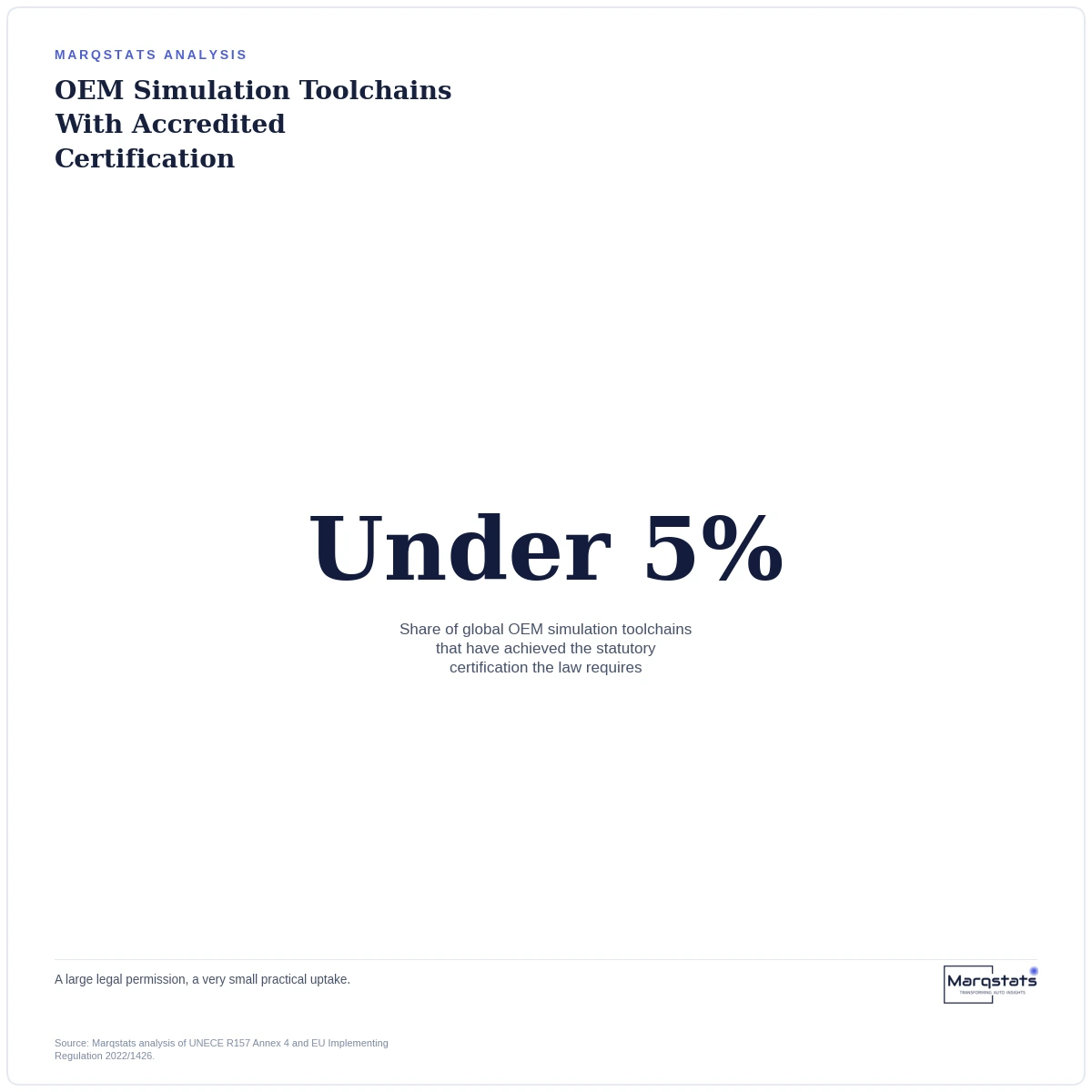
- Fewer than 5.00% of global OEM simulation toolchains have actually achieved the accredited statutory certification this pathway requires.
- Automakers routinely run billions of synthetic validation miles internally, yet still perform duplicative physical proving ground trials.
On paper, this should be a straightforward win for automakers. Verifying Level 3 and Level 4 driving automation requires billions of operating kilometers - a volume mathematically impossible to clear solely through physical on-road testing. Regulators recognized this, and built a legal pathway for simulation to substitute. Annex 4 of UNECE Regulation No. 157 formalizes virtual testing as a legally binding pillar of type-approval. The European Union's Implementing Regulation 2022/1426 does the same for fully automated vehicles under General Safety Regulation 2. Similarly, UN Regulation No. 171 on Driver Control Assistance Systems, which entered into force in September 2024, replicates these same toolchain credibility principles for supervised automated driving specifically.
In practice, almost nobody can actually walk through that door yet.
Why the legal permission isn't the same as practical access
The regulations don't just say simulation is allowed - they specify exactly how rigorously it has to be proven trustworthy first. Annex 4 of UN Regulation No. 157 enforces what's called a credibility assessment framework: automakers must formally document the pedigree of their entire virtual toolchain, calibrate every mathematical sub-model against empirical proving ground test runs, quantify simulation uncertainty numerically, and submit the whole synthetic architecture to independent technical services, such as TÜV SÜD or UTAC, for formal audit.
That's a genuinely demanding bar. It's not enough to show that your simulation produces plausible-looking results - you have to prove, with quantified statistical confidence, that your synthetic camera sensor transfer functions, your radar clutter models, your simulated weather conditions, all match real-world physical behavior within tight tolerance bounds. Building and documenting that proof, for an entire toolchain spanning perception, planning and control, is a substantial engineering and administrative undertaking in its own right.
It's not enough for the simulation to look right. You have to prove, numerically, that it is right.
— Marqstats Analyst Team
Why this creates a genuinely wasteful outcome
Here's the frustrating part: automakers aren't sitting on their hands waiting for certification. They're already running billions of kilometers of synthetic validation internally, using exactly the kind of high-fidelity multiphysics and scenario-generation software this market analysis covers. The simulation work is happening. What's missing is the audited paper trail that would let regulators actually accept that work as a legal substitute for physical testing.
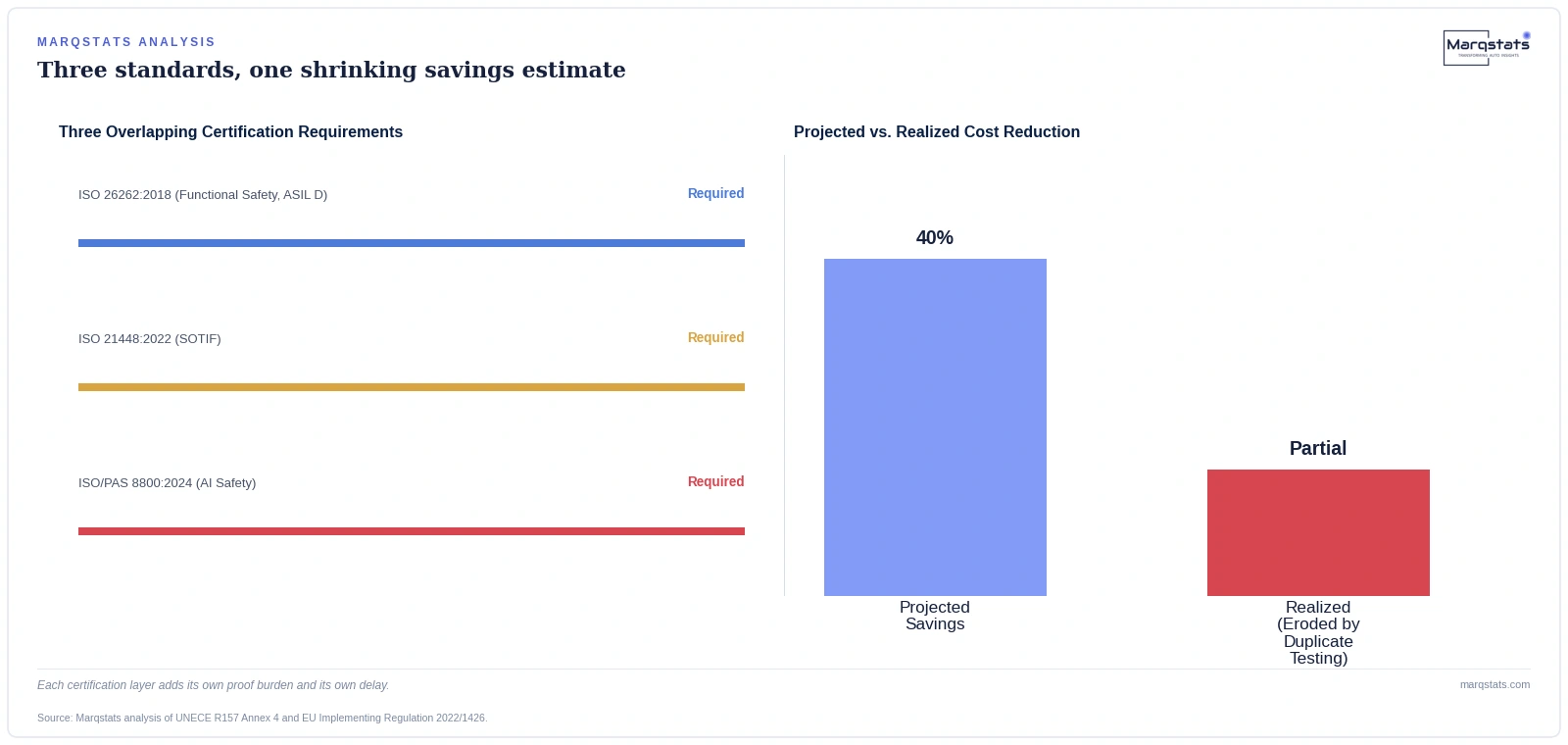
The consequence is that engineering departments end up doing the simulation anyway, for genuine engineering value, and then also running duplicative physical proving ground trials because their simulation toolchain hasn't cleared the certification bar that would let it count officially. This is precisely the mechanism eroding the market's own projected 40.00% cost reduction from virtual validation - the savings only fully materialize once simulation can legally replace physical testing, not merely supplement it.
Why so few companies have cleared the bar
Part of the explanation is structural: few off-the-shelf simulation engines currently ship with pre-audited credibility packages built in. An automaker licensing a general-purpose multiphysics or scenario-generation platform typically still has to do the certification work themselves, mapping that specific tool's outputs against the specific statistical requirements Annex 4 demands. That's a meaningfully different, and much more specialized, task than simply using the software to run simulations well.
This also explains why the market's own strategic analysis identifies automated credibility compliance suites, tools purpose-built to map simulation output directly to ISO/PAS 8800 and UNECE R157 statistical requirements, as one of the most significant unmet technological opportunities in this entire market. Whoever solves this problem well stands to capture disproportionate value, because right now almost every automaker is solving it, expensively and slowly, on their own.
The counter-argument: is 5% actually a crisis, or just an early-stage adoption curve?
A fair objection is that any genuinely new regulatory pathway takes time to reach broad adoption, and a low initial certification rate might simply reflect the natural lag between a rule taking effect and the industry building compliant infrastructure around it, rather than a permanent structural problem. This is a reasonable read, and it's likely at least partially true - certification rates will probably rise over the coming years as more automated credibility tooling reaches the market. But the specific costs of the current gap, ongoing duplicative physical testing and a delayed realization of the promised cost savings, are real and material right now, regardless of whether the gap eventually closes. Whether this is a temporary growing pain or a longer-lasting structural bottleneck is precisely the open question the market's own upside and downside forecast scenarios are built around.
What this means for automakers and simulation vendors
- Automakers should treat credibility certification, not simulation capability alone, as the critical near-term investment priority if they want virtual validation to actually reduce physical testing costs.
- Simulation software vendors should prioritize building pre-audited credibility packages directly into their platforms, since this represents a significant unmet demand few competitors currently address.
- Investors evaluating automotive simulation vendors should ask specifically about certification track record, not just simulation fidelity claims, when assessing competitive positioning.
Three overlapping standards, three overlapping certification burdens
It's worth understanding that the certification gap isn't the product of a single regulation - it sits at the intersection of at least three distinct, though related, international standards, each imposing its own documentation burden. ISO 26262:2018 requires deterministic virtual simulation environments to validate fail-operational hardware behaviors up to the highest safety integrity level, ASIL D. ISO 21448:2022, known as SOTIF, requires massive synthetic scenario exploration specifically to discover unknown hazardous scenarios within a vehicle's operational envelope. And ISO/PAS 8800:2024, published in December 2024, adds an entirely separate layer of requirements specific to artificial intelligence and machine learning components, covering synthetic training data sufficiency and neural generalization boundaries.
An automaker pursuing type-approval credibility isn't satisfying one certification requirement - they're satisfying all three simultaneously, each with its own statistical proof burden, its own documentation format, and in the case of ISO/PAS 8800 specifically, requirements published so recently that supporting compliance tooling has barely had time to mature. This layered structure is a meaningful part of why the certification rate remains so low: it isn't one hurdle to clear, but three overlapping ones.
What a genuinely compliant toolchain would actually need to demonstrate
To make the abstract requirement concrete: a fully credible simulation toolchain under Annex 4 would need to show, with quantified statistical confidence, that its synthetic camera sensor transfer functions match real camera behavior under varying lighting and weather; that its radar clutter and multipath models match real radar returns in cluttered urban environments; that its simulated tire-road friction coefficients match real-world measurements across surface conditions; and that its scenario-generation engine's coverage of edge cases has been validated against actual observed real-world driving data, not just synthetically generated variations. Each of these represents a genuinely difficult metrology problem, not a simple checkbox, which is a large part of why building and auditing this proof for an entire toolchain takes considerable time and specialized expertise most automotive engineering organizations are still developing.
The full market picture
Marqstats' complete global automotive digital twin synthesis software market analysis, including the full regulatory landscape and a three-scenario forecast through 2029, is available in the linked report below.
Related reportGlobal Automotive Digital Twin Synthesis Software Market Size, Share & Forecast 2025 – 2029