
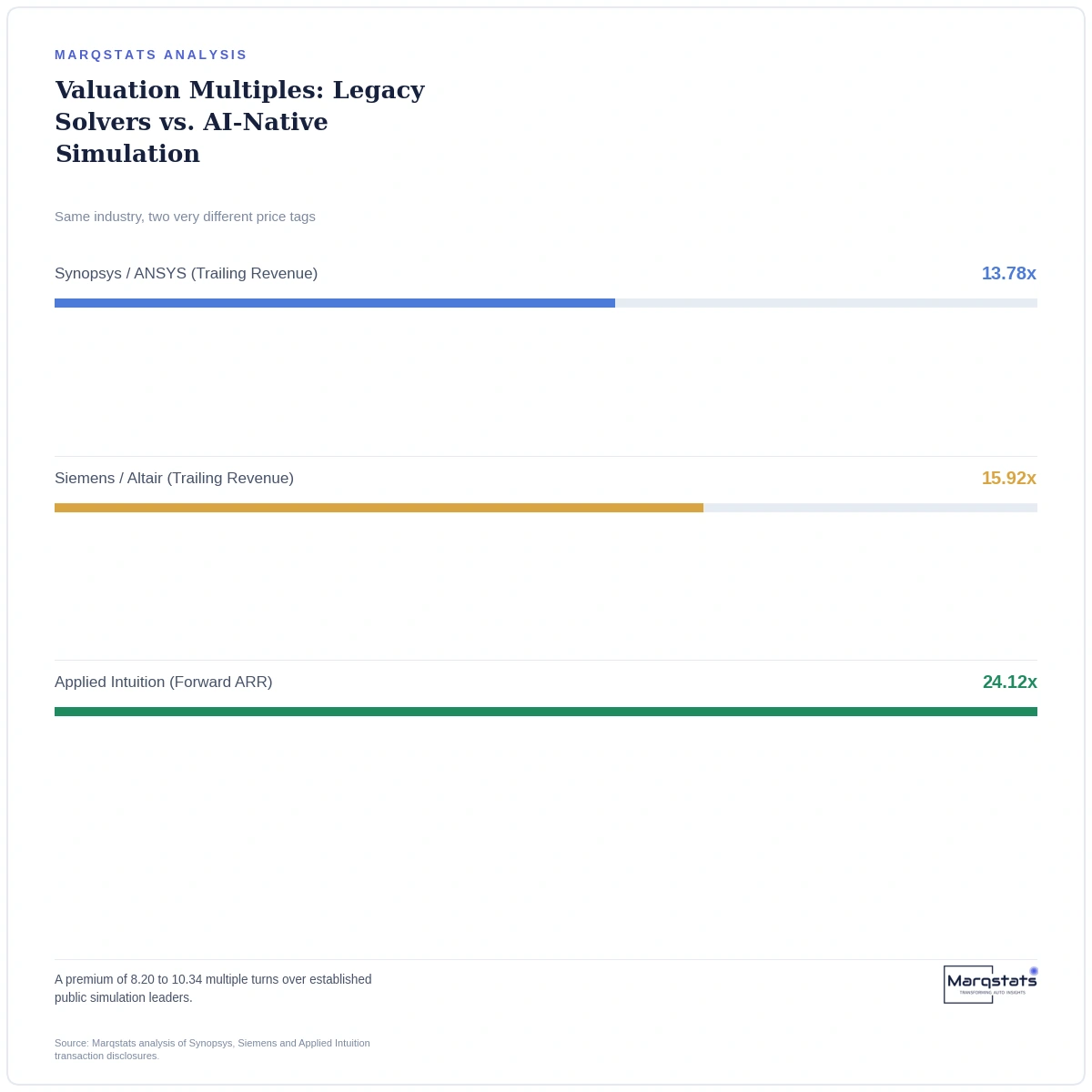
Synopsys paid 13.78 times revenue for Ansys. Applied Intuition just raised money at 24.12 times.
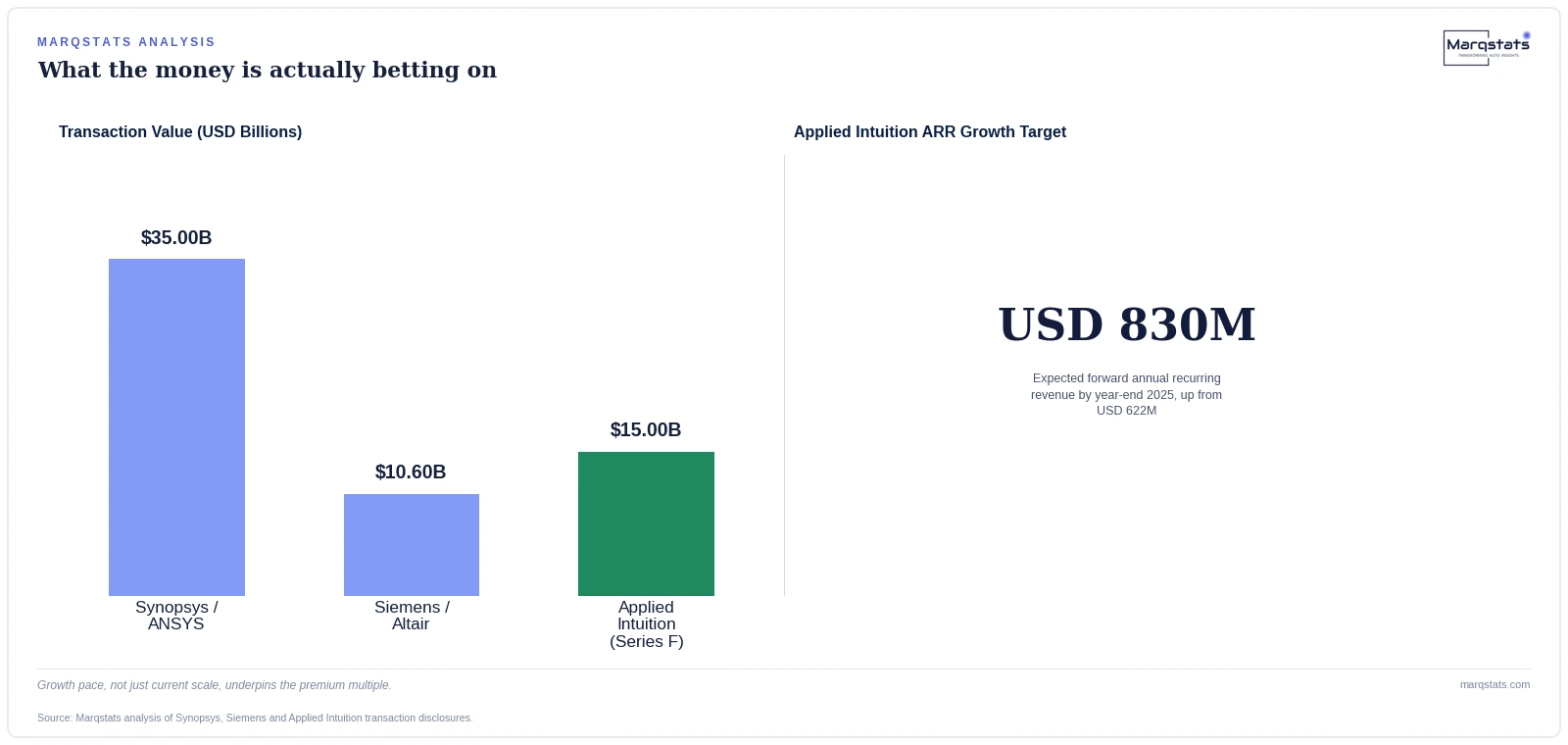
Three major transactions happened in the automotive simulation software industry within roughly eighteen months of each other. Two were acquisitions of long-established public companies. One was a private funding round for a company founded in 2017. Line up the valuation multiples side by side, and the gap is striking enough to demand an explanation. All three are well-documented, publicly disclosed transactions, giving a genuinely clean basis for comparison.
Same industry, different measuring sticks
It's worth being precise about what's actually being compared here, since the multiples aren't measuring quite the same thing. Synopsys and Siemens paid trailing revenue multiples - a price based on what Ansys and Altair had already earned in their most recent fiscal year. Applied Intuition's valuation is based on forward annual recurring revenue - what investors expect the company to earn going forward, scaling toward $830.00 million by the end of 2025. Forward multiples are typically somewhat higher than trailing multiples for any growing company, simply because they're priced against a bigger expected number.
But even accounting for that difference, the gap here is unusually wide. Applied Intuition's multiple sits 8.20 to 10.34 turns above what public markets paid for two long-established, profitable simulation companies. That's not a modest premium for growth expectations - it's a fundamentally different valuation regime.
The market isn't just paying more for Applied Intuition. It's pricing it as a different kind of company entirely.
— Marqstats Analyst Team
What Ansys and Altair actually are
Ansys and Altair built their businesses over decades on finite-element and multiphysics solvers - mathematically rigorous software that resolves coupled physical equations governing structural mechanics, fluid dynamics, electromagnetics and more. This software is genuinely powerful and deeply entrenched in automotive, aerospace and industrial engineering workflows. But it's also, by industry consensus, a mature technology category. The core mathematical approaches have been refined for decades, the competitive landscape is well understood, and growth largely comes from expanding into adjacent applications rather than from a fundamentally new technical capability.
What Applied Intuition represents instead
Applied Intuition's platform, spanning products called Simian, Spectral, Neural Sim and Basis, centers on generative physical AI: using machine learning models, rather than purely deterministic physics solvers, to synthesize realistic driving scenarios and sensor data at scale. This is a meaningfully different technical bet - one aligned specifically with the explosive growth of autonomous vehicle development, where the volume of edge-case scenarios needed for safety validation vastly exceeds what deterministic scenario authoring alone can efficiently produce.
Investors pricing Applied Intuition at 24.12 times forward revenue are making a specific bet: that generative AI-driven simulation, not incremental improvement to traditional multiphysics solvers, represents the next major technology shift in this industry, and that a company built natively around that approach from the start has a structural advantage over incumbents retrofitting AI capability onto decades-old solver architecture.
The counter-argument: is this premium justified, or is it simply AI-hype pricing?
A fair objection is that 2024-2025 saw extraordinarily elevated valuations across nearly every company with a credible AI narrative, and Applied Intuition's premium might reflect broad market enthusiasm for AI-labeled companies generally, rather than a specifically well-reasoned bet on generative physical AI's advantage over traditional simulation. This is a genuinely reasonable concern, and it's difficult to fully separate company-specific conviction from broader market sentiment in any single valuation data point. What can be said with more confidence is that Applied Intuition's revenue growth trajectory, scaling from $622.00 million forward ARR toward an expected $830.00 million by year-end 2025, is a real, disclosed operating metric, not merely a narrative - meaning at minimum the company is growing quickly enough to partially justify a premium multiple, even if the exact size of that premium remains open to debate.
What this means for investors and industry participants
- Investors evaluating automotive simulation software companies should weigh technical architecture, generative AI-native versus retrofitted, as a distinct valuation factor, not merely current revenue scale.
- Legacy simulation incumbents should treat the valuation gap as a competitive signal, not just a financial curiosity, since it reflects genuine market conviction about where technical advantage is shifting.
- Track Applied Intuition's actual revenue realization against its $830.00 million year-end 2025 target specifically, since sustained growth at that pace would meaningfully validate the current premium multiple.
How the incumbents are responding, not just watching
It would be a mistake to read this valuation gap as evidence that Ansys and Altair, or now their acquirers Synopsys and Siemens, are simply standing still while a more highly valued upstart captures the future. Both megadeals are themselves a direct response to exactly this competitive pressure. Synopsys specifically framed its acquisition of Ansys around combining semiconductor electronic design automation expertise with Ansys' simulation capabilities to address integrated design and simulation demand across an expanded addressable market, explicitly including automotive alongside aerospace and other industries. Siemens similarly described its Altair acquisition as accelerating integration of structural solvers and AI optimization tools into its broader Xcelerator portfolio.
In other words, the two largest incumbent transactions in this market's recent history are themselves evidence that legacy solver providers recognize the competitive threat Applied Intuition's valuation represents, and are actively acquiring scale and AI capability rather than assuming their traditional multiphysics strength alone will carry them forward.
What a narrowing or widening gap would each signal going forward
Watching how this valuation gap evolves over the next several years offers a genuinely useful signal for the broader market. If Applied Intuition's premium narrows relative to how Synopsys and Siemens' newly combined portfolios trade or get valued, that would suggest the market increasingly views AI-native and legacy-plus-AI-integration approaches as converging toward comparable value, rather than representing fundamentally different technology bets. If the gap instead widens further, or if additional AI-native pure-plays achieve comparable premium valuations, that would suggest investors remain convinced generative physical AI represents a durable, structural advantage that acquisition-driven AI integration at legacy incumbents has not fully closed.
The full market picture
Marqstats' complete global automotive digital twin synthesis software market analysis, including the full competitive valuation landscape, is available in the linked report below.
Related reportGlobal Automotive Digital Twin Synthesis Software Market Size, Share & Forecast 2025 – 2029