Industry has formally told the European Commission its 2027 bidirectional charging deadline is not achievable
In brief:
- Regulation (EU) 2023/1804 requires all new public and private AC chargers to support ISO 15118-20 bidirectional communication from 1 January 2027.
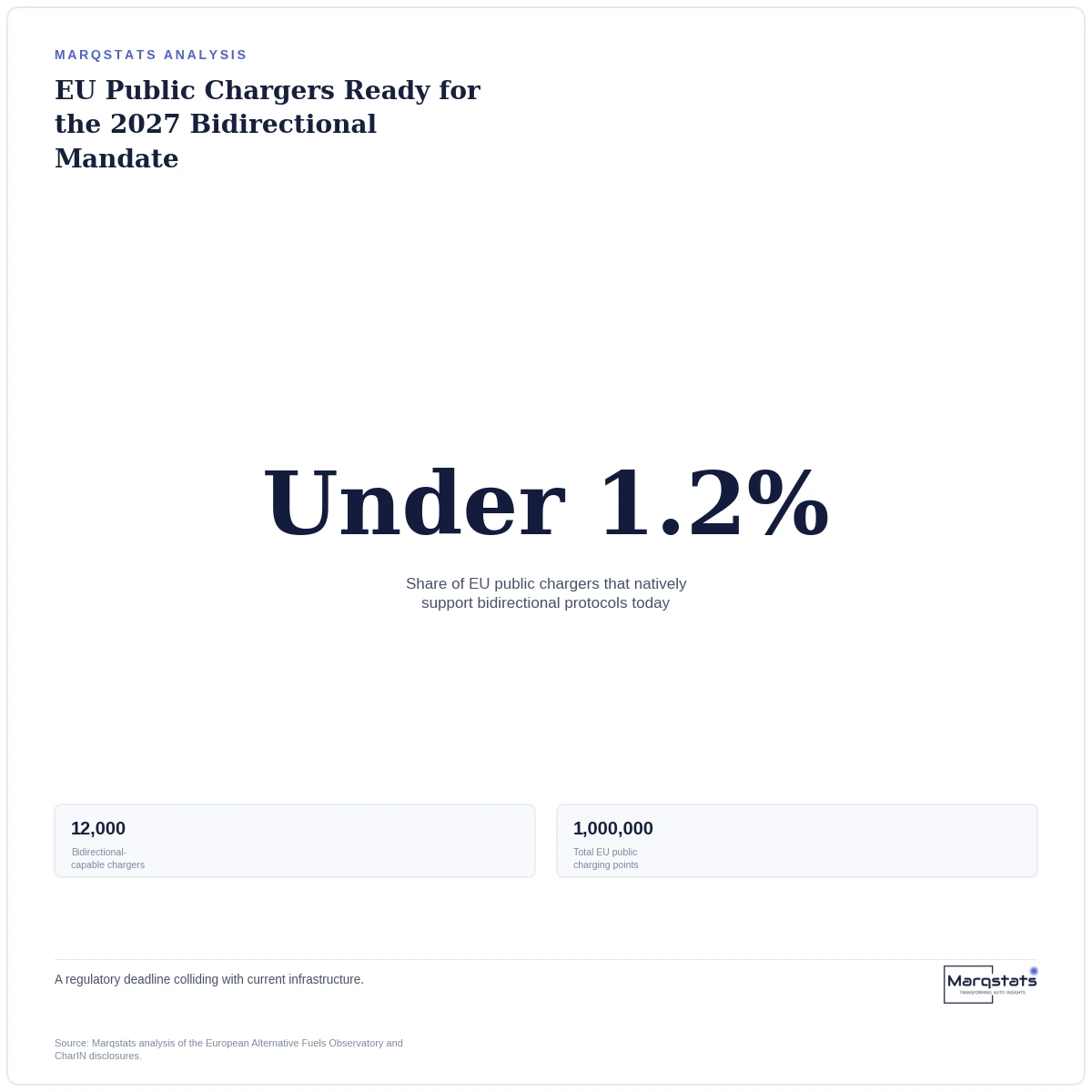
- Fewer than 12,000 of the EU's roughly 1,000,000 public charging points natively support bidirectional protocols today.
- Industry standards body CharIN has formally submitted comments to the European Commission stating the January 2027 date is not technically realistic.
Europe's Alternative Fuels Infrastructure Regulation sets a specific, binding deadline: from 1 January 2027, every newly installed or substantially upgraded public and private AC charger in the European Union must support EN ISO 15118-20, the standard that enables bidirectional power transfer. This is not a target or a recommendation. It is a statutory requirement with a fixed date, applying across all 27 member states without national transposition.
An empirical reconciliation against the European Alternative Fuels Observatory database shows just how far current infrastructure sits from that requirement. Of the roughly 1,000,000 public charging points already deployed across the EU-27, fewer than 12,000, well under one and a half percent, natively support bidirectional protocols today. That gap alone would be a significant execution challenge. What makes it a genuinely structural problem is what CharIN, the global charging interoperability association, has told Brussels directly: the deadline cannot actually be met on schedule, for a specific and verifiable technical reason. This is not a rounding error or a data-lag artifact - it reflects that the overwhelming majority of Europe's existing charging infrastructure was built for a purely unidirectional purpose and was never designed to be retrofitted for two-way power flow.
The specific problem: you cannot certify against a test that does not exist
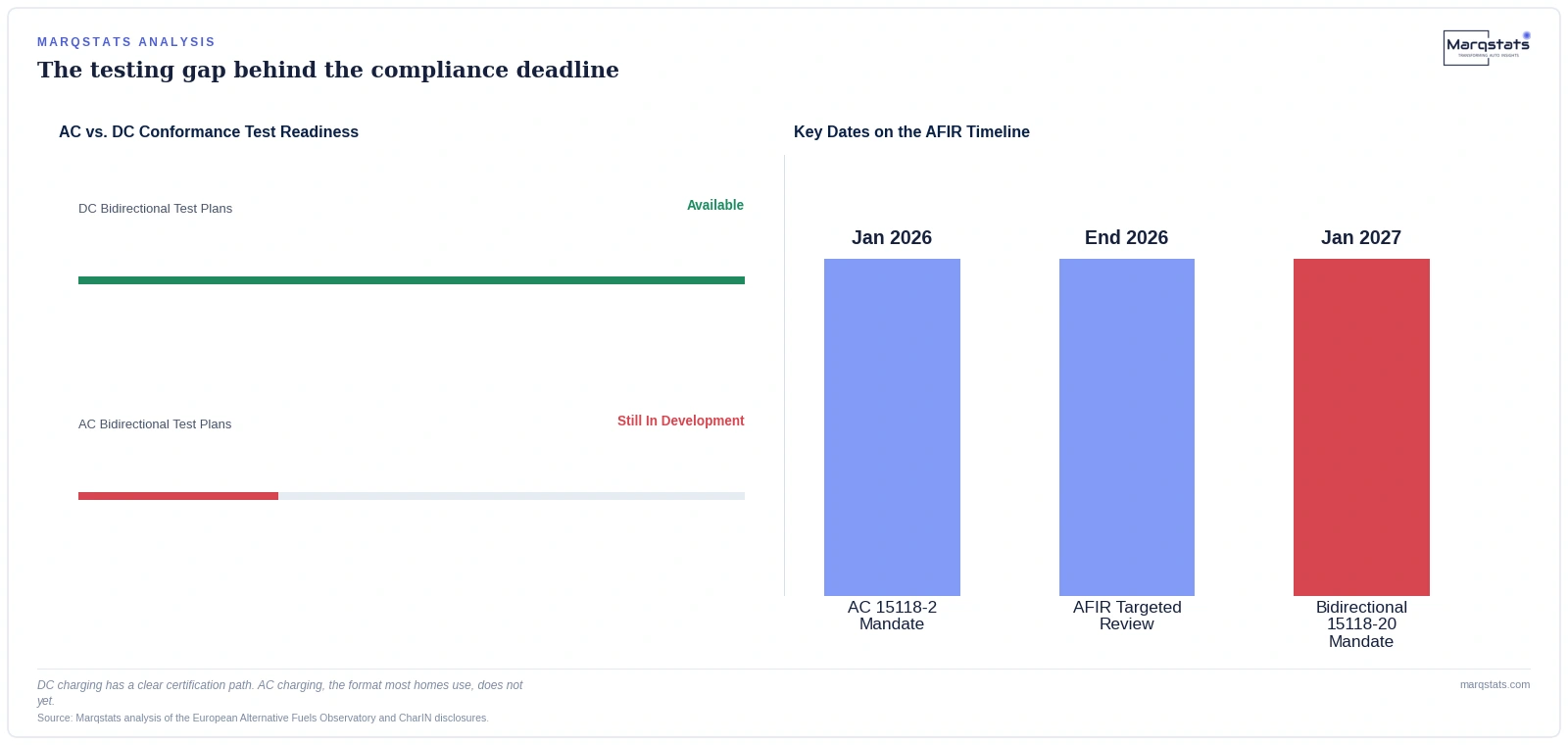
ISO 15118-20 is the communication standard. But manufacturers do not simply build a charger and declare it compliant - they certify it against a formal conformance test plan that verifies the charger actually implements the standard correctly. For direct-current charging, those conformance test plans exist. For alternating-current charging specifically, the format most residential and workplace chargers use, they do not yet exist in finalized form. The relevant test standards, ISO/PAS 15118-23 covering conformance procedures, are still under development, with AC test coverage specifically identified as an open gap as of this writing.
This creates a genuinely awkward sequencing problem: manufacturers are legally required to implement full AC bidirectional capability by January 2027, but the official mechanism for proving that implementation is correct will not be finished before that date arrives. CharIN's submission to the European Commission's ongoing AFIR review makes exactly this point, describing the proposed software implementation date as not technically realistic. Manufacturers are, in effect, being asked to build toward a moving target: implement a standard whose own verification framework is still being written around them.
The rule says be ready by January 2027. The test that proves you're ready isn't finished yet.
— Marqstats Analyst Team
This is not the same problem as slow charger installation
It would be easy to read the sub-12,000-charger figure as simple infrastructure lag - manufacturers haven't gotten around to building enough compliant hardware yet, and given more time and money, they will. The CharIN submission points to something different: even a manufacturer that wanted to build and certify a fully compliant AC bidirectional charger today could not complete formal conformance certification, because the certification framework itself is incomplete. This is a standards-development timing problem sitting underneath what looks, on the surface, like an infrastructure deployment problem. In other words, the constraint is not primarily one of manufacturing capacity or capital investment, both of which respond predictably to more time and money - it is a constraint on the standards-development process itself, which does not necessarily accelerate simply because a regulatory deadline is approaching.
The counter-argument: does a missing AC test plan actually block real-world deployment?
A fair objection is that formal conformance test plans matter primarily for regulatory certification and interoperability guarantees, and a technically competent manufacturer could plausibly ship AC bidirectional hardware that works correctly in practice even before an official test suite exists to prove it - much as software can function correctly before every edge case has a formal test written for it. This is a reasonable point, and it is likely true for some manufacturers. But it does not resolve the compliance question at the center of AFIR: a charger cannot be declared conformant to a regulation that explicitly references a standard's test procedures if those procedures are not yet published, regardless of whether the underlying hardware happens to work. For a market that depends on verifiable, auditable compliance rather than informal functional testing, the missing test plan is a genuine blocker, not a formality.
What this means for anyone planning around the 2027 deadline
- Charging hardware manufacturers should track the ISO/PAS 15118-23 AC conformance test development timeline directly, since formal certification cannot proceed faster than the underlying test standard allows.
- Charge point operators and fleet planners should build contingency timelines that account for a plausible delay to the AFIR bidirectional mandate, rather than assuming the January 2027 date will hold exactly as written.
- Policymakers evaluating similar bidirectional-charging mandates in other jurisdictions should sequence the conformance testing framework's completion ahead of, not concurrent with, the enforcement deadline itself.
The 2026 AFIR review is the moment this actually gets resolved
The European Commission has a targeted review of AFIR scheduled for the end of 2026, and CharIN's submission was made specifically as part of that review process rather than as an informal complaint. This timing matters: the review gives the Commission a genuine, structured opportunity to either adjust the January 2027 date, grant a transition period specifically for AC bidirectional certification, or hold the deadline as written and accept that some manufacturers will face a formal compliance gap through no fault of their own. Any of those three outcomes is plausible, and each has meaningfully different consequences for how quickly the settlement engine market this report covers can actually scale.
A Commission decision to hold the deadline firm despite the missing test standards would create an unusual situation: a regulation whose compliance requirement technically cannot be verified through the process the regulation itself implicitly assumes. A decision to extend the AC-specific timeline, by contrast, would validate CharIN's position and likely be read across the industry as confirmation that the broader AFIR bidirectional charging rollout, not just the testing framework, needs more runway than originally planned.
Why DC charging does not face the same problem
It's worth being precise about the scope of this gap, since it is specific to AC charging rather than the AFIR mandate as a whole. Conformance test plans for direct-current bidirectional charging already exist, meaning DC-based public fast chargers and destination hubs can pursue formal ISO 15118-20 certification today without waiting on the same standards-development timeline. This distinction matters for market sizing: the segments of the V2G settlement engine market most exposed to the AFIR compliance uncertainty are residential and workplace AC charging specifically, not the public DC fast-charging and commercial depot segments that already have a clear path to certification.
The full market picture
Marqstats' complete global V2G settlement engine market analysis, including the full regulatory landscape and a three-scenario forecast through 2031, is available in the linked report below.
Related reportVehicle-to-Grid Micro-Transaction Settlement Engine Market Size, Share & Forecast 2026 – 2031