
ACEA says Europe needs 35,000 megawatt-class truck chargers. ACEA also says about 1,100 suitable chargers exist.
The European Automobile Manufacturers' Association publishes both figures, in separate documents, for the same market. Its 2030 position paper on decarbonising heavy-duty road transport calls for 50,000 public charging points including 35,000 MCS-class connectors by 2030. Its more recent interactive zero-emission tracker states that only around 1,100 public chargers of 350 kW or above currently exist across the EU.
Read side by side, this looks like a contradiction, or worse, like the trade association does not know its own numbers. It is neither. The two figures answer different questions, and understanding which is which matters more than picking a side.
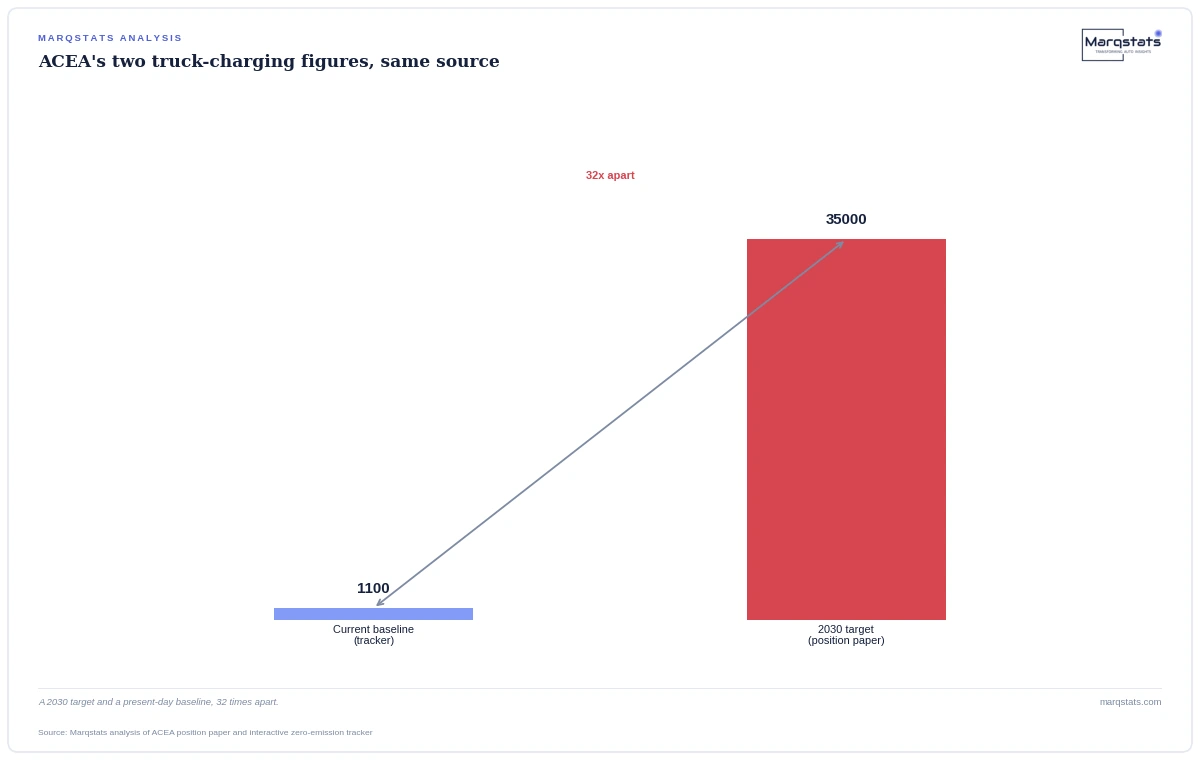
One number is a target. The other is a baseline.
The 35,000-point figure is forward-looking: it is ACEA's own estimate of what the public charging network needs to look like by 2030 to support the fleet electrification pace the EU's revised CO2 standards require. It is a policy recommendation, built on assumptions about fleet growth, utilisation and duty cycles that ACEA itself selected.
The 1,100-point figure is backward-looking: it is a count of what exists today, or close to today, using a threshold ACEA set at 350 kW and above. It is not a subset of the 35,000 target using the same methodology; it is a separate measurement exercise, run at a different time, for a different purpose, against a different power threshold than the position paper's implicit MCS-class definition.
Why this matters more than which number is 'right'
Neither figure is wrong, and treating one as correct and the other as an error is exactly the mistake to avoid. The 35,000-point target is useful for capital planning: an equipment supplier, a charge point operator or a grid operator sizing a multi-year investment case should use it, understanding it embeds ACEA's own fleet-growth assumptions, which our own research found imply roughly 4.2 times the charging capacity Transport & Environment's independent modelling says a 2030 fleet would actually draw.
The 1,100-point figure is useful for anyone asking what a truck driver or fleet operator can actually plug into right now. It is the number a route planner, a near-term site-selection team, or a journalist covering the state of the market today should reach for. Using the 2030 target to answer a today question, or the today baseline to answer a 2030 planning question, produces a genuinely misleading answer even though both source numbers are accurate.
A target and a baseline from the same source are not in conflict. They are answers to two different questions, and the mistake is asking one number to answer both.
— Marqstats Research
The broader pattern: ACEA is not the only source doing this
This is not unique to ACEA. Regulation (EU) 2023/1804, the AFIR regulation, sets a statutory minimum coverage requirement, not a fleet-matched capacity target, and our research found it will deliver 41% more charging energy by 2030 than the EU's own -45% CO2 fleet target implies the fleet will need. AFIR and ACEA's 35,000-point target are both, in their own ways, forward-looking figures built on different assumptions about how fast the fleet will actually electrify, and both diverge from what current deployment data shows today.
The practical lesson generalises: when a single source, or even the same document, appears to publish contradictory figures for a market's scale, the first question is not which number is correct. It is what each number is actually measuring, over what time horizon, against what threshold. Public data on emerging infrastructure markets routinely mixes targets, baselines and industry recommendations without always labelling which is which as clearly as it should.
Use ACEA's 35,000-point target for multi-year capital planning and investment cases, understanding it embeds a specific, aggressive fleet-growth assumption.
Use ACEA's roughly 1,100-point tracker figure for near-term operational questions about what exists today.
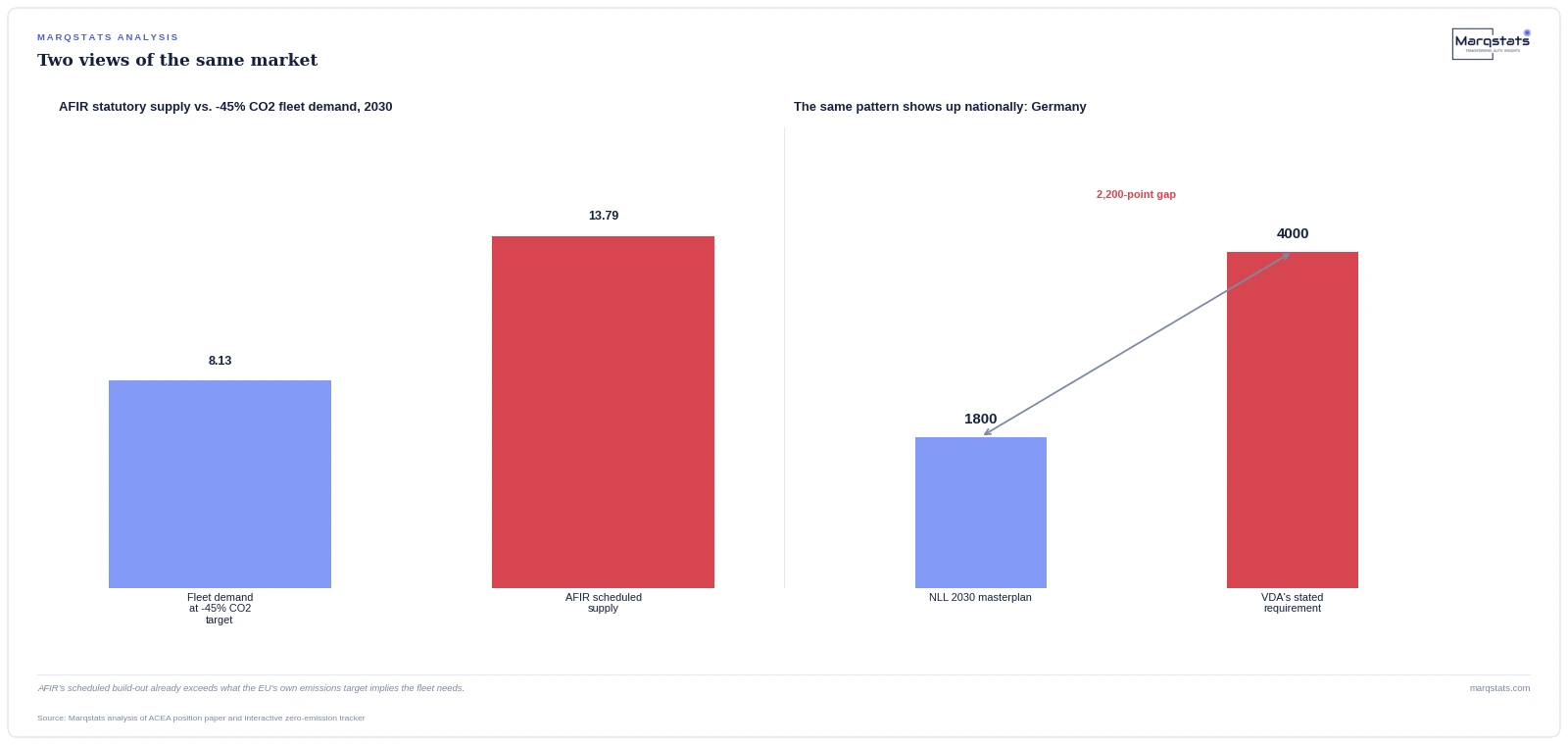
When two figures from the same source appear to conflict, check the publication date, the stated time horizon and the power threshold before assuming an error.
The counter-case: publishing both without reconciling them is still a communications failure
The fair objection is that ACEA, or any source doing this, bears some responsibility for the confusion even if both numbers are individually defensible. A trade association publishing a 2030 target in one document and a present-day baseline in another, without a single page that states the relationship between them, makes it easy for a reader, a journalist or another analyst to cite either figure as if it were the market's current or future size without qualification.
We think the underlying figures are sound and the divergence is explainable, which is the point of this piece. But the absence of a single reconciling statement from ACEA itself is a real gap, and it is exactly the kind of gap that produces the two-different-numbers confusion in the first place. Until that reconciliation exists in ACEA's own publications, pieces like this one are doing work the original source should have done.