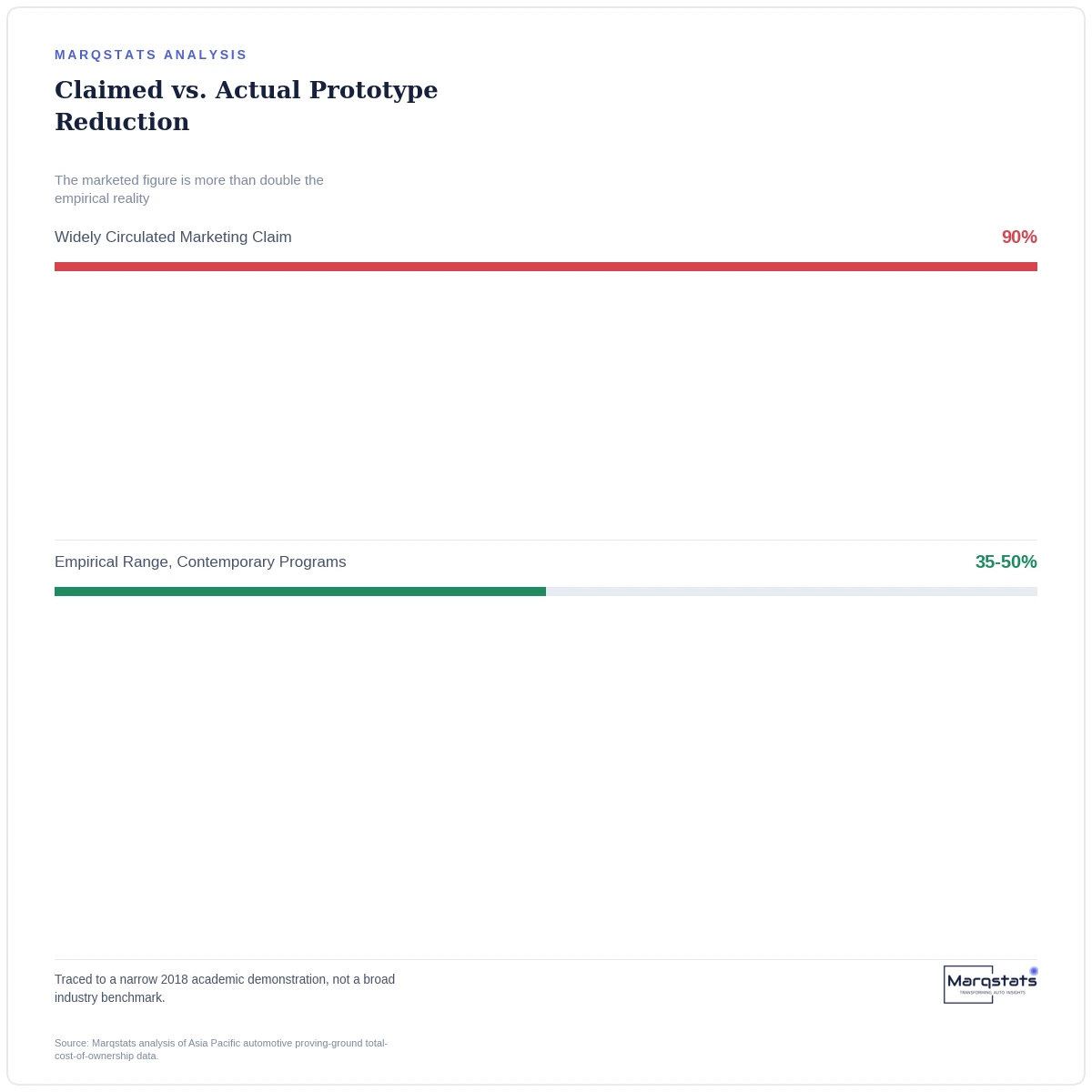
You've probably heard digital twins eliminate 90% of physical prototypes. That number traces to a single 2018 academic demo.
If you've spent any time around automotive engineering software sales materials, you've likely encountered some version of this claim: digital twin synthesis eliminates up to 90% of physical prototype requirements. It's a genuinely striking number, repeated widely enough across vendor decks and conference talks that it's easy to assume it reflects a broad industry consensus. Tracing the claim back to its actual origin tells a different story.
Where the 90% number actually comes from
Tracing this widespread industry claim to its source leads back to early academic hardware-in-the-loop experiments conducted in 2018 - a specific, narrow research demonstration, not a broad survey of production automotive programs. Academic proof-of-concept studies are frequently designed to showcase a technology's theoretical ceiling under favorable, controlled conditions, which is a legitimate and useful research exercise. The problem is what happened after: that specific, favorable result appears to have been lifted out of its original context and repeated as a general industry benchmark, without the caveats that would normally accompany a single early-stage academic finding.
What the actual, contemporary data shows instead
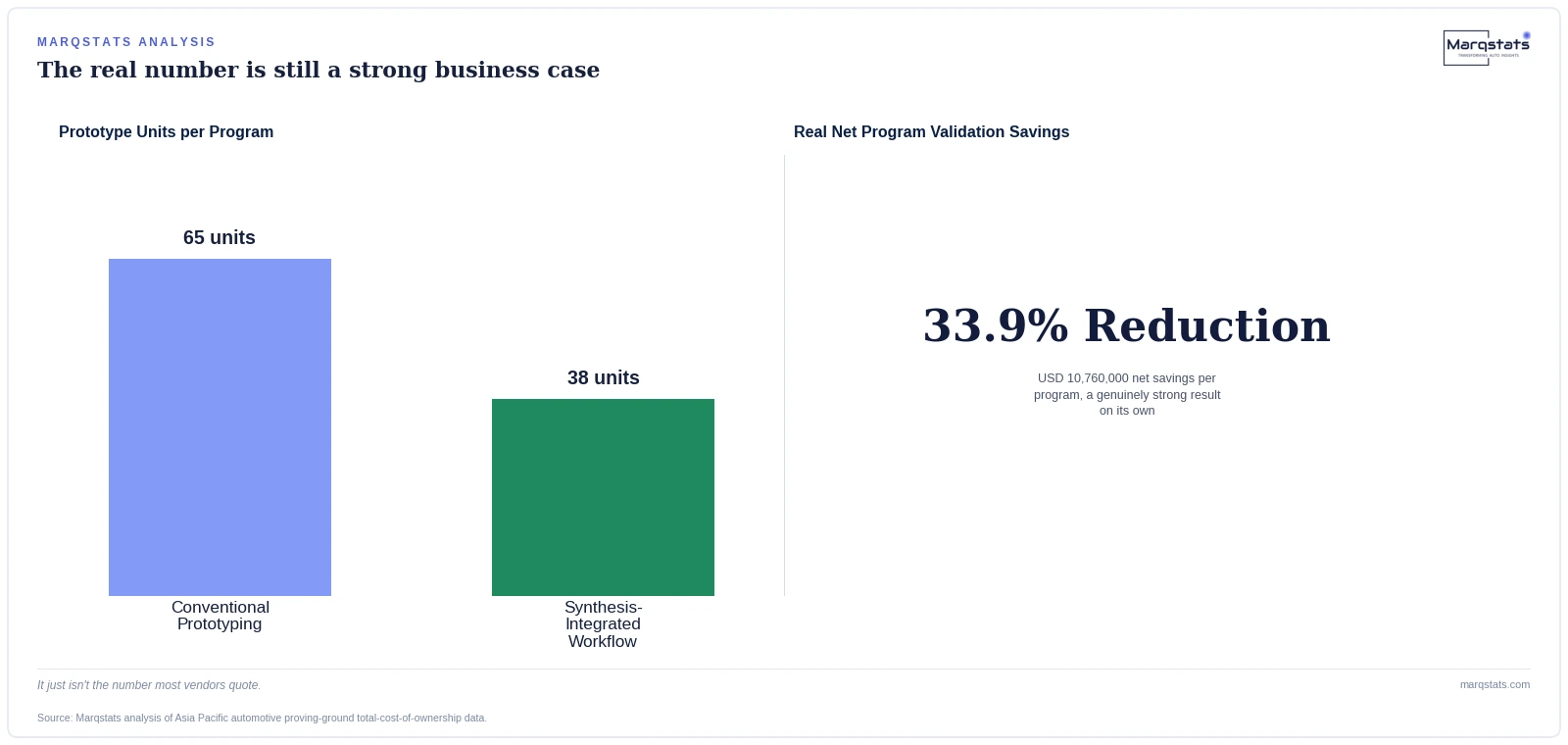
Evaluating vehicle testing economics across contemporary Asia Pacific automotive proving grounds tells a considerably more modest story. Implementing high-fidelity digital twin synthesis software reduces physical prototype fleet requirements by 41.5%, from a baseline of 65 units down to 38 units per vehicle program - a genuinely meaningful reduction, but less than half of the widely circulated 90% figure. Across contemporary multi-physics vehicle programs more broadly, the empirical baseline savings range sits between 35% and 50%.
A single 2018 lab demonstration became an industry-wide marketing statistic. The real number is less than half of what gets claimed.
— Marqstats Analyst Team
The real savings are still genuinely substantial
It's worth being clear that the corrected, more modest figure is still a real and financially significant result, not a disappointment. A 41.5% reduction in physical prototype units, from 65 to 38 per program, generates direct capital savings of USD 10,260,000 alongside USD 3,100,000 in reduced track facility and crew costs. Even after accounting for USD 2,600,000 in incremental software and compute licensing costs, the net program validation savings reach USD 10,760,000, a 33.9% reduction in fully loaded program cost. That's a strong, defensible business case on its own - it simply isn't the 90% figure that circulates in less careful marketing materials.
Why this discrepancy actually matters for procurement decisions
The gap between the marketed figure and the empirical reality has practical consequences for anyone building a business case around digital twin adoption. A procurement team or engineering budget planner who anchors their return-on-investment model to the 90% figure will build an expectation the technology genuinely cannot meet, regardless of how well it's implemented, setting the project up to appear disappointing even when it delivers a legitimately strong 35% to 50% improvement. Anchoring expectations to the empirically observed range instead avoids this mismatch entirely.
The counter-argument: could the 90% figure be accurate for some specific, narrower use case?
A fair objection is that the 90% claim might not be entirely fabricated marketing excess - it could reflect a genuinely achievable result for a narrow, specific application, such as a single, well-isolated subsystem validation task, even if it doesn't generalize to full, complex vehicle programs. This is plausible, and it would be consistent with how the figure likely originated: a controlled academic demonstration focused on a specific, favorable test case can legitimately produce dramatic results that simply don't scale to the messier, more varied reality of a full multi-physics vehicle development program spanning structural, thermal, electrical and control systems simultaneously. The issue isn't necessarily that the original 2018 result was fabricated - it's that a narrow, favorable result got generalized into a broad industry claim without the scope limitations that would make it accurate.
What this means for anyone evaluating digital twin investment
- Build return-on-investment models around the empirically observed 35% to 50% prototype reduction range, not the widely circulated 90% figure, to avoid setting unmeetable internal expectations.
- Ask vendors making dramatic efficiency claims to specify the exact source and scope of the underlying data, distinguishing narrow academic demonstrations from broad production program results.
- Recognize that a genuine 33.9% net program cost reduction is a strong, defensible business case in its own right, without needing inflated secondary claims to justify the investment.
The full market picture
Marqstats' complete Asia Pacific automotive digital twin synthesis software market analysis, including the full total-cost-of-ownership comparison, is available in the linked report below.
Related reportAsia Pacific Automotive Digital Twin Synthesis Software Market Size, Share & Forecast 2025 – 2030