
The fifth-ranked search result can now outperform the first-ranked one in AI-generated answers
Search engine optimization has always rewarded the top of the results page disproportionately. First position gets the clicks, the trust, the traffic. That hierarchy still holds for traditional search. Inside generative answer engines, though, controlled testing reveals something genuinely counterintuitive: a page ranked fifth can gain more from targeted improvements than a page ranked first loses from the same competitive pressure.
What the controlled testing actually found
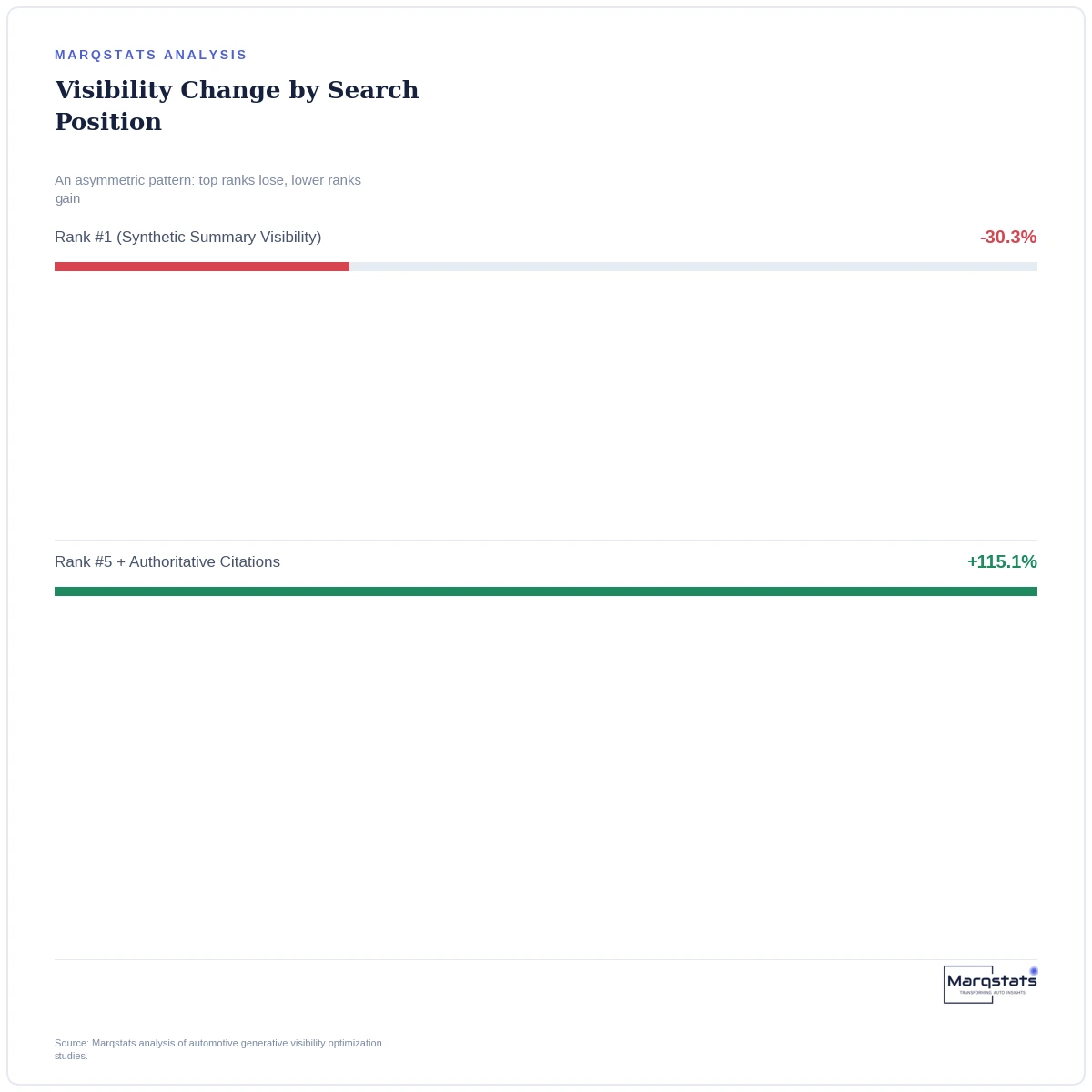
Researchers evaluating how generative answer engines weight different search positions found a genuinely asymmetric pattern. Top-ranked search results, the pages that dominate traditional click-through rates, experience a 30.3% reduction in visibility once content moves into synthetic, AI-generated summaries. Meanwhile, fifth-ranked listings, when specifically enriched with authoritative citations, achieve a 115.1% visibility lift. Add statistical data instead, and fifth-ranked listings still gain a 97.9% lift.
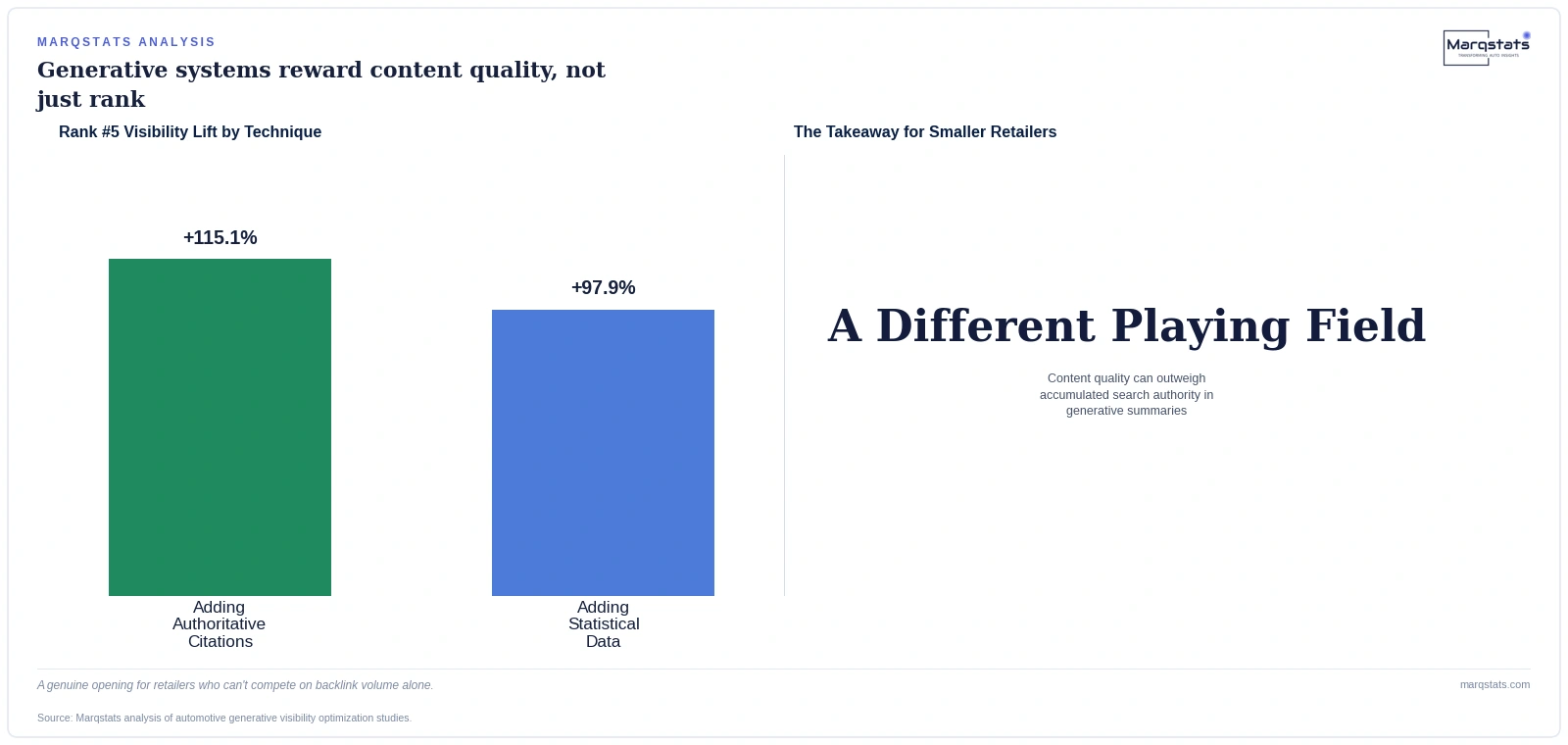
Put those two numbers side by side and the implication is striking: a well-optimized fifth-ranked page can end up more visible inside a generative summary than the first-ranked page that dominates traditional search.
Generative summarization doesn't just reorder the leaderboard. In some cases, it inverts it.
— Marqstats Analyst Team
Why this happens, and why it isn't an accident of the testing methodology
This pattern reflects something genuine about how generative summarization systems evaluate content, rather than a quirk of one specific study. Traditional search ranking rewards accumulated signals, backlink authority, historical traffic, domain age, that compound over time and are difficult for a newer or smaller competitor to overcome quickly. Generative summarization systems, by contrast, appear to weight content quality signals, the presence of specific, verifiable citations and statistics, more heavily relative to those accumulated authority signals. A page doesn't need years of backlink accumulation to demonstrate that it includes a specific statistic or an authoritative quote - it either does or it doesn't, and that's evaluable immediately.
What this means specifically for smaller automotive retailers
For a large, well-established dealership group with a first-ranked Vehicle Detail Page and years of accumulated search authority, this dynamic is a genuine risk: that hard-won ranking position doesn't automatically translate into generative visibility, and may even work against them relative to smaller, more nimble competitors who invest specifically in citation and statistic-rich content. For a smaller, independent dealership without the resources to compete on traditional search engine optimization metrics like backlink volume, this is a genuine opportunity: competing for generative visibility runs on a meaningfully different, more content-quality-driven playing field than competing for traditional search rank.
The counter-argument: does this finding generalize beyond the specific study conditions?
A fair skepticism is whether these specific lift percentages, developed through controlled academic testing across a defined set of queries and domains, would hold up identically across the full range of real-world automotive search queries and dealer website conditions, or whether the effect might be smaller, or different in direction, once applied outside the study's specific parameters. This is a reasonable caution, and any single study's precise percentages should be treated as a directional finding rather than a universal constant. What makes the underlying mechanism credible beyond the specific numbers is that it aligns with a coherent, explainable theory, generative systems weighting verifiable content quality over accumulated ranking authority, rather than an unexplained statistical anomaly. Automotive retailers testing this approach on their own content should expect the general direction of the effect, lower-ranked pages benefiting disproportionately from citation-rich content, even if their own specific percentage results vary from the study's figures.
What this means for automotive content strategy
- Smaller dealerships and independent retailers should prioritize citation-rich, statistically grounded content specifically, since this appears to be where generative visibility competition is least tied to accumulated search authority.
- Larger dealership groups should not assume traditional top rankings automatically confer generative visibility, and should audit their own top-ranked pages for the same citation and statistic density that benefits lower-ranked competitors.
- Content teams should treat citation and statistic inclusion as a measurable optimization lever with documented effect sizes, not a vague best practice, when building content specifically for generative visibility.
The full market picture
Marqstats' complete global automotive Generative Engine Optimization market analysis, including the full content optimization technique breakdown, is available in the linked report below.
Related reportGlobal Automotive Generative Engine Optimization Market Size, Share & Forecast 2026 – 2030