Price is now the battleground
For most of the category's history the credible electric scooter in India started above INR 100,000, while the volume petrol scooter sold between INR 70,000 and INR 90,000. In 2026 that gap closed. Twenty-one electric scooters launched or were repriced between January and September 2026, and the India electric scooter prices 2026 ladder now runs from INR 49,999 for a TVS Orbiter V1 on a leased battery to INR 281,000 for a Yamaha Aerox E. Nine of the twenty-one sit at or below INR 100,000, inside 110cc petrol scooter territory.
The ladder tells two stories at once. At the bottom, lower-cost LFP chemistry, platform re-engineering and battery-as-a-service pricing pulled the entry price under the petrol benchmark. At the top, 4.4–6.5 kWh packs, dual-battery architectures and performance motors created a premium tail at INR 130,000–280,000 that did not exist two years ago. The result is a barbell, and average selling prices in the industry rose during the year even as the cheapest electric scooter fell to half the price of the cheapest credible product of 2024.
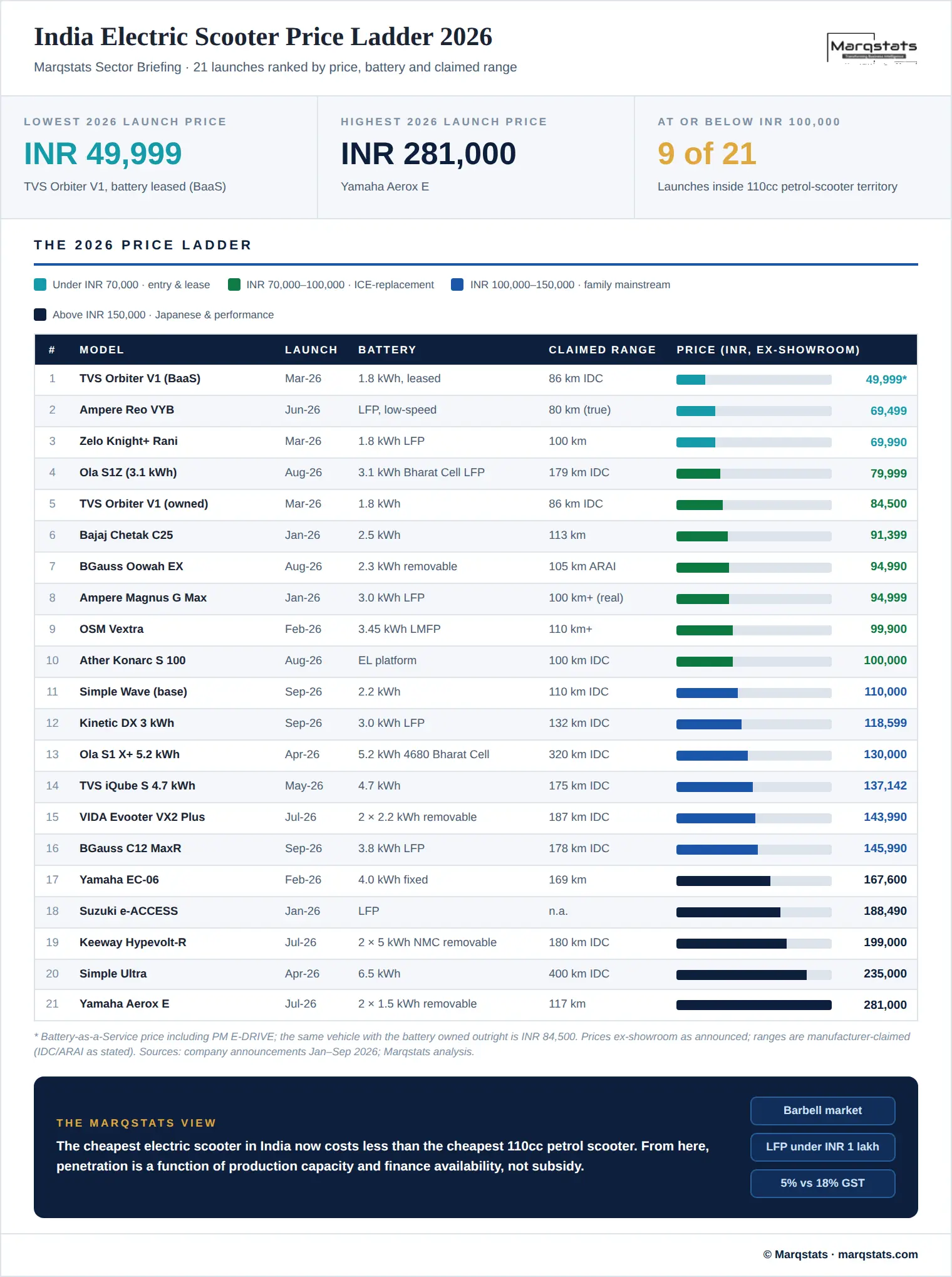
Marqstats compiled every launch from the CY2026 news flow and ranks it below by ex-showroom price as announced. Ranges are manufacturer-claimed (IDC or ARAI as stated) and are described as such throughout; they are not independently measured values.
The cheapest electric scooter in India now costs less than the cheapest 110cc petrol scooter. From here, penetration is a function of production capacity and finance availability, not subsidy.
— Marqstats Analyst Team
The 2026 price ladder
* TVS Orbiter V1 at INR 49,999 is the Battery-as-a-Service price including PM E-DRIVE; the same vehicle with the battery owned outright is INR 84,500. Prices are ex-showroom as announced; introductory prices shown where the OEM quoted one.
Band 1: Under INR 70,000 — low-speed and lease-priced entry
Three products sit below INR 70,000, and none of them is a conventional purchase of a conventional scooter. The TVS Orbiter V1 reaches INR 49,999 only because the 1.8 kWh battery is leased under a Battery-as-a-Service plan and the PM E-DRIVE incentive is applied; bought outright the same vehicle is INR 84,500. The Ampere Reo VYB at INR 69,499 is a 25 km/h low-speed scooter with an LFP pack and a claimed 80 km true range, positioned against the lead-acid low-speed segment rather than against petrol scooters. The Zelo Knight+ Rani at INR 69,990 pairs a 1.8 kWh portable LFP pack with a 1.5 kW motor and a 55 km/h top speed.
Below this band sit the sub-INR 60,000 low-speed products that were repriced rather than launched: the Zelio 2026 Gracy from INR 59,999 (lead-acid or lithium, 25 km/h, 60–120 km) and the upgraded X-Men+ from INR 60,000. They are excluded from the ladder because they compete on lead-acid economics, but they mark the floor of the market.
Band 2: INR 70,000–100,000 — the ICE-replacement zone
This is where the year's competitive energy went. Six launches landed between INR 79,999 and INR 100,000, each explicitly aimed at the 110cc petrol scooter buyer. Ola's S1Z at INR 79,999 carries a 3.1 kWh indigenous Bharat Cell LFP pack and a claimed 179 km IDC range — the most battery and the most range offered anywhere under INR 100,000. Bajaj's Chetak C25 at INR 91,399 brings a 2.5 kWh pack, a metal mono-body and 113 km. BGauss's Oowah EX at INR 94,990 uses a 2.3 kWh removable pack for indoor charging. Ampere's Magnus G Max at INR 94,999 and OSM's Vextra at INR 99,900 both carry 3.0–3.45 kWh iron-phosphate packs with 100–110 km claimed real-world range.
Ather's Konarc S 100 at exactly INR 100,000 is the most significant entry: it is the first Ather product at this price point, built on the new EL platform, which sell-side analysis estimates carries a 10–12% lower bill of materials than the Rizta series. The discount to Ather's existing range was larger than the market expected. Greaves has positioned the FY27 Ampere 6th Gen as an "ICE breaker" for the same band, and E3 Electric.AI positions the Trion (2.3–3 kWh, 108–165 km) as a mass-market alternative to 110cc petrol scooters.
Ola S1Z (3.1 kWh) — INR 79,999; 3.1 kWh Bharat Cell LFP; 179 km IDC; deliveries from Dec-26.
Bajaj Chetak C25 — INR 91,399; 2.5 kWh; 113 km; 55 km/h; 80% charge in 2h15m.
BGauss Oowah EX — INR 94,990; 2.3 kWh removable; 105 km ARAI; 80% in 1h55m on a 1,350 W fast charger.
Ampere Magnus G Max — introductory INR 94,999; 3.0 kWh LFP; 100 km+ real-world in Eco; 65 km/h.
OSM Vextra — INR 99,900; 3.45 kWh IP67 LMFP; 110 km+; 70 km/h; AIS-156 BMS.
Ather Konarc S 100 — INR 100,000; EL platform; 100 km IDC; six Konarc variants span 100–200 km IDC.
Band 3: INR 100,000–150,000 — the family mainstream
Seven launches fall between INR 110,000 and INR 146,000, and this band carries the largest spread of battery sizes on the ladder. Simple Energy's Wave family starts at INR 110,000 with a 2.2 kWh pack, and Kinetic's DX at INR 118,599 uses a 3.0 kWh LFP pack for a claimed 132 km IDC. Above them the pack sizes jump: Ola's S1 X+ 5.2 kWh at an introductory INR 130,000 claims 320 km IDC on the in-house 4680 Bharat Cell; TVS's iQube S 4.7 kWh at INR 137,142 (including central and state subsidies) claims 175 km IDC; VIDA's Evooter VX2 Plus at INR 143,990 pairs two removable 2.2 kWh packs for 187 km IDC; and BGauss's C12 MaxR at INR 145,990 carries a 3.8 kWh IP67 LFP pack for 178 km IDC.
Honda's QC3 (3 kWh, 151 km IDC, 0–80% in 2h40m) is announced for this same family-commuter buyer as part of a ten-model portfolio. The band is where the year's largest volume OEMs — TVS, Bajaj, Ather and Hero — earn most of their realisations, and it is the band where feature content has escalated fastest: 5–7 inch TFT or touchscreen dashboards, traction control and connected features that shipped with an LCD cluster two years earlier.
Band 4: Above INR 150,000 — Japanese entrants and the performance tail
The five products above INR 160,000 split into two groups. Yamaha's EC-06 at INR 167,600 (4.0 kWh fixed pack, 169 km certified, 79 km/h) and Suzuki's e-ACCESS at INR 188,490 (LFP pack, belt drive rated for 7 years / 70,000 km) are the Japanese majors' first serious Indian electric scooters, priced at a premium to the domestic mainstream. The performance group is separate: Keeway's Hypevolt-R at INR 199,000 (12 kW mid-mounted motor, 115 km/h, dual 5 kWh NMC packs, 180 km IDC), Simple's Ultra at INR 235,000 (6.5 kWh, 400 km IDC, 115 km/h, lifetime warranty on motor and battery) and Yamaha's Aerox E at INR 281,000 (9.4 kW, 95.5 km/h, two removable 1.5 kWh packs).
This tail is small in volume but it is expanding rather than being cannibalised. Ather's average selling price rose to INR 150,698 in 1QFY27, +7.7% year-on-year, even as the company prepared its INR 100,000 entry, and management reported no meaningful change in customer profile at higher prices. Retail finance is absorbing the difference.
What a rupee buys: price per kWh and per kilometre
Ranking the ladder by price per kilowatt-hour of installed battery and per kilometre of claimed range shows where the value sits. The figures below are Marqstats-reconciled from the announced price, pack size and claimed range; they are a comparison tool, not a measure of real-world cost, because claimed ranges are manufacturer figures and pack sizes for the Ather Konarc, Ampere Reo VYB and Suzuki e-ACCESS were not disclosed at launch.
Marqstats-reconciled from announced price, pack size and manufacturer-claimed range. TVS Orbiter V1 (BaaS) shown at the lease-inclusive price; the battery is not owned. Models without a disclosed pack size or range are excluded.
Three patterns stand out. First, the Keeway Hypevolt-R (about INR 19,900/kWh) and Ola's two Bharat Cell products (about INR 25,000–25,800/kWh) deliver the cheapest installed energy on the ladder, which is the direct result of large packs on in-house or NMC cells. Second, the mass-band products cluster at INR 29,000–41,000/kWh, with Bajaj's Chetak C25, Kinetic's DX and BGauss's Oowah EX at the upper end of that cluster because they carry smaller packs at mainstream prices. Third, on a per-kilometre basis the Ola S1 X+ (about INR 406/km of claimed range) and S1Z (about INR 447/km) undercut every other product, while the Yamaha Aerox E at about INR 2,400/km is priced on performance and brand, not on energy.
The petrol benchmark and the GST wedge
The reference point for every price on this ladder is the 110cc petrol scooter at INR 70,000–90,000, a volume pool of roughly 13–14 million petrol scooters and commuter motorcycles a year. Nine electric launches now sit at or below INR 100,000 and five sit below the INR 90,000 top of the petrol band. The tax structure widens the gap further: electric two-wheelers attract 5% GST against 18% on ICE two-wheelers up to 350cc, a rate cut from 28% in September 2025 that did not slow electrification. The 13-point differential is a material contributor to price competitiveness, and it is also the single largest pricing risk on the ladder if the rates converge.
Central support is a smaller lever than it looks. The PM E-DRIVE incentive is capped at INR 5,000 per approved e2W and now runs to 31 March 2028, so its expiry moves the ladder by at most five percentage points at the INR 100,000 mark. State schemes matter more where they exist: Delhi's 2026 policy pays INR 10,000 per kWh up to INR 30,000 in year one for vehicles priced up to INR 225,000 ex-showroom, tapering to INR 20,000 and INR 10,000 in the following two years, plus a INR 10,000 scrappage bonus for BS-IV or older petrol two-wheelers.
Battery-as-a-service: the price that is not a price
The lowest number on the ladder is a lease, and that distinction matters. TVS separates vehicle and battery pricing across its full EV portfolio, with plans from about INR 862 per month and unlimited usage over the chosen tenure. The INR 34,501 gap between the Orbiter V1 leased (INR 49,999) and owned (INR 84,500) is the battery's share of the purchase price, moved into a monthly charge. For the buyer it converts the largest and most uncertain component of an electric scooter's residual value into an operating cost; for the OEM it retains the battery asset and its second-life value.
The rest of the industry is attacking the same residual-value problem from the ownership side. Ather's fifth-generation Bedrock battery carries a 10-year / 100,000 km warranty with a guaranteed minimum 70% state of health, backed by an assured buyback of 60% of value at 36 months and 50% at 48 months; Simple Energy offers a lifetime warranty on motor and battery; Ampere claims up to 100,000 km of battery life on the Reo VYB. Either way, the effective price of an electric scooter is increasingly a function of what the battery is worth at the end, and the 2026 ladder is the first in which that question has a contractual answer.
Related reportIndia Electric Scooter Battery Replacement and Warranty Services Market Report, 2026–2030Who prices where: OEM positioning on the ladder
TVS Motor: brackets the market — Orbiter V1 at INR 49,999 (BaaS) / INR 84,500 and iQube S 4.7 kWh at INR 137,142 — and was the volume leader in FY2026 (341,471 units) and Aug-2026 (27.1% share).
Bajaj Auto: Chetak C25 at INR 91,399 anchors the mass band; second in FY2026 (289,323 units) and +236% YoY in Aug-2026.
Ather Energy: moves down-ladder with Konarc S 100 at INR 100,000 while ASPs rise to INR 150,698; 15.9% share in Aug-2026.
Ola Electric: cheapest installed energy on the ladder (S1Z INR 79,999, S1 X+ INR 130,000) on Bharat Cell packs, but share fell from 18.7% in Jun-25 to 7.7% in Aug-26.
Hero MotoCorp (VIDA): Evooter VX2 Plus at INR 143,990 with dual removable packs; capacity tripling from 15,000 to 45,000 units a month within FY27.
Greaves (Ampere): Reo VYB INR 69,499 and Magnus G Max INR 94,999 cover the entry and mass bands; the software-defined 6th Gen is positioned against sub-INR 100,000 petrol scooters for FY27.
Japanese majors: Suzuki (INR 188,490), Yamaha (INR 167,600 and INR 281,000) and Honda (QC3 announced) enter above the domestic mainstream rather than beneath it.
Specialists: Simple (INR 110,000–235,000), Kinetic (INR 118,599–127,650), BGauss (INR 94,990–145,990), OSM (INR 99,900), Keeway (INR 199,000), Zelo and Zelio (INR 59,999–76,999) fill the gaps between the majors.
Related reportIndia Electric Scooter and Motorcycle Market Size, Share & Forecast 2026 – 2030Where the ladder goes in 2027
Three moves are already announced. Ola's S1Z range at INR 80,000–100,000 begins deliveries in December 2026 and March 2027, adding a 5.1 kWh / 301 km IDC variant at the top of the mass band. Greaves's Ampere 6th Gen arrives in FY27 as a software-defined product aimed at the sub-INR 100,000 petrol segment. Honda's QC3 and the balance of its ten-model portfolio bring the largest petrol-scooter maker in the country onto the ladder for the first time. Kinetic has already lifted the DX to 3.1 kWh at INR 118,599–127,650.
The pressure on prices is upward on inputs and downward on competition. Commodity inflation ran at 5.6% in 1QFY27 with a 500–600 basis point rise in the commodity index, and rare-earth magnet supply remains a live risk — which is why Simple Energy and Greaves are commercialising rare-earth-free motors. Against that, the sell-side risk case is that ICE OEMs respond to the sub-INR 100,000 electric products with discounting that caps the EV price premium. The most likely 2027 ladder therefore holds its floor near INR 50,000 on lease pricing and INR 80,000 on outright purchase, while the mass band fills in with more 3–5 kWh products at INR 100,000–130,000.
Bottom line
The 2026 price ladder is the first in which an electric scooter is cheaper to buy than the petrol scooter it replaces, and the first in which the top of the market is defined by 5–6.5 kWh packs and 300–400 km claimed ranges rather than by the absence of a subsidy. Both ends are growing. The mid-band product that offered 2.5 kWh for INR 130,000 in 2024 is the one being squeezed out.
For a buyer, the relevant comparison is no longer the sticker price but price per kWh, contractual battery health at 100,000 km and the lease-versus-own decision. For an OEM, the ladder shows that the cheapest installed energy belongs to whoever controls the cell.
Sources
Company launch announcements and press releases, January–September 2026: TVS Motor, Bajaj Auto, Ather Energy, Hero MotoCorp (VIDA), Ola Electric, Greaves Electric Mobility (Ampere), Simple Energy, Kinetic Watts & Volts, BGauss, Omega Seiki Mobility, Zelo Electric, Zelio E-Mobility, Honda Motorcycle & Scooter India, Suzuki Motorcycle India, Yamaha Motor India, Keeway, E3 Electric.AI.
Vahan (Ministry of Road Transport and Highways) registration data as reported by Autocar Professional, Autocar India and Business Standard. vahan.parivahan.gov.in
Ministry of Heavy Industries — PM E-DRIVE scheme notifications and the August 2026 extension of e2W incentives to 31 March 2028. heavyindustries.gov.in
Government of NCT of Delhi — Delhi EV Policy 2026. transport.delhi.gov.in
International Centre for Automotive Technology (ICAT) — CMVR certification of the Ola 4680 Bharat Cell pack, May 2026. icat.in
Sell-side equity research on Ather Energy Limited, August 2026 — average selling price, bill-of-materials and management commentary from the 1QFY27 earnings call and Community Day 2026.
Marqstats analysis — price per kWh and per kilometre of claimed range reconciled from announced specifications.
─── END OF INSIGHT ───