For years, salvaged Tesla and Leaf modules were the cheap way into home battery storage. That math just broke.
The pitch was simple and, for a long time, genuinely true: a wrecked EV at a salvage auction has a battery pack worth far more as usable energy storage than the car's insurer paid out for it. Buy the pack, pull the modules, wire up a bank in your garage, and you'd built a Powerwall-equivalent for a fraction of Tesla's retail price. Entire online communities formed around exactly this project. It made real financial sense - until it stopped.
The number that made the whole project work
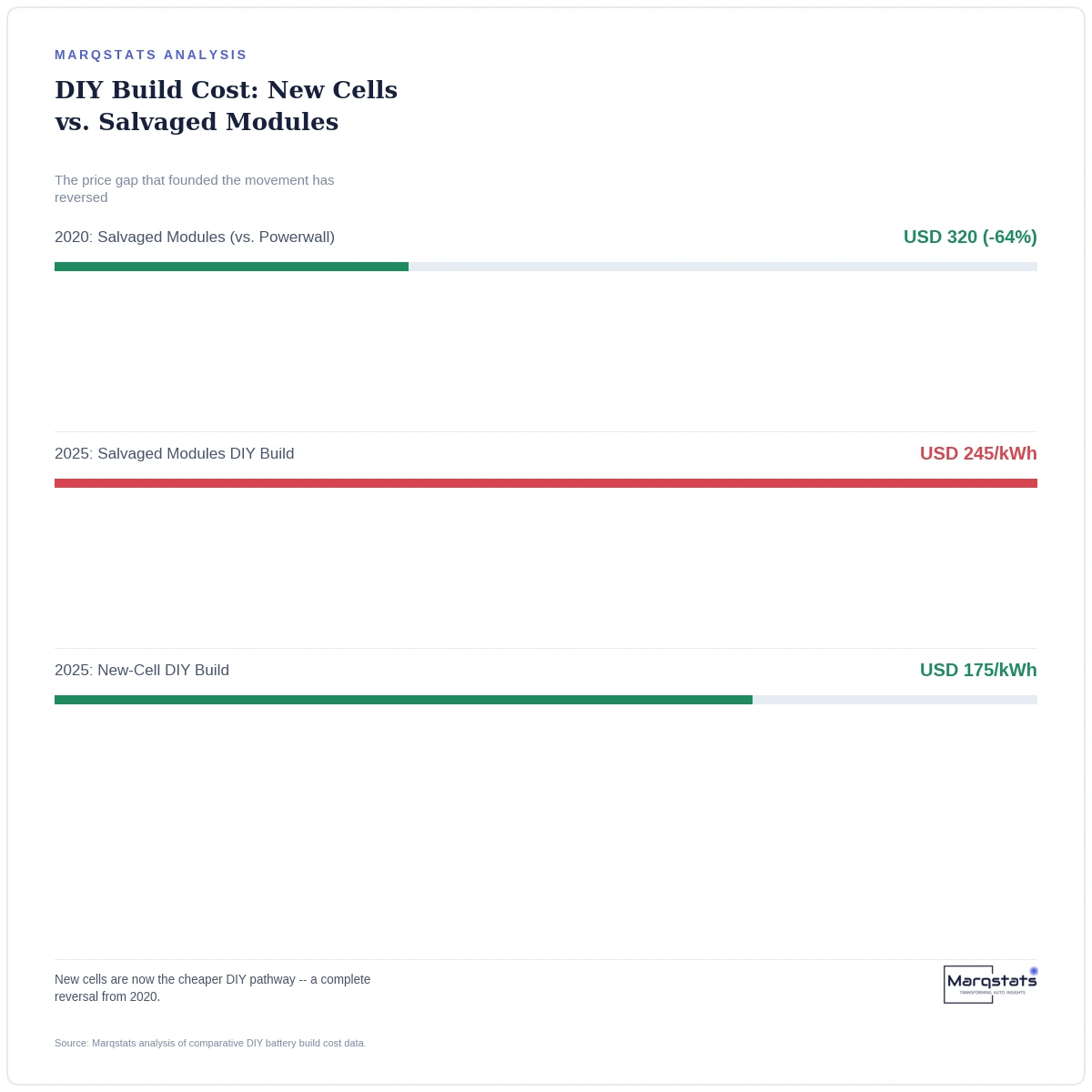
In 2020, a salvaged automotive module cost roughly $80 to $100 per kWh at auction. A Tesla Powerwall, by comparison, worked out to an effective $880 per kWh once installation was included. That's a 64% discount for going the DIY salvage route - a genuinely enormous gap, large enough to justify the real risks and real labor involved in sourcing, testing and wiring a battery pack that wasn't designed to be pulled apart.
That discount is what the entire movement was priced on. Forums, YouTube build logs, parts suppliers selling adapter hardware - all of it assumed salvaged automotive cells would keep being the cheap option relative to anything factory-built.
The project was never really about EV batteries. It was about one number being smaller than another.
— Marqstats Analyst Team
What actually changed
China's battery manufacturing sector built enormous lithium iron phosphate production capacity over the past several years, and that capacity eventually outran demand. The result: wholesale prices for brand-new, factory-warrantied Grade-A LFP prismatic cells from Tier-1 manufacturers collapsed to $30 to $45 per kWh. Large-scale institutional procurement in China has confirmed cell-level pricing as low as $47 per kWh in bulk tenders as of mid-2026 - real, contracted pricing, not a speculative forecast.
Run the actual build math with today's numbers, and the comparison inverts completely. A DIY build using brand-new LFP cells now costs $175 per usable kWh. The equivalent build using salvaged automotive modules - after accounting for hazardous-materials freight, auction platform fees, and the fact that the cells have already burned through 20% to 30% of their useful life - costs $245 per usable kWh. New cells are now the cheaper option, by a meaningful margin, before even accounting for the fact that they also come with 6,000 to 8,000 cycles of life instead of a used pack's already-depleted remaining capacity.
Why the used pack is even more expensive than it looks
The $245 per kWh figure for salvaged modules isn't just the sticker price at auction - it bakes in real logistics costs that don't apply to a new cell shipped directly from a factory. Class 9 hazardous-materials freight rules for lithium-ion cells add real money per shipment. Auction platform fees take a cut. And the module itself has already been discharged and recharged thousands of times in its automotive life, meaning the buyer is paying for capacity that's already partially used up before the DIY project even begins.
The counter-argument: doesn't this ignore sustainability and material-reuse value?
A fair objection is that pure per-kWh cost isn't the only reason people pursued salvage-based builds - some were motivated by a genuine desire to extend the useful life of a battery that would otherwise be scrapped, independent of whether it was the cheapest path in dollar terms. This is a legitimate motivation, and it hasn't disappeared just because the economics shifted. But it's now a values-driven choice rather than a financially rational one for most buyers, and framing it honestly as the former rather than continuing to market it as the latter matters for anyone giving advice to a first-time DIY builder today.
What this means for anyone considering a DIY battery build
- Run the actual per-kWh math against current new-cell pricing before assuming salvage is the budget option - it usually no longer is.
- If pursuing a salvage build anyway for sustainability reasons, be clear with yourself that it is a values choice, not a cost-saving one, at today's prices.
- Watch new-cell pricing trends specifically, since further declines would only widen the gap further in favor of new cells over salvaged automotive scrap.
The cycle-life gap makes the price gap even more one-sided
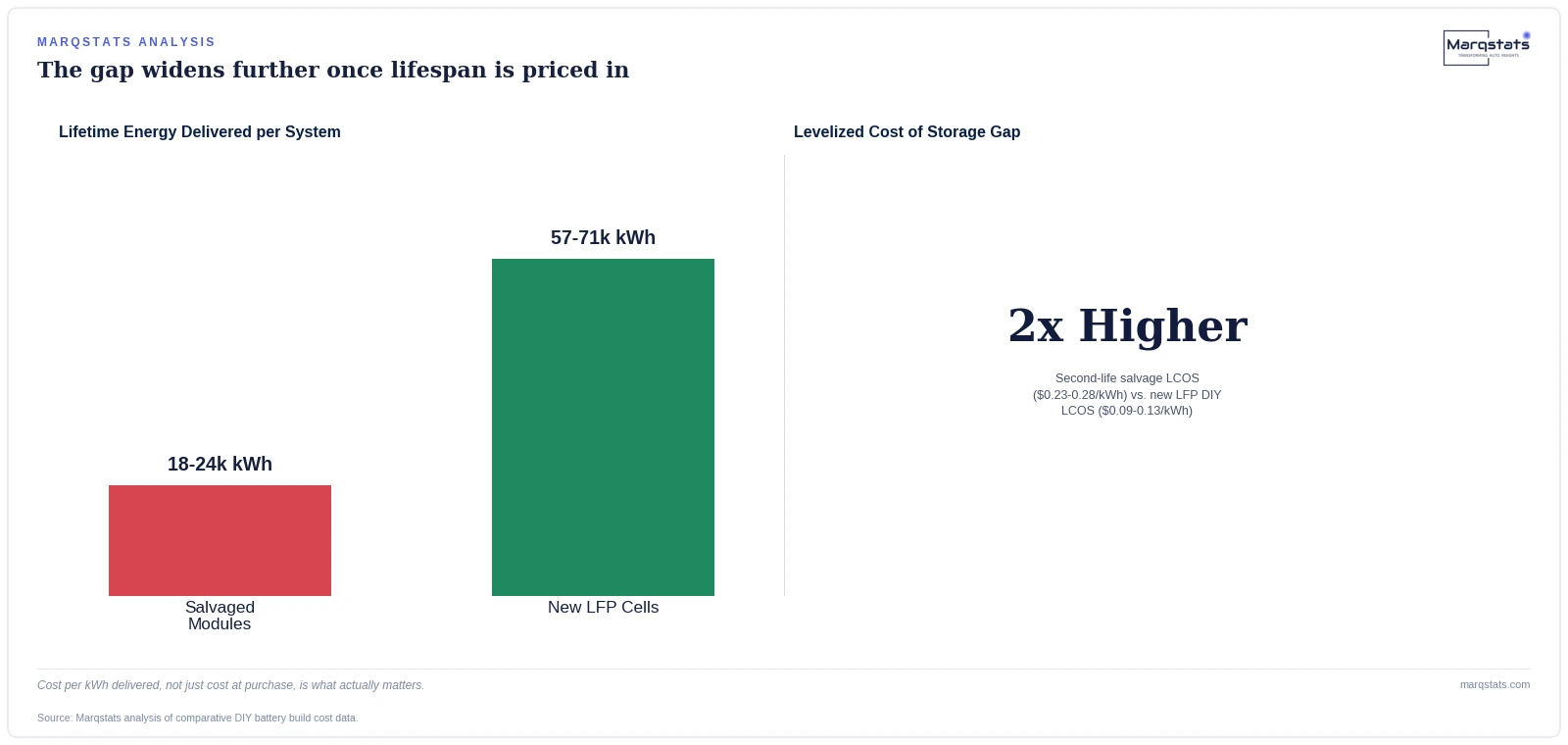
Price per kWh at purchase is only half the comparison - what matters over the system's lifetime is cost per kWh actually delivered before the battery needs replacing. A new LFP cell rated for 6,000 to 8,000 cycles will deliver roughly 57,000 to 71,000 kWh of usable energy over its lifetime. A salvaged automotive module, already having burned through 20% to 30% of its life in vehicle service, typically has 1,000 to 1,800 cycles of useful capacity remaining before hitting the non-linear aging cliff where degradation accelerates sharply - delivering something closer to 18,000 to 24,000 kWh total. When you divide the total installed cost by the energy actually delivered over the system's life, rather than just comparing sticker prices, the gap between new and salvaged cells widens even further than the per-kWh purchase price alone suggests.
This is the calculation a University of California, Davis and U.S. Department of Transportation study formalized as levelized cost of storage: new LFP DIY systems land around $0.09 to $0.13 per kWh delivered over their full operational life, while second-life salvage systems land at $0.23 to $0.28 per kWh delivered - more than double, once the shorter remaining lifespan is properly accounted for.
What this means for the online DIY community specifically
A meaningful share of existing DIY guides, parts lists and cost comparisons circulating online were written when the salvage arbitrage was real - some as recently as 2021 or 2022, when the price gap still favored used automotive modules. Anyone researching a build today by reading older forum threads or YouTube videos is very likely working from stale economics without realizing it, since the underlying cell-price collapse happened gradually enough that it wasn't a single dramatic headline moment most casual readers would have noticed.
The full market picture
Marqstats' complete global second-life EV battery residential and DIY storage conversion market analysis, including the full techno-economic cost-ladder comparison and a three-scenario forecast through 2030, is available in the linked report below.
Related reportGlobal Depreciated EV Battery Residential and DIY Storage Conversion Market Size, Share & Forecast 2026 – 2030