
Why a Supreme Court Ruling Just Redefined What 'Connected' Means in India
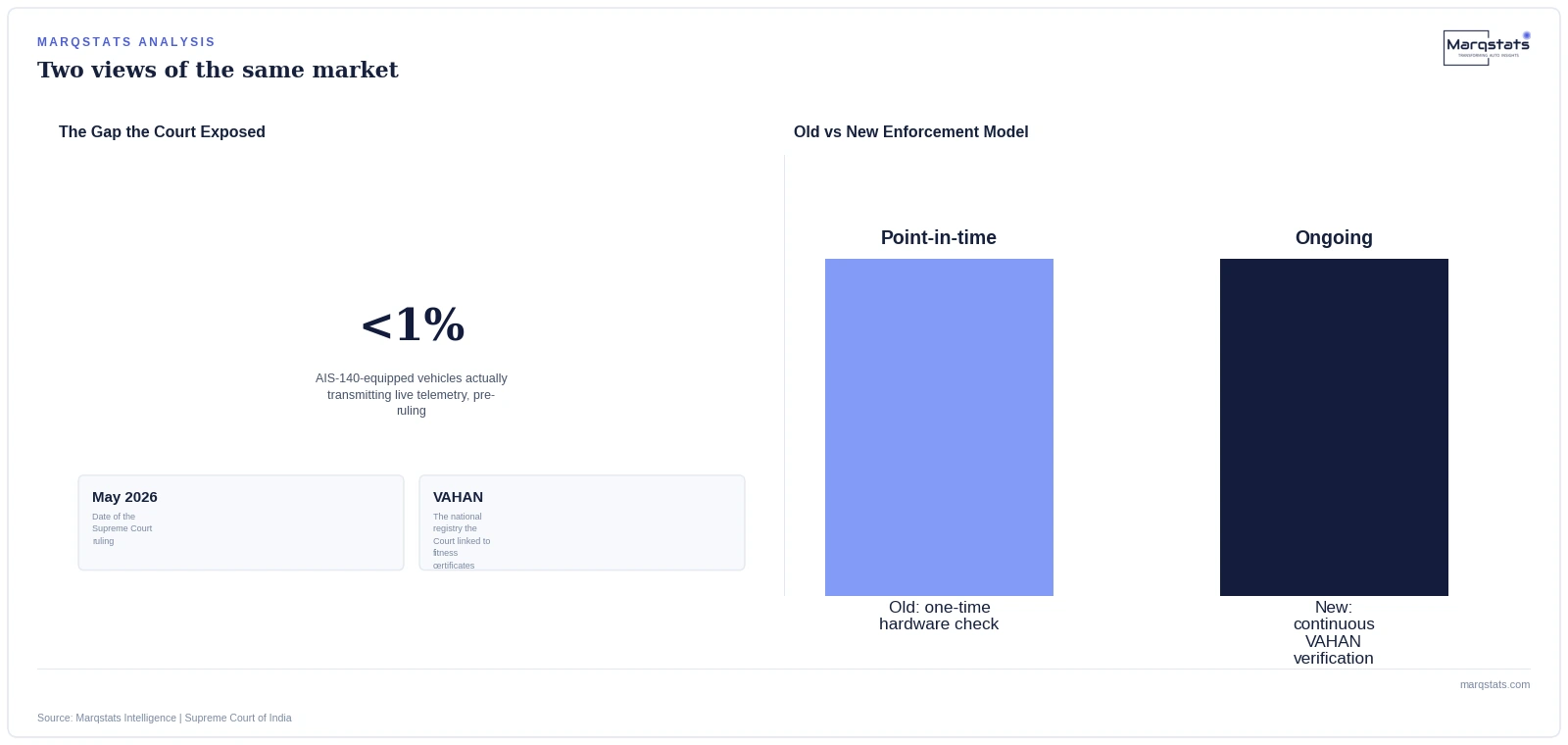
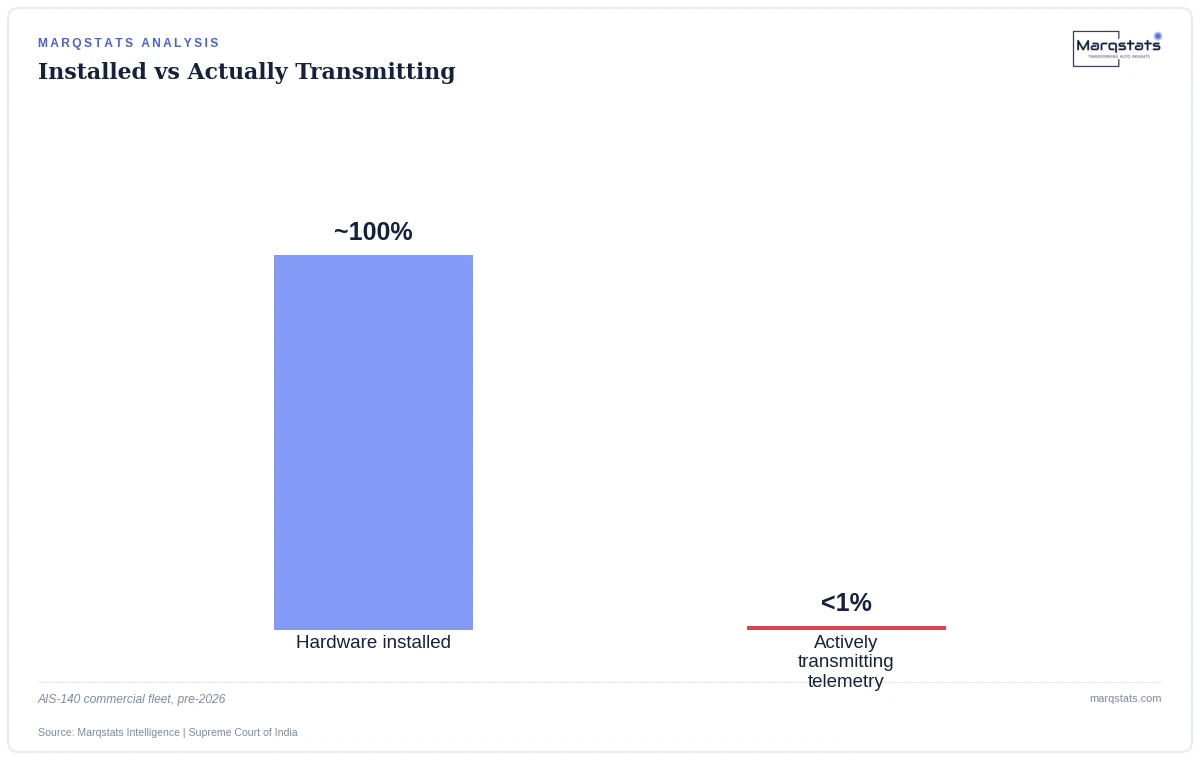
For years, India's commercial vehicle telematics statistics told a reassuring story: near-universal AIS-140 hardware installation across medium and heavy commercial trucks, buses and hazardous-material haulers. In May 2026, the Supreme Court revealed what that statistic was actually hiding. In S. Rajaseekaran v. Union of India, the Court found that fewer than 1.0% of that hardware was transmitting live location and safety data to state emergency monitoring centers. The rest was installed, certified, and silent.
How a Compliance Mandate Became a Compliance Loophole
The mechanism is almost elegant in its simplicity. Regional Transport Offices require AIS-140 hardware installation as a condition of annual vehicle registration and permit renewal. Fleet operators, especially smaller and price-sensitive ones, learned they only needed the physical installation certificate to satisfy the RTO — the recurring cellular M2M data subscription that actually makes the hardware functional was a separate, ongoing cost nobody was checking on. Once the certificate was issued, the subscription lapsed, and the vehicle went dark while remaining, on paper, fully AIS-140 compliant.
Why the Timing of This Ruling Matters
The ruling landed at a specific moment in this market's own regulatory calendar, arriving roughly a year before the Ministry of Road Transport & Highways' own targeted finalization window for AIS-189 and AIS-190 cybersecurity and software-update mandates. That sequencing matters: enforcement infrastructure built to satisfy the Supreme Court's VAHAN-verification directive is likely to become the same technical foundation AIS-189/190 compliance eventually relies on, rather than two separate systems built independently of each other.
Why This Changes How Every Prior India Connected-Vehicle Statistic Should Be Read
This finding has implications well beyond the specific court case. Any historical estimate of India's connected-vehicle penetration that counted hardware installations, rather than verified active transmissions, likely overstated genuine functional connectivity by a wide margin for years. The commercial fleet segment specifically — the segment this market's own research describes as having reached near-total AIS-140 fitment — is precisely where that gap between installed and functioning hardware was largest.
The Fix the Court Ordered, and Why It's Structurally Different
The Supreme Court's directive doesn't just ask RTOs to check harder — it restructures the entire enforcement mechanism. RTOs must now verify active VAHAN telemetry before issuing vehicle fitness certificates at all, converting the annual renewal checkpoint from a one-time hardware inspection into a continuous, cloud-verified compliance requirement. A fleet operator can no longer certify once and go dark; staying certified now requires staying connected.
Why the Same Pattern Likely Extends Beyond This One Court Case
It would be a mistake to treat this as a single isolated finding specific to one lawsuit. The underlying incentive structure that produced it — a one-time physical check with no ongoing verification — exists wherever a regulatory mandate requires hardware installation without also requiring continuous proof of function, and India's own commercial vehicle compliance framework has historically leaned on exactly that kind of point-in-time check across multiple regulatory domains, not just AIS-140 telematics specifically.
A Named Comparison: How Thailand's Pickup Gap Shows the Mirror Image
Thailand, covered elsewhere in this coverage set, shows a structurally related but inverted problem: more than 7.1 million pickup trucks there sit entirely outside any telematics mandate at all, with genuinely no hardware installed. India's problem is different in kind — the hardware is there, certified and installed, but disconnected from the network that would make it functional. Thailand needs a mandate extension to create coverage where none exists; India needed enforcement to activate coverage that technically already existed on paper.
That distinction matters for how quickly each fix can plausibly work. Extending a mandate to a previously uncovered vehicle population, as Thailand's own Accelerated Expansion scenario assumes, requires new hardware deployment across millions of vehicles from scratch. India's fix, by contrast, requires no new hardware at all — simply activating cellular subscriptions on units already physically installed, a genuinely faster and cheaper remediation path once the enforcement mechanism itself is in place.
The Counter-Case: Could This Just Create a New Loophole?
A fair skeptic might ask whether fleet operators will simply find a new way to game the system — activating subscriptions briefly around inspection dates, for instance, then lapsing again. It's a genuine risk, and the underlying research doesn't claim the Court's directive eliminates gaming entirely. What it does change is the cost-benefit calculation: continuous VAHAN verification, rather than a point-in-time physical check, makes intermittent activation materially harder to sustain than the old system's install-once-and-forget pattern, even if it doesn't make evasion impossible.
Why Fleet Operators Let This Happen in the First Place
It's worth understanding the fleet operator's own incentive structure here, because it explains why this gap persisted for so long without drawing scrutiny. A recurring cellular M2M subscription is a genuine, ongoing operating cost with no immediate, visible return for a price-sensitive operator running thin margins — the RTO doesn't check whether the subscription is active, only whether the hardware was installed and certified at registration time. Rationally, an operator facing no consequence for letting the subscription lapse, and a real cost for maintaining it, will let it lapse. The system wasn't being gamed maliciously so much as it was responding entirely predictably to the incentives it was actually built around.
What This Means for Anyone Sizing This Market
The practical lesson is straightforward: treat India's historical connected-vehicle hardware statistics as a ceiling on genuine functional connectivity, not a floor, and treat the Supreme Court's enforcement mechanism as this market's single most consequential near-term catalyst for closing that gap — more consequential, in the near term, than any organic consumer demand shift.
That overlap is a genuinely efficient outcome for a regulatory system that might otherwise have built two parallel, redundant verification infrastructures — one for the Court-driven fitness-certificate requirement, another for AIS-189/190 software-lifecycle audits — when a single, well-designed VAHAN-linked system could plausibly satisfy both.
The Number Worth Watching Over the Next Two Years
The single clearest leading indicator for whether this fix is actually working will be the share of AIS-140-equipped commercial vehicles showing active VAHAN telemetry at each annual fitness-certificate renewal cycle, tracked over time rather than as a single snapshot. A rising share confirms the enforcement mechanism is genuinely converting dormant hardware into active connections; a plateau well below full compliance would suggest fleet operators have found a new way to satisfy the letter of the requirement without the underlying substance.
What This Means for a Sizing or Sourcing Model
Anyone forecasting India's connected-vehicle revenue should model VAHAN enforcement effectiveness as a distinct, trackable variable separate from new-vehicle sales growth. The full market sizing this piece draws on is set out in the Marqstats analysis linked below.
Related reportIndia Connected Car Market Size, Share & Forecast 2026 – 2030