It's Not About Willingness. It's About Two Specific Barriers.
This distinction matters because it changes what actually fixes the problem. A public awareness campaign encouraging mechanics to "get trained" or "invest in EVs" misses both concrete barriers entirely — what closes this gap is specifically TESDA facility expansion and financing mechanisms that make the PHP 250,000 tooling outlay affordable for a shop that hasn't yet seen enough EV volume to justify it on its own.
Ask most independent mechanics in Metro Manila why they won't touch a battery-electric vehicle's high-voltage system, and the honest answer isn't reluctance. It's that they genuinely can't, safely or legally, without clearing two specific hurdles most haven't cleared yet.
Barrier One: The Tools
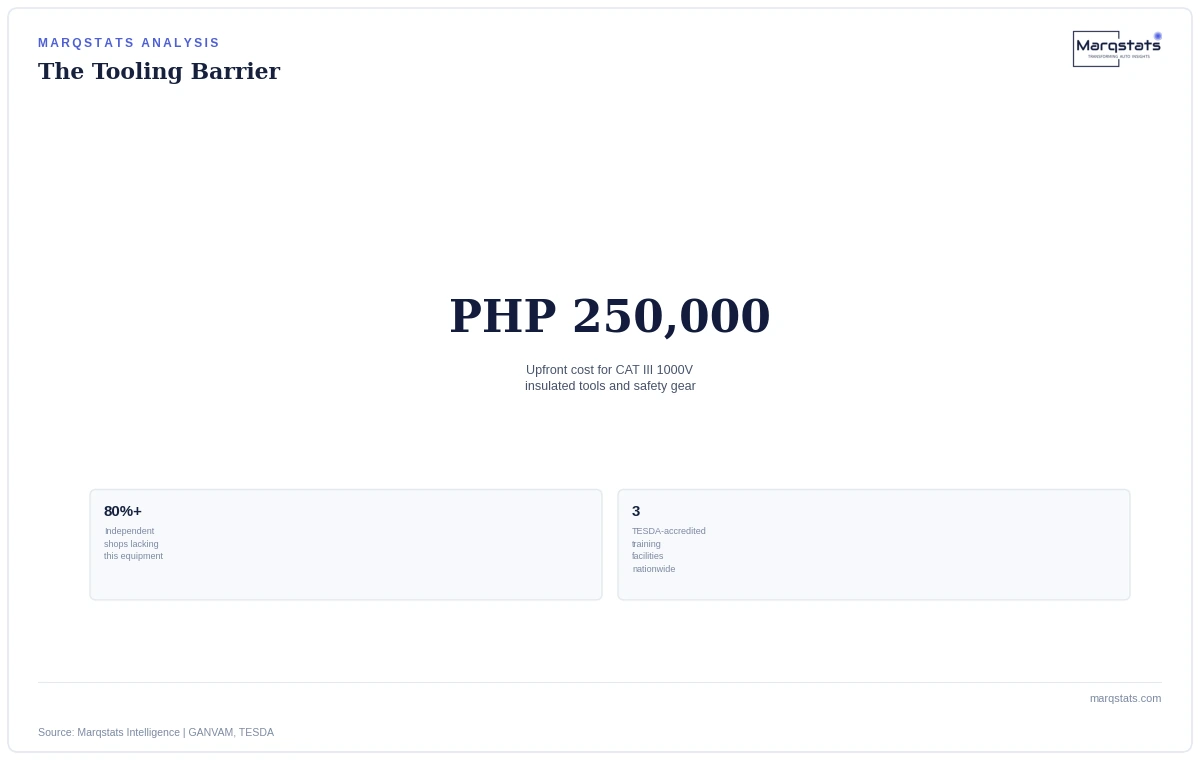
High-voltage battery service requires CAT III 1000V insulated hand tools and insulated safety gloves — equipment rated specifically to protect a technician from a fault current that a standard automotive tool set was never designed to handle. Outfitting a shop with this equipment carries a real upfront cost: approximately PHP 250,000. For a small independent garage running on thin margins, that's a genuinely difficult capital decision to justify before enough EV volume walks through the door to pay it back.
Barrier Two: The Certification
Even with the tools, a technician needs training TESDA recognizes as competent to perform high-voltage work safely. TESDA's Pure BEV Servicing Level II competency standard exists — but the national accredited facility count sits at just 3, nationwide, against a registered EV fleet of 60,906 vehicles. That's not a capacity gap independent workshops can simply train their way around quickly; it's a bottleneck in the national training infrastructure itself.
What Happens Instead
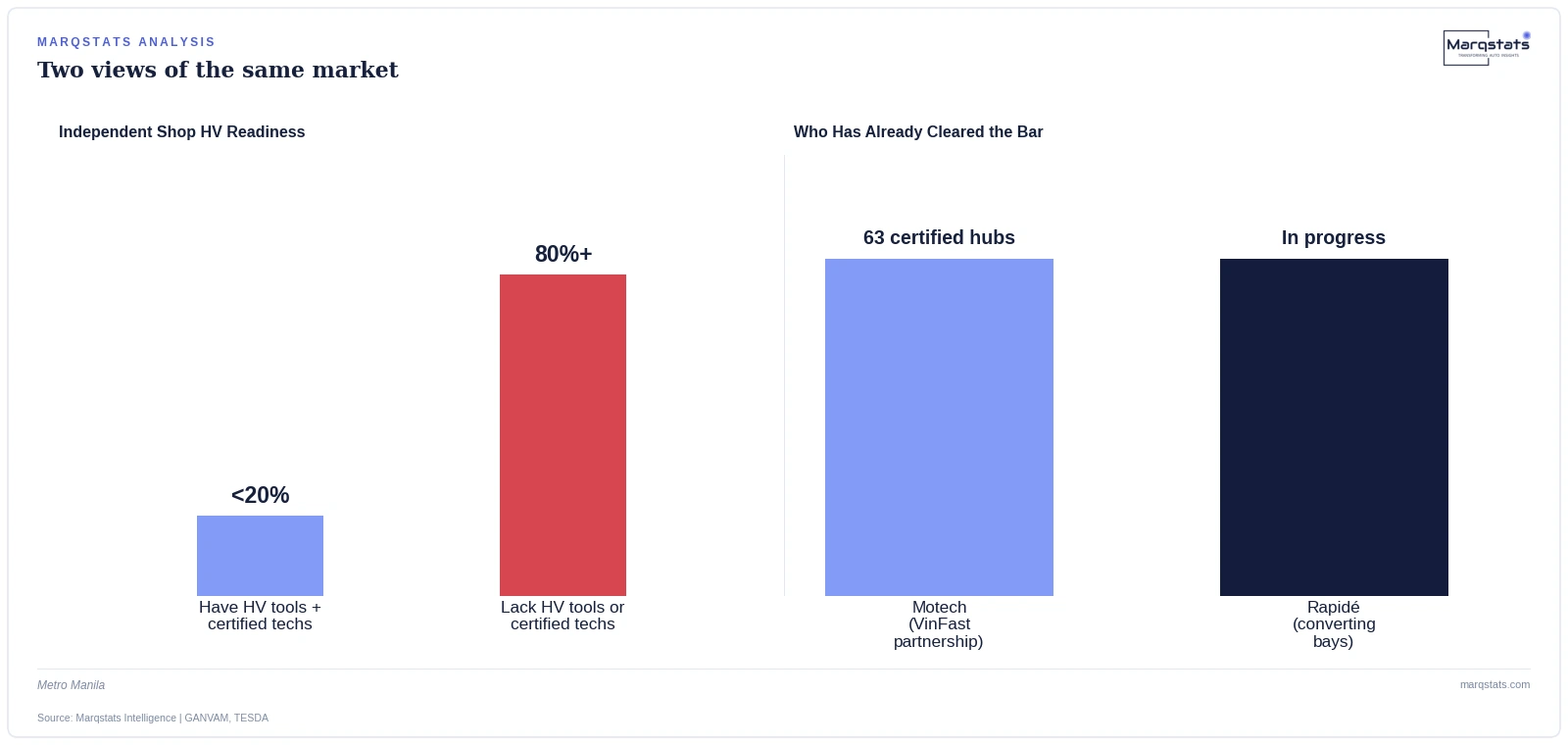
Over 80% of independent repair shops in Metro Manila currently lack both the tooling and the certified technicians this work requires. The practical result: out-of-warranty EV owners get pushed back toward OEM dealership servicing by default, not because the dealership offers better value, but because the independent alternative genuinely cannot legally perform the work yet.
A Named Comparison: How OEM Dealerships Avoid This Problem Entirely
Authorized OEM dealerships never face this specific barrier — they receive factory tooling, training and technical support directly from the manufacturer as part of their dealership agreement, with the capital cost absorbed into the broader dealership investment rather than falling on an individual independent shop owner. That structural difference, more than any difference in genuine repair competence, is what currently channels out-of-warranty EV owners toward dealership pricing by default.
Why This Is Starting to Change, Slowly
Larger independent chains are moving first: Motech Automotive has built certified capacity specifically through its VinFast partnership, while Rapidé Auto Service Experts is actively converting service bays for high-voltage diagnostics. These are the operators with enough scale to absorb the PHP 250,000 tooling cost and enough volume to justify sending technicians through TESDA-recognized training — a path smaller independent garages genuinely cannot follow yet without either consolidation or a meaningful expansion in accredited training capacity.