Why BMW's 9 Million Connected Cars Are Really 1.45 Million in Germany
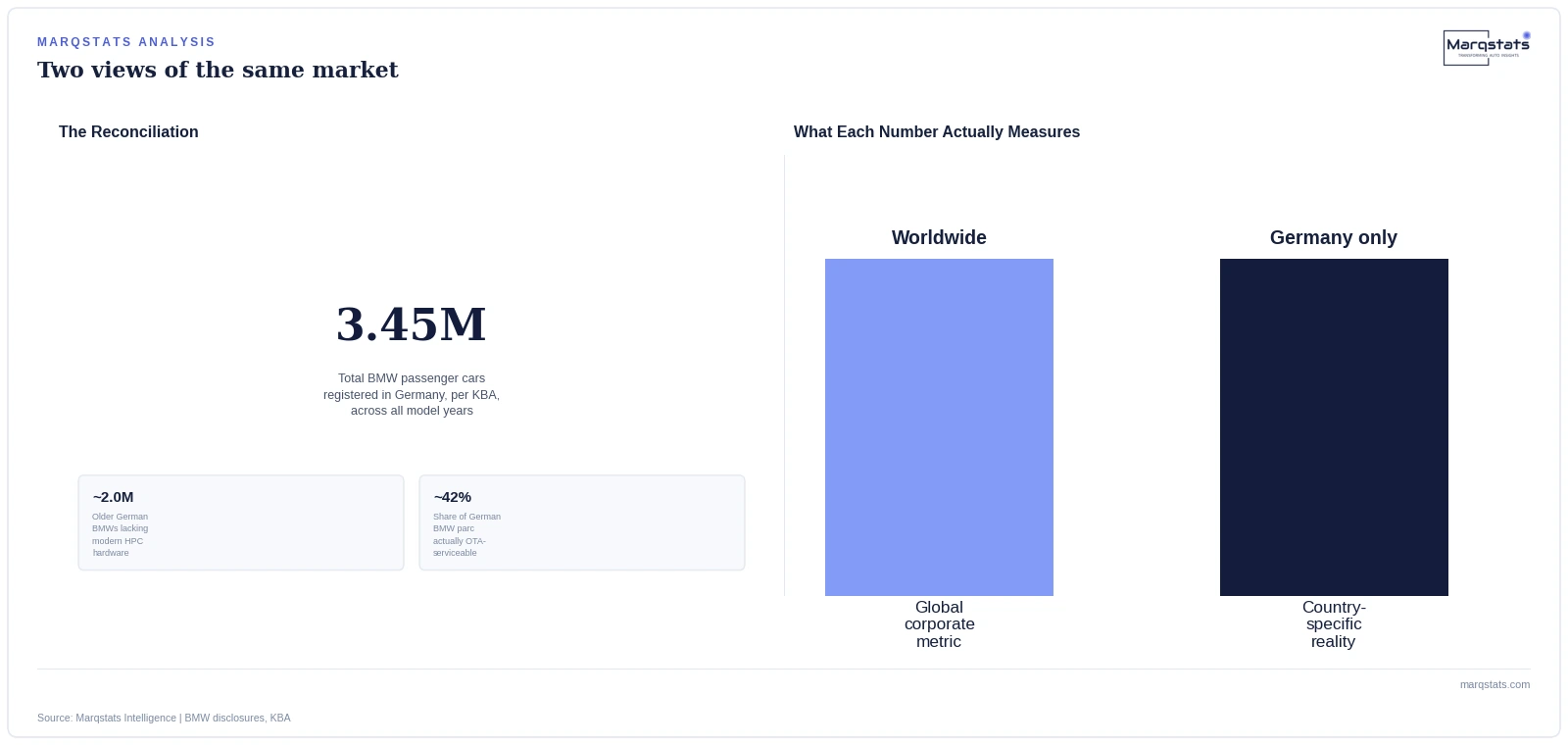
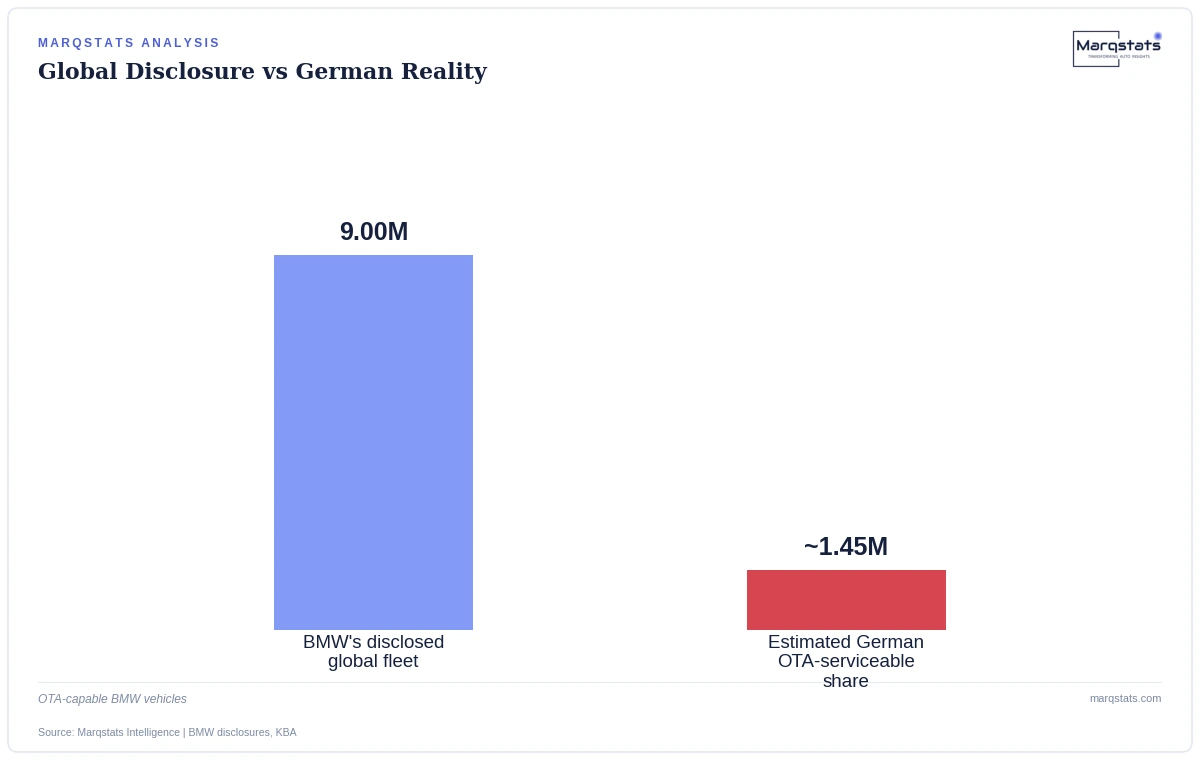
BMW's own corporate disclosures are impressive: more than 9 million globally active OTA-capable vehicles, over 10 million cumulative software upgrades delivered by October 2024. Read against Germany's own vehicle registry, a very different number emerges. Cross-reference that 9 million global figure with KBA's own German BMW passenger car parc — 3.45 million units across all model years — and the actual domestically OTA-serviceable BMW fleet in Germany is roughly 1.45 million vehicles. Not 9 million. Not even close.
Where the Rest of the 9 Million Actually Are
The gap isn't a discrepancy or an error — it's simply what happens when a genuinely global corporate statistic gets applied to a single national market without adjustment. BMW's 9 million-vehicle figure describes its entire global connected fleet, across every market it sells into worldwide. Germany, however large a market for BMW, is one country among many, and its own domestic BMW parc — all 3.45 million vehicles, new and old combined — is a fraction of that global total.
The Scale of Global-to-Domestic Gaps Across This Industry
BMW's roughly six-to-one gap between its global OTA fleet and its estimated German-serviceable share isn't an outlier by industry standards — any automaker selling meaningfully outside its home market will show a broadly comparable ratio, since a domestic market, however large, is mathematically bounded by that market's own total vehicle population while a global corporate figure isn't bounded by anything except the company's total worldwide fleet across every country it operates in simultaneously.
A Named Comparison: How UK Registration Distortions Show the Same Pattern
This isn't a uniquely German phenomenon, or even a uniquely BMW one. The UK, covered elsewhere in this coverage set, shows a structurally comparable distortion: corporate fleet and long-term contract-hire vehicles registered to South East leasing headquarters despite being driven across the Midlands and northern England. Germany's own version adds a second layer beyond pure geography — a global corporate statistic being read as a national one, which is a distinct category error from a domestic registration-address distortion, even though both ultimately mislead anyone using the raw figure at face value.
Why Even the German-Specific Number Needs a Second Look
There's a further layer to this reconciliation worth understanding. Germany's own BMW parc of 3.45 million vehicles spans every BMW currently registered in the country, regardless of age or hardware generation. Older BMWs built before modern high-performance domain computers became standard equipment simply cannot run the OTA update infrastructure BMW's global figure describes, no matter how connected the vehicle might technically be in some limited sense. That's why the actual OTA-serviceable estimate lands closer to 1.45 million — roughly the share of Germany's own BMW fleet built recently enough to carry the necessary hardware.
How the Reconciliation Was Actually Done
The method here is straightforward and repeatable: take BMW's own disclosed global OTA-capable fleet figure, then divide it against BMW's total worldwide sales volume to estimate roughly what share of a typical national BMW parc would plausibly be OTA-capable, then apply that ratio to KBA's own confirmed German BMW registration count. The resulting 1.45 million estimate isn't a precise audited figure — BMW doesn't publish country-specific OTA-capability data directly — but it's a far more defensible starting point than simply citing the 9 million global number as if it described Germany specifically.
The Counter-Case: Is This Actually Misleading, or Just Normal Corporate Reporting?
It's worth being fair to BMW here: a global automaker disclosing a global fleet statistic isn't doing anything unusual or deceptive — investors and analysts generally understand that a company's worldwide operating metrics aren't meant to describe any single national market in isolation. The issue isn't BMW's disclosure practice; it's how easily that global figure gets repurposed, in secondary reporting and casual market commentary, as if it described German market penetration specifically, when it plainly doesn't.
What This Says About Reading Any Automaker's Global Statistics
The practical rule worth taking away extends well past BMW or even Germany specifically: treat any globally-scoped connectivity, OTA or fleet-size figure as a starting point for further reconciliation, never as a direct national market-sizing input on its own. Mercedes-Benz, Volkswagen and every other automaker with meaningful global scale face the identical structural issue — their own investor-facing disclosures are built for global audiences, not calibrated for any single country's market researcher trying to size a domestic opportunity.
Why This Matters Beyond BMW Specifically
This reconciliation exercise matters well beyond one automaker's own numbers. Any market analysis using global corporate OTA or connectivity disclosures as a proxy for country-specific market penetration is making the same category error this piece just corrected for BMW — and Germany's own connected car statistics, this report's own research shows, contain a second, structurally similar conflation in how alternative-powertrain registrations get read as pure electric-vehicle adoption.
That distinction between what a market could theoretically look like at global scale and what it genuinely supports today is exactly the gap this piece has spent the last several sections walking through in detail.
Why This Matters for a Genuine 2030 Forecast
A forecast built on the assumption that Germany's OTA-capable fleet already resembles BMW's own global scale would badly overstate near-term addressable market size for anything requiring genuine OTA capability — dashboard-based usage-based insurance products, remote diagnostic subscriptions, feature-unlock revenue — all of which depend on the roughly 1.45 million vehicle base actually capable of receiving them today, not the far larger global number that regularly gets cited in casual industry discussion.
What a More Careful Disclosure Might Look Like
There's a simple fix automakers could adopt voluntarily: publishing OTA-capability figures broken out by major market alongside the global total, the way many companies already report regional sales or revenue. Until that becomes standard practice across the industry, anyone using a global OEM connectivity statistic for country-level analysis is responsible for doing the reconciliation themselves — exactly the exercise this piece walked through for BMW's own German-specific numbers.
What This Means for a Sizing or Sourcing Model
Anyone building a Germany-specific connected-vehicle model should cross-reference every global OEM disclosure against the automaker's own KBA-registered domestic parc before using it as a market-sizing input. The full market sizing this piece draws on is set out in the Marqstats analysis linked below.
Related reportGermany Connected Car Market Size, Share & Forecast 2026 – 2030