A modern car generates 10 terabytes of data a year. Roughly 200,000 times less than that ever reaches the cloud.
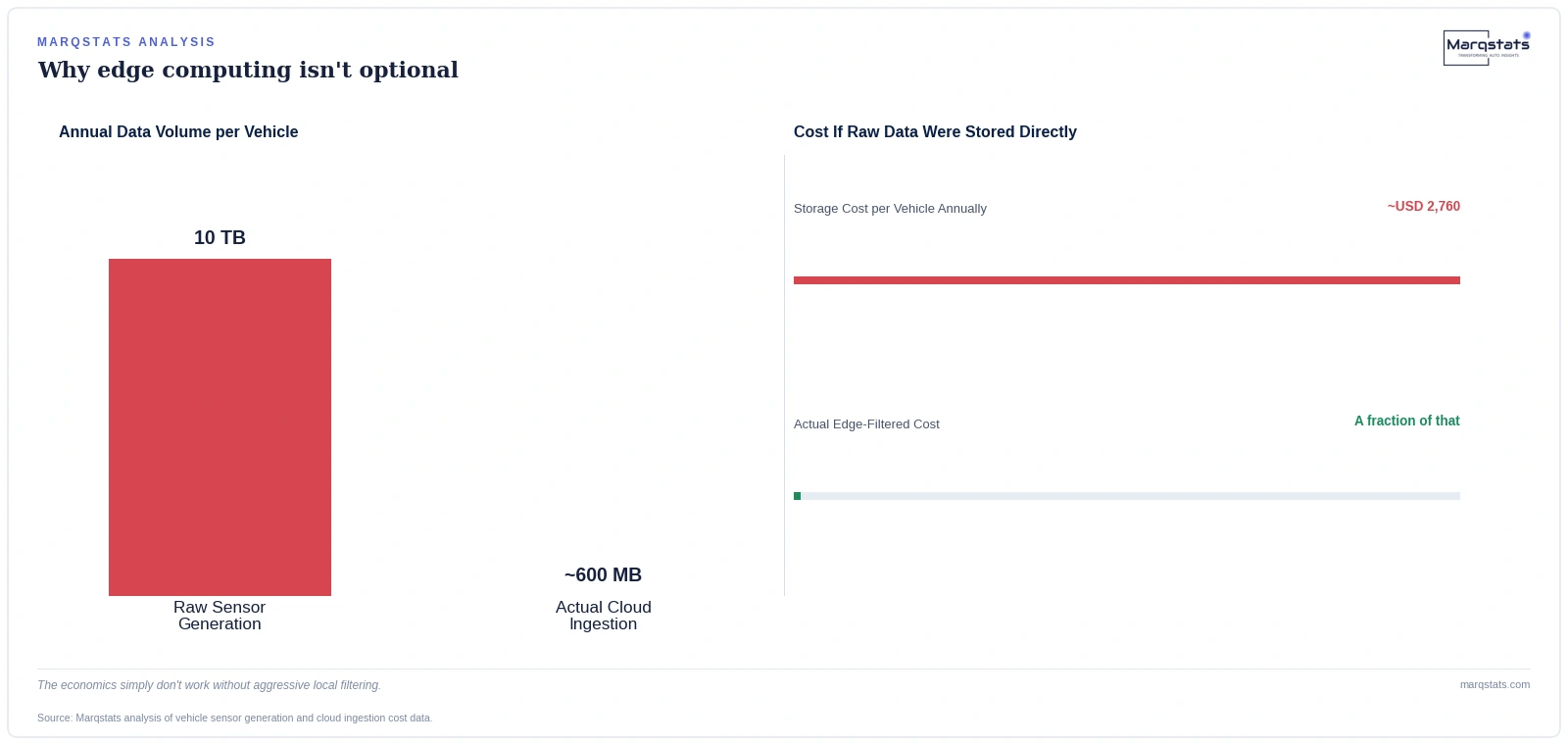
Here's a number that sounds almost unbelievable until you actually work through the math: a modern connected vehicle, packed with cameras, radar, and dozens of internal sensors, can generate up to 25 gigabytes of raw data per hour of driving. Assume 400 hours of driving a year, a reasonable average, and a single car produces roughly 10 terabytes of data annually. That's more than most people's entire personal computer could hold, generated by one vehicle, every year.
What would happen if all of it went to the cloud
Do the math on what storing that raw volume would actually cost, and the reason almost none of it gets transmitted becomes obvious fast. Standard commercial cloud storage runs roughly $0.023 per gigabyte per month. Multiply that out across 10 terabytes for a full year, and storing just one vehicle's raw sensor output would cost around $2,760 annually - and that's storage alone, before accounting for the cellular data charges required to actually transmit 10 terabytes off the vehicle in the first place.
Now multiply that per-vehicle cost across the millions of connected vehicles on the road today. At that rate, the industry would be looking at storage costs alone running into the hundreds of billions of dollars annually, just to keep every raw sensor reading from every connected car. No commercially viable software product could be built on economics like that.
Storing everything a car generates would cost more than most cars are worth.
— Marqstats Analyst Team
So the car does the thinking first
The actual solution is edge computing: software running directly on the vehicle's own onboard hardware that processes raw sensor data locally and extracts only what's actually useful, before anything gets sent anywhere. Instead of streaming every frame of camera footage or every reading from every sensor, the vehicle's edge software identifies meaningful events, a hard braking incident, a diagnostic fault code, a GPS position update every few seconds, and transmits only that distilled summary.
The result is a genuinely dramatic reduction: instead of 10 terabytes annually, enterprise telematics platforms typically ingest somewhere between 10 and 50 megabytes of actual cloud data per vehicle, per month. Do that division and you get an attenuation ratio of roughly 200,000 to 1 - for every 200,000 units of data a vehicle's sensors actually generate, only about 1 unit makes it to the cloud.

Why this ratio explains a lot about how the industry is built
This single number explains several things about how automotive data companies are structured that might otherwise seem puzzling. It's why edge computing middleware providers like BlackBerry QNX, Sonatus and Sibros exist as a distinct, valuable layer of the industry rather than a minor technical detail - the software doing this filtering is directly responsible for making the entire connected-vehicle data business economically possible. It's also why cellular data backhaul fees, typically five to fifteen cents per gigabyte on commercial IoT plans, remain a serious constraint on system design even though they sound trivially small: at raw sensor-data volumes, even a small per-gigabyte fee becomes an enormous line item.
The counter-argument: doesn't this mean valuable data is being thrown away?
A fair question is whether this aggressive filtering means genuinely useful data, evidence that might help investigate a rare mechanical failure or improve a safety algorithm, gets discarded before anyone ever sees it. This is a real trade-off, not a solved problem. Engineering teams make ongoing judgment calls about what counts as a meaningful event worth transmitting, and those judgment calls necessarily mean some potentially useful signal gets filtered out along with the noise. The industry's response so far has been to make those filtering rules increasingly sophisticated and configurable, but the fundamental tension between wanting complete data and needing to keep transmission costs sane isn't going away as long as cellular and cloud storage pricing remains what it is today.
What this means for anyone building or evaluating automotive data products
- Evaluate any connected-vehicle data platform's edge filtering methodology specifically, since it directly determines what data will and won't be available for later analysis.
- Treat cellular backhaul cost as a first-order design constraint for any new telematics product, not an afterthought to address once the software works.
- Recognize that edge computing middleware providers occupy a genuinely foundational, not peripheral, position in the automotive data value chain.
The full market picture
Marqstats' complete United States automotive data management market analysis, including the full deployment architecture breakdown, is available in the linked report below.
Related reportUnited States Automotive Data Management Market Size, Share & Forecast 2025 – 2029