Sending everything your car records to the cloud would cost up to $3,600 a month. Here's why it doesn't.
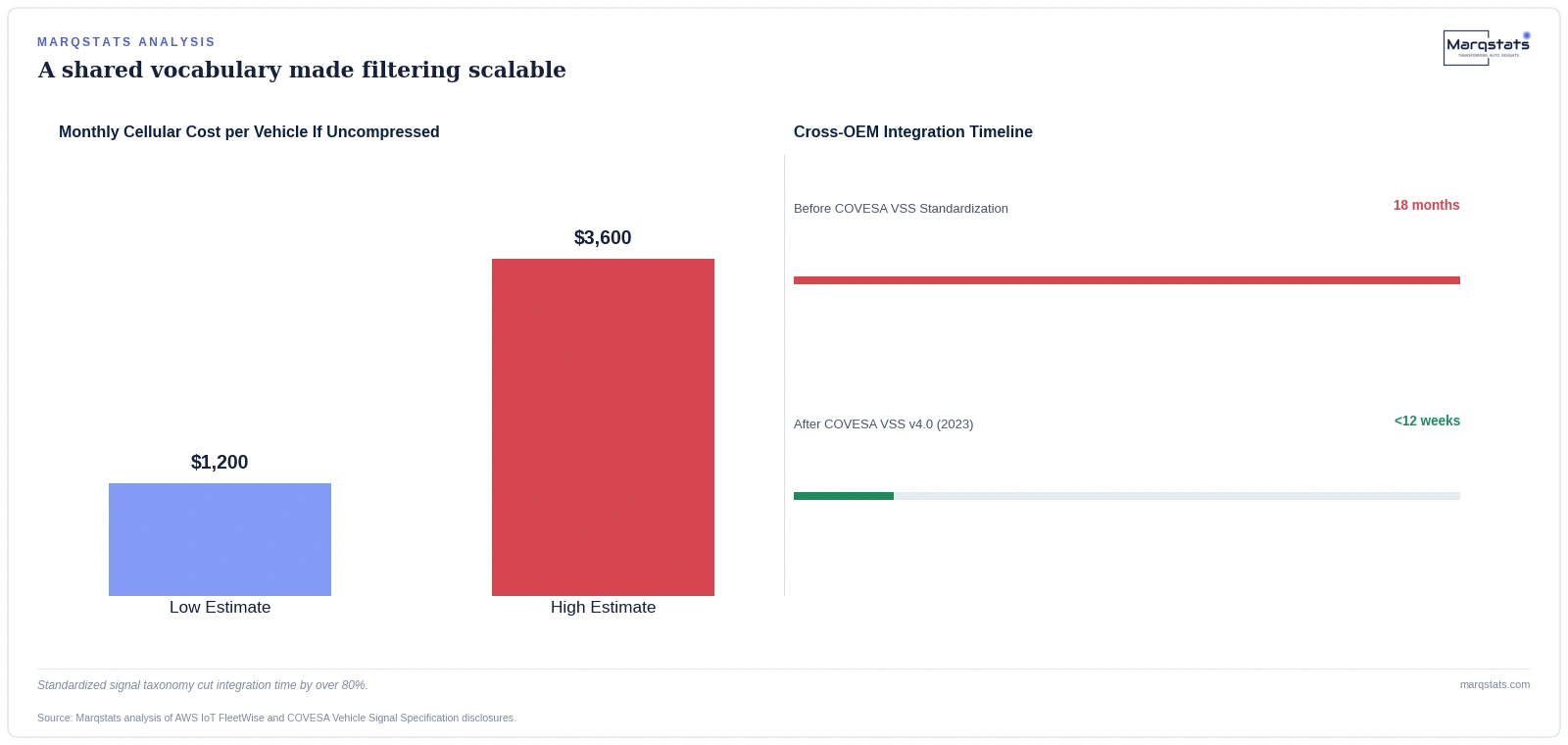
An autonomous or advanced driver-assistance test vehicle generates between 5.0 and 20.0 terabytes of raw sensor data every single day - camera footage, radar returns, LiDAR point clouds, and hundreds of individual vehicle bus signals, all captured continuously. If a fleet tried to upload all of that directly to the cloud over a cellular connection, the monthly bill per vehicle would run somewhere between $1,200 and $3,600. Multiply that across a fleet of even a few thousand vehicles, and the economics collapse instantly. This is a solved problem, but the solution is worth understanding.
Where all that raw data actually goes
The answer isn't a bigger cellular data plan. It's software that runs directly on the vehicle itself, evaluating sensor data in local memory before deciding what's actually worth sending anywhere. Platforms including AWS IoT FleetWise and BlackBerry IVY execute this filtering logic inside the telematics gateway or domain controller, comparing incoming data against dynamic, cloud-configured collection rules. Routine, unremarkable driving data simply never leaves the vehicle. Only genuinely relevant anomaly frames, diagnostic trouble codes, or safety-critical event traces get packaged up and transmitted.
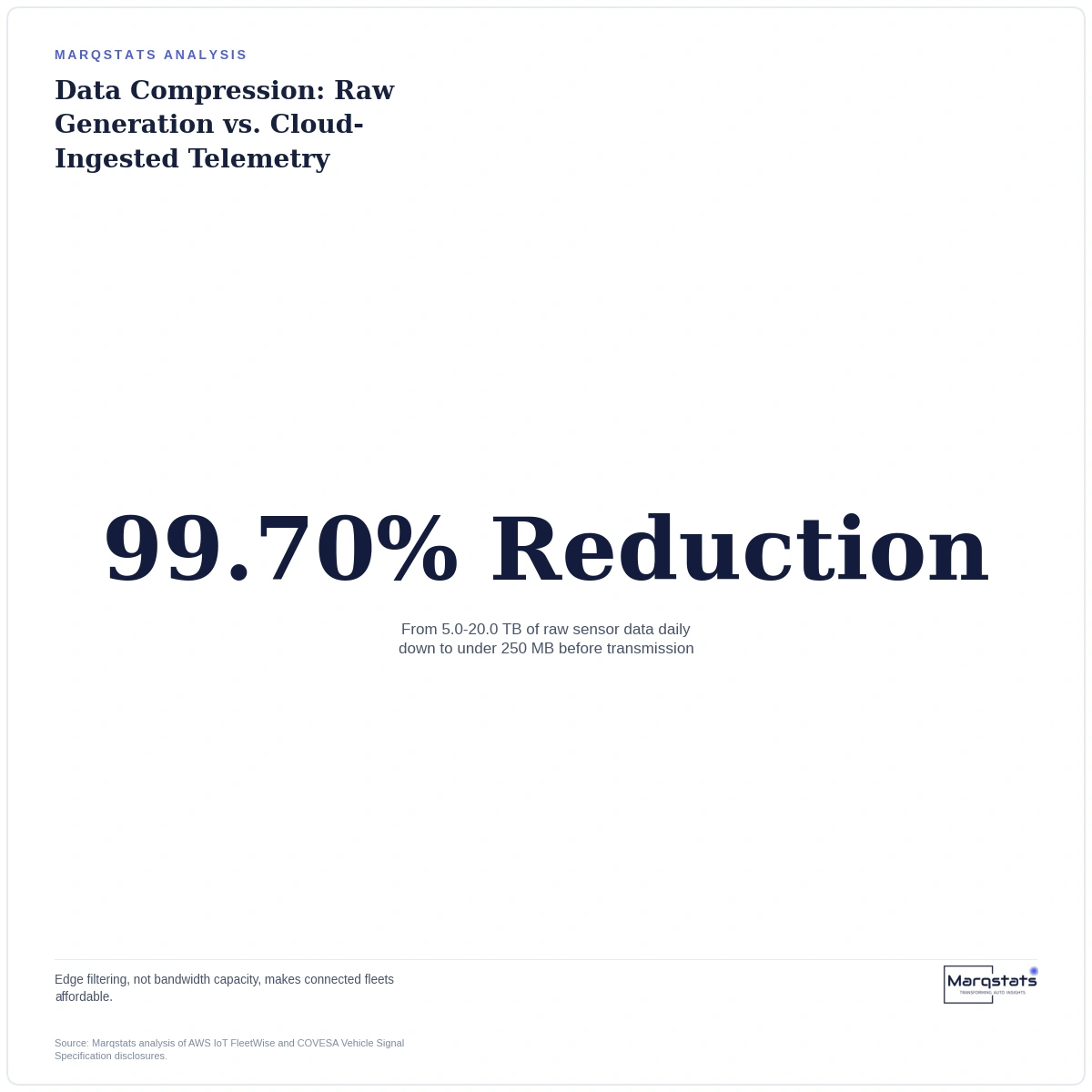
The result of this filtering: cloud transmission volumes shrink from that 5-to-20-terabyte daily baseline down to under 250 megabytes per day. That's a reduction of 99.70% - and it's the specific mechanism that makes mass-market connected vehicle data pipelines economically viable at all.
The car decides what's worth telling the cloud about before it ever picks up the phone.
— Marqstats Analyst Team
Why this required a shared vocabulary, not just faster filtering
Filtering data locally only works cleanly if there's a consistent way to describe what's being filtered. Every automaker's internal vehicle bus signals are proprietary and inconsistent - one manufacturer's format for describing battery temperature looks nothing like another's. The Connected Vehicle Systems Alliance addressed this with the Vehicle Signal Specification, a standardized semantic taxonomy that normalizes proprietary electronic control unit signals into a shared vocabulary across body, powertrain and chassis domains. Version 4.0, released in May 2023, has become the domain taxonomy adopted across AWS IoT FleetWise, Android Automotive and numerous Tier-1 supplier architectures.
This standardization has a genuinely measurable downstream effect: cross-OEM software integration timelines have fallen from roughly 18 months to less than 12 weeks, since engineering teams no longer need to build custom translation logic for every new vehicle platform or partner integration from scratch.
The economics don't stop once data reaches the cloud
Filtering at the edge solves the transmission cost problem, but storing and querying the resulting telemetry in the cloud carries its own cost curve. Standard hot-access cloud storage tiers run approximately $23,000 per petabyte per month - expensive enough that automakers applying automated data lifecycle policies, routing high-priority anomaly events to premium storage while offloading routine driving cycles to cold archival tiers costing roughly $1,000 per petabyte per month, achieve an additional 82.50% reduction in long-term storage and analytics expenditure on top of the edge-filtering savings.
The counter-argument: does aggressive filtering risk throwing away useful data?
A fair concern is whether this level of filtering, discarding over 99% of raw sensor output before it ever reaches cloud storage, means genuinely useful signal gets lost along with routine noise, particularly for rare failure modes engineers haven't yet anticipated and built filtering rules around. This is a real, acknowledged trade-off in the industry rather than a solved problem. The filtering rules embedded in edge software represent a judgment call about what counts as a meaningful event, and any such rule set will inevitably miss some patterns a full, unfiltered dataset might have revealed. The practical response has been to make these filtering rules increasingly sophisticated across successive vehicle software generations, but the fundamental tension between wanting complete data and needing commercially viable transmission costs remains a permanent architectural constraint, not a problem with a final, complete solution.
What this means for anyone building connected vehicle infrastructure
- Evaluate any connected vehicle data platform's edge filtering methodology and Vehicle Signal Specification compliance specifically, since both directly determine transmission cost viability at scale.
- Treat cellular transmission cost as a first-order architectural constraint from the earliest design stage of any new connected vehicle program, not an optimization to address after launch.
- Track how filtering rule sophistication evolves across vehicle software generations, since increasing precision there, more than raw compute capacity alone, determines how much useful signal future systems can capture without sacrificing cost viability.
The full market picture
Marqstats' complete global automotive data management market analysis, including the full edge-to-cloud architectural pipeline and platform component breakdown, is available in the linked report below.
Related reportGlobal Automotive Data Management Market Size, Share & Forecast 2025 – 2030