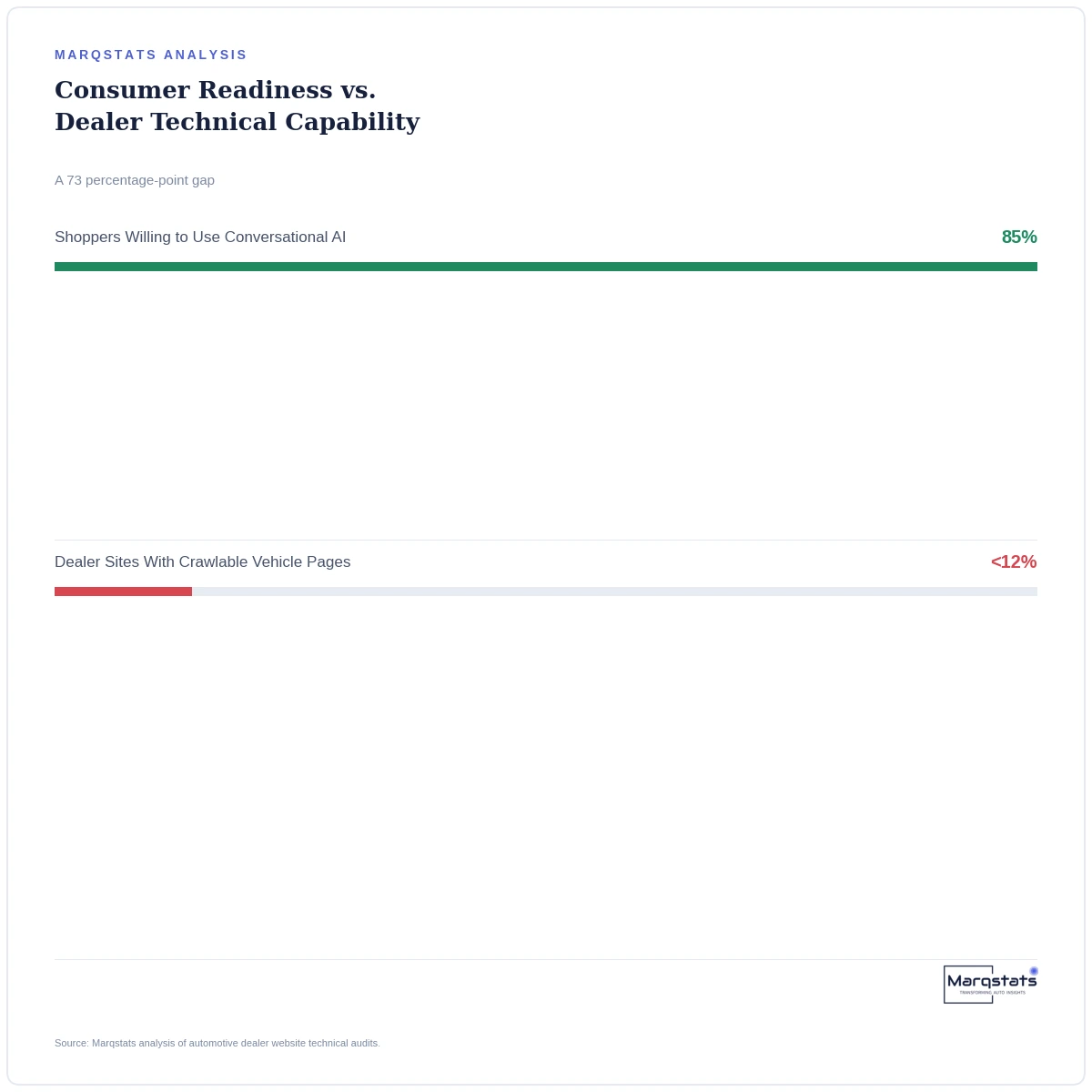
85% of car shoppers are ready for AI-assisted research. Fewer than 12% of dealer sites can actually be read by an AI system.
There's a genuine, well-documented gap between what car shoppers want and what dealership websites are technically capable of delivering. Survey data shows 85% of car shoppers conduct online research and say they're willing to use conversational AI tools somewhere in their vehicle-buying process. Separately, technical audits of dealer websites find that fewer than 12% maintain Vehicle Detail Pages that are actually crawlable and structured well enough for a generative retrieval system to reliably read them.
What 'crawlable and structured' actually means in practice
This isn't a vague technical complaint - it describes a specific, identifiable set of problems. Many dealer Vehicle Detail Pages render their core content, price, trim, mileage, availability, using client-side JavaScript that executes in a shopper's browser after the page loads. A human visitor sees the finished result. An automated crawling system attempting to read that same page programmatically, without executing a full browser rendering pipeline, often sees an empty shell instead, because the actual vehicle data hasn't been inserted into the page yet at the point the crawler reads it.
Layered on top of that, many dealer inventory pages sit behind paywalled or authentication-gated scripts intended to prevent competitor scraping, a reasonable defensive measure against human competitors that also, as a side effect, blocks the exact kind of automated access a generative retrieval system needs to verify current vehicle availability and pricing.
The customer is ready to ask the question. The dealership's own website often can't be read well enough to supply the answer.
— Marqstats Analyst Team
Why this gap has real, measurable consequences
This isn't a purely theoretical technical shortfall - it connects directly to documented commercial outcomes. Shoppers referred to a dealer's website by a conversational platform convert at 14.2%, compared to 2.8% for traditional organic search visitors. But a dealership can only capture that higher-converting audience if a generative system can actually retrieve and cite its inventory in the first place. A dealer with genuinely excellent pricing, selection and service, but an inaccessible Vehicle Detail Page architecture, is functionally invisible to exactly the audience segment that converts best.
Why this problem is more solvable than it sounds
The good news, relative to the size of the gap, is that the underlying fix is a known, well-documented technical pattern rather than a fundamentally new capability dealerships need to build from scratch. Server-side rendering, where the full page content, including current price and availability, is generated before it reaches the browser or crawler, rather than assembled afterward via client-side scripts, solves the core accessibility problem directly. Structured data markup, using established schema formats that explicitly label vehicle identification numbers, trim levels, pricing and availability, gives automated systems an unambiguous, machine-readable data source to draw from rather than requiring them to parse and interpret unstructured page text.
Neither of these techniques is exotic or unproven - both have existed in web development practice for years, originally developed for reasons unrelated to generative AI retrieval. What's changed is the commercial incentive to actually implement them consistently across dealer inventory, given the documented conversion premium now sitting on the other side of that technical gap.
The counter-argument: is this really a dealer-level problem, or a platform-level one?
A fair objection is that responsibility for this gap might sit more with the software platforms dealerships use to build and host their websites than with individual dealership operators, many of whom have limited in-house technical capacity and rely entirely on their platform vendor's default configuration. This is a reasonable framing, and platform-level defaults genuinely matter here - a dealer using a platform that renders Vehicle Detail Pages server-side by default inherits that advantage automatically, without needing custom technical work. What this means practically is that the 73-point gap is likely to close unevenly: dealers on platforms that prioritize this kind of technical accessibility will close it quickly, while dealers on platforms that haven't prioritized it will remain effectively invisible to generative retrieval regardless of their own individual effort, until their platform vendor addresses the underlying architecture.
What this means for dealership technical teams and platform vendors
- Dealership technical teams should audit whether their Vehicle Detail Pages render core inventory data, price, trim, availability, before or after client-side script execution, since this single distinction largely determines generative crawler accessibility.
- Platform vendors serving multiple dealership clients should prioritize server-side rendering and structured schema markup as default configuration, since doing so closes the readiness gap for every dealer on that platform simultaneously.
- Marketing teams evaluating generative visibility investment should treat basic technical crawlability as a prerequisite step before investing in content-level optimization techniques like citation and statistic inclusion.
Where the crawlability problem sits inside a much bigger data problem
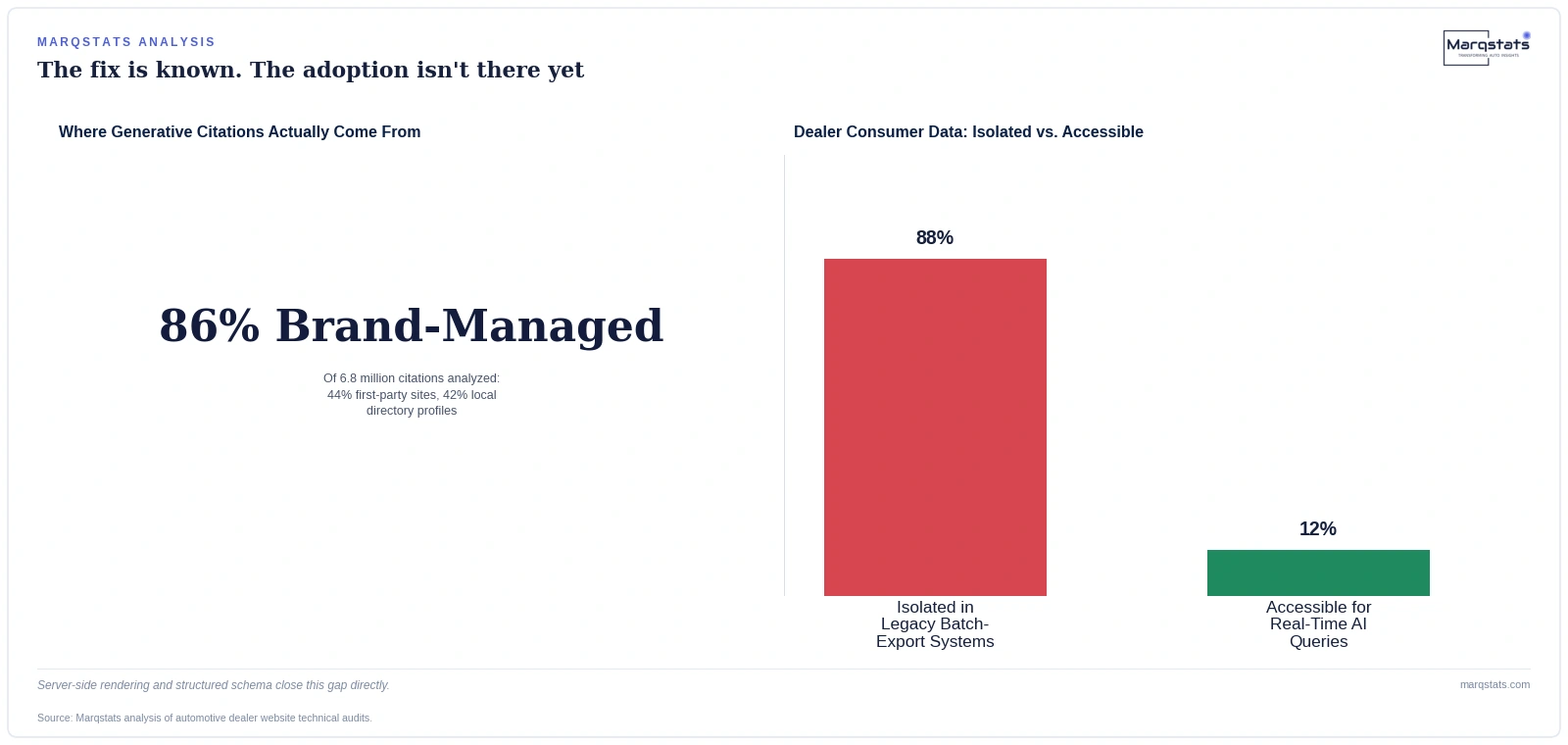
The technical accessibility gap is compounded by a separate, related issue: the sheer volume of customer and inventory data most dealerships already hold, largely disconnected from any system capable of feeding it to a generative retrieval agent in real time. The average franchised dealership manages 2,149,759 consumer data points, expanding 24.0% annually. More than 88% of that data remains isolated inside legacy dealer management system environments that rely on periodic batch-file exports, updating perhaps once or several times a day, rather than the sub-second application programming interface responses a real-time conversational shopping agent actually needs to confirm current availability.
This means the crawlability problem and the data-freshness problem are related but distinct obstacles. A Vehicle Detail Page can technically be crawlable and still surface stale information if the underlying inventory data feeding it only refreshes on a delayed batch schedule. Solving one without the other still leaves a meaningful reliability gap for any generative system attempting to cite current, accurate vehicle availability.
Why brand-controlled channels matter more than you'd expect
A related finding reinforces why dealership-level technical readiness specifically, rather than external marketing or backlink strategy, deserves priority. Forensic analysis of 6.8 million generative AI citations found that 86.0% originate from brand-managed channels, split roughly evenly between first-party corporate websites and local business directory profiles. Only a small remainder traces back to independent, unaffiliated third-party sources. This confirms that a dealer's own website and directory listings, not external backlinks or press coverage, are the primary lever generative systems actually draw from when constructing an answer - which is precisely why Vehicle Detail Page technical readiness carries outsized importance relative to more traditional off-site search engine optimization tactics.
The full market picture
Marqstats' complete global automotive Generative Engine Optimization market analysis, including the full technical readiness landscape across dealership networks, is available in the linked report below.
Related reportGlobal Automotive Generative Engine Optimization Market Size, Share & Forecast 2026 – 2030