The Number That Gets the Headline
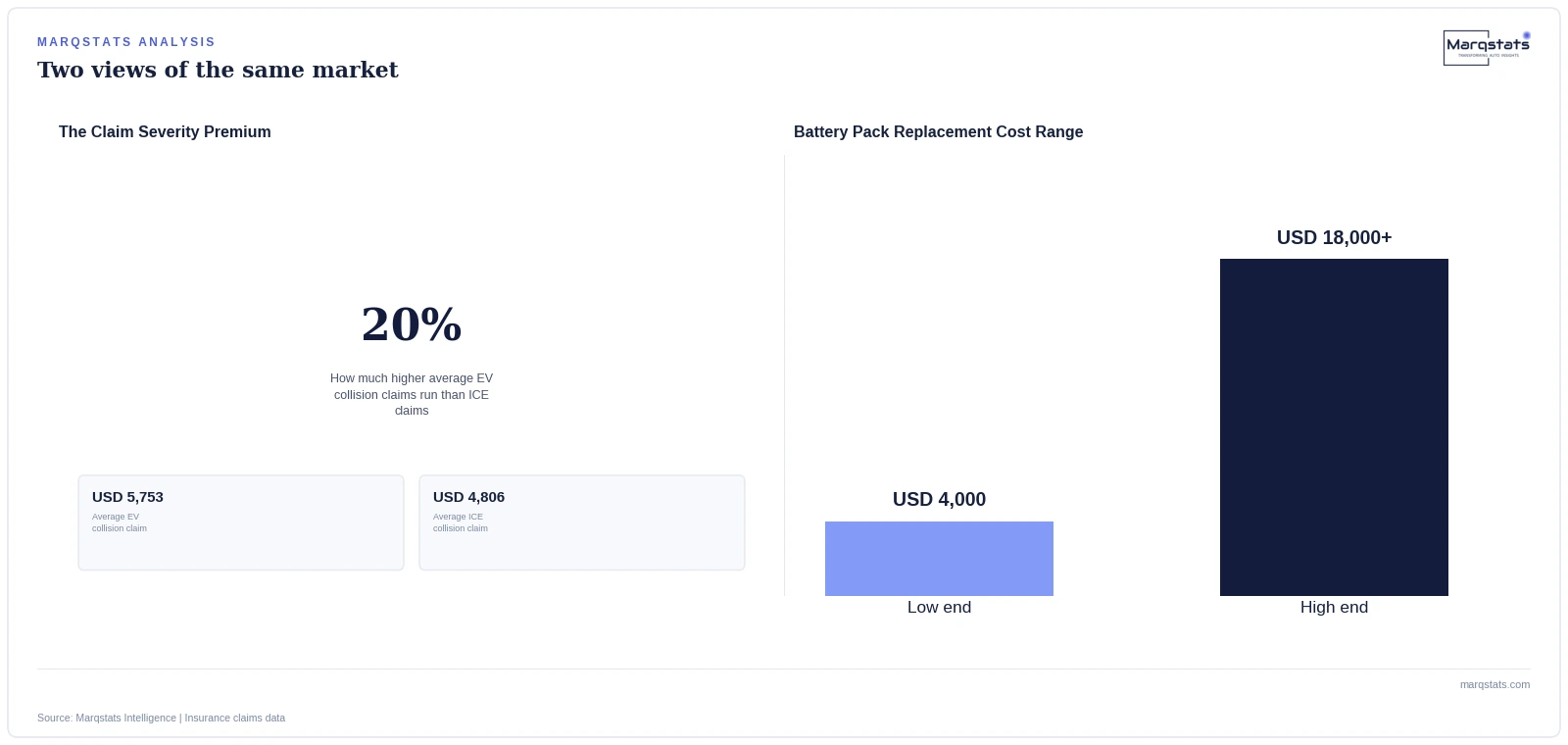
In brief: the average US EV collision repair claim reaches roughly 5,753 dollars, a 20% premium over the roughly 4,806 dollar average for conventional ICE platforms. Most people reading that number assume it's a parts-cost story — expensive battery packs, specialized sensors. The underlying research's own data points somewhere else entirely.
What's Actually Driving the Gap
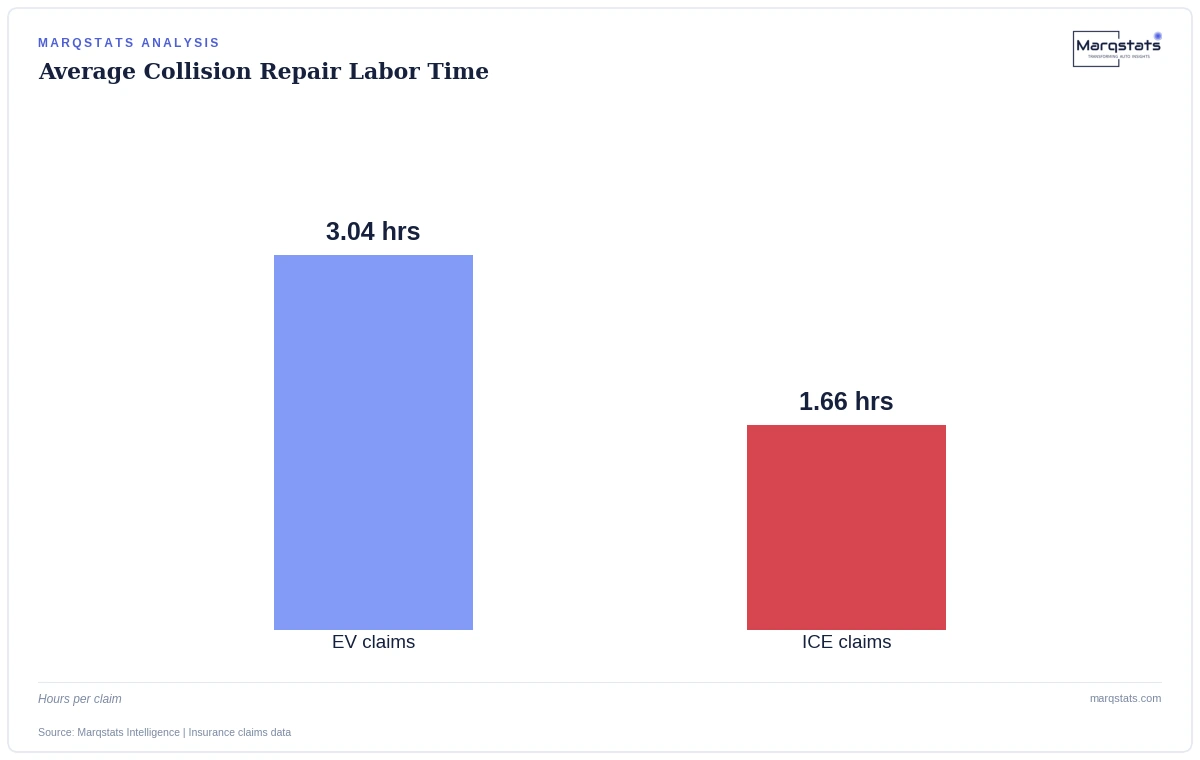
Average EV mechanical repair labor time reaches 3.04 hours per claim against 1.66 hours for ICE vehicles — very nearly double. That gap is procedural, not incidental to the repair itself.
The Procedure Behind the Number
Before a technician can touch a suspension cradle near a high-voltage bus line, they have to prove it's actually safe to touch.
— Marqstats Analyst Team
High-voltage safety protocols require technicians to execute formal electrical isolation, lock-out/tag-out procedures, and residual voltage verification before servicing steering racks, suspension cradles, or heat pump assemblies located near 400V to 800V bus lines. These are mandatory safety steps with no equivalent in a comparable ICE repair — and they take real time to execute correctly, every single time, regardless of how minor the actual collision damage turns out to be.
Why the Parts Story Isn't Wrong, Just Incomplete
Parts costs do matter too, particularly when structural battery enclosures or internal busbars sustain damage: complete pack assembly replacements, rarely supported by OEMs at the component level due to liability restrictions, can range from 4,000 to over 18,000 dollars. But for the broader claim population — not just the most severe structural cases — the labor-time data suggests procedure, not parts, is the more consistent driver of the overall premium.
A Named Comparison: How This Should Change Claim Estimation
Traditional ICE collision estimation tools are built around parts-and-labor tables calibrated to conventional repair procedures. An estimation approach that simply applies a flat percentage markup to account for "EV complexity" risks under- or over-estimating specific claims, since the actual driver is a specific, quantifiable labor-time increase tied to mandatory safety procedure, not a generalized complexity premium.
Why This Gap Is Likely to Persist, Not Narrow
There's little reason to expect this labor-time gap to shrink significantly over time. High-voltage safety protocols aren't a temporary training gap technicians will simply work faster through with experience -- they're mandatory procedural steps tied directly to electrical safety, meaning the extra time they require is a durable feature of EV collision repair, not a transitional inefficiency.
What This Means for Insurers and Collision Centers
The practical implication: insurers and collision repair networks should model EV claim severity around labor-time-specific safety protocol requirements directly, rather than applying a blanket cost multiplier borrowed from parts-cost assumptions that don't reflect what's actually driving the majority of the premium.