48% of car-shopping questions never name a brand. Generative AI recommends one anyway, 97% of the time.
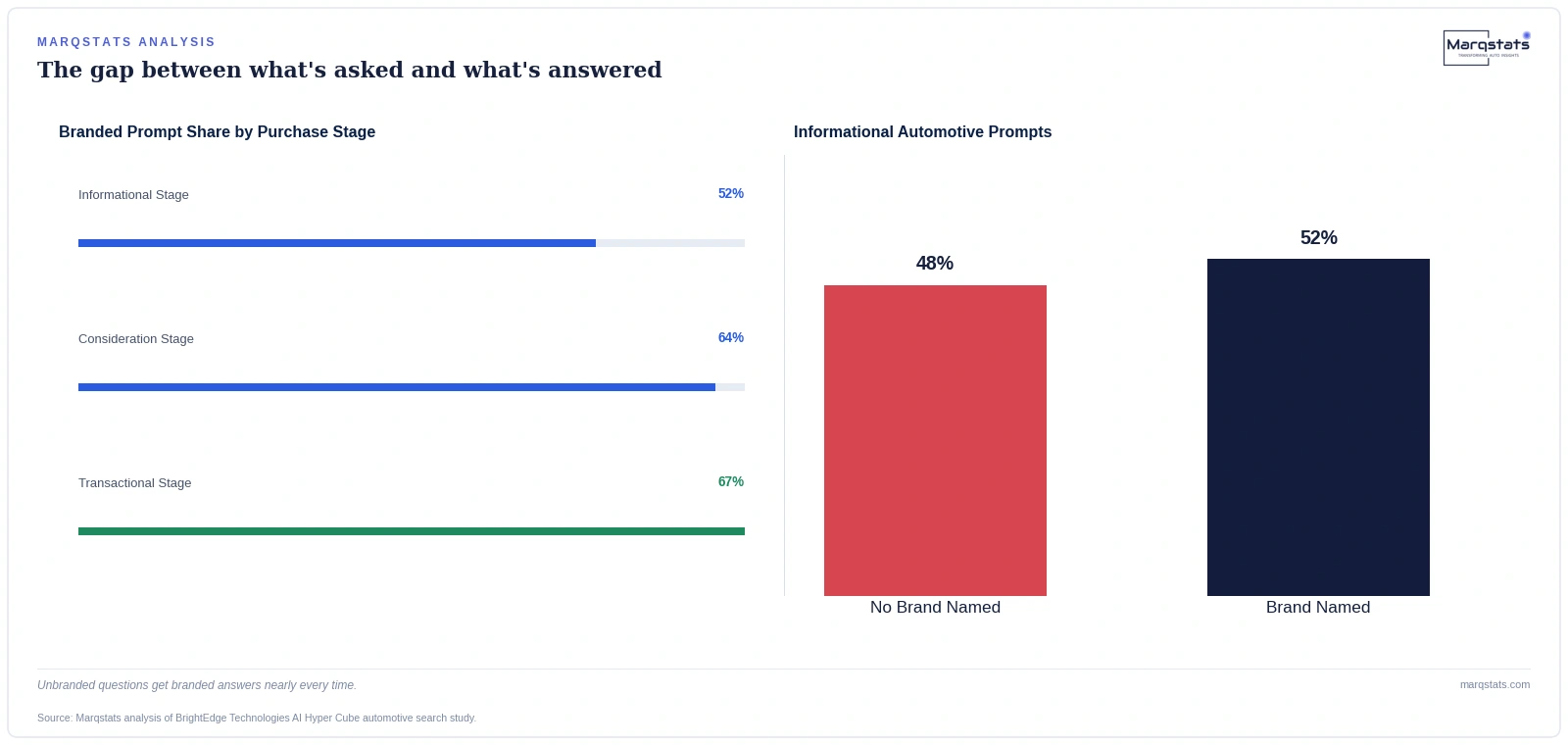
There's a specific finding buried in a 2024 industry study that quietly rewrites the rules of automotive digital competition. Researchers analyzing generative search behavior found that 48.0% of informational automotive search prompts contain no brand name at all - a shopper asking something like which mid-size SUV gets the best highway fuel economy, without naming Toyota, Honda, or any specific manufacturer. Despite that complete absence of brand language in the question, generative search models inject specific automotive brand and dealer recommendations into 97.0% of the resulting answers.
Why this finding actually matters, and isn't just a curiosity
For most of the history of digital automotive marketing, unbranded search queries were treated differently than branded ones, and for a defensible reason. A branded search, someone typing a specific manufacturer or dealership name, signals a consumer who already has a preference and is looking to act on it. An unbranded search, someone asking a general question about vehicle types or features, was treated as earlier-funnel, lower-intent traffic - informational browsing rather than a genuine competitive moment.
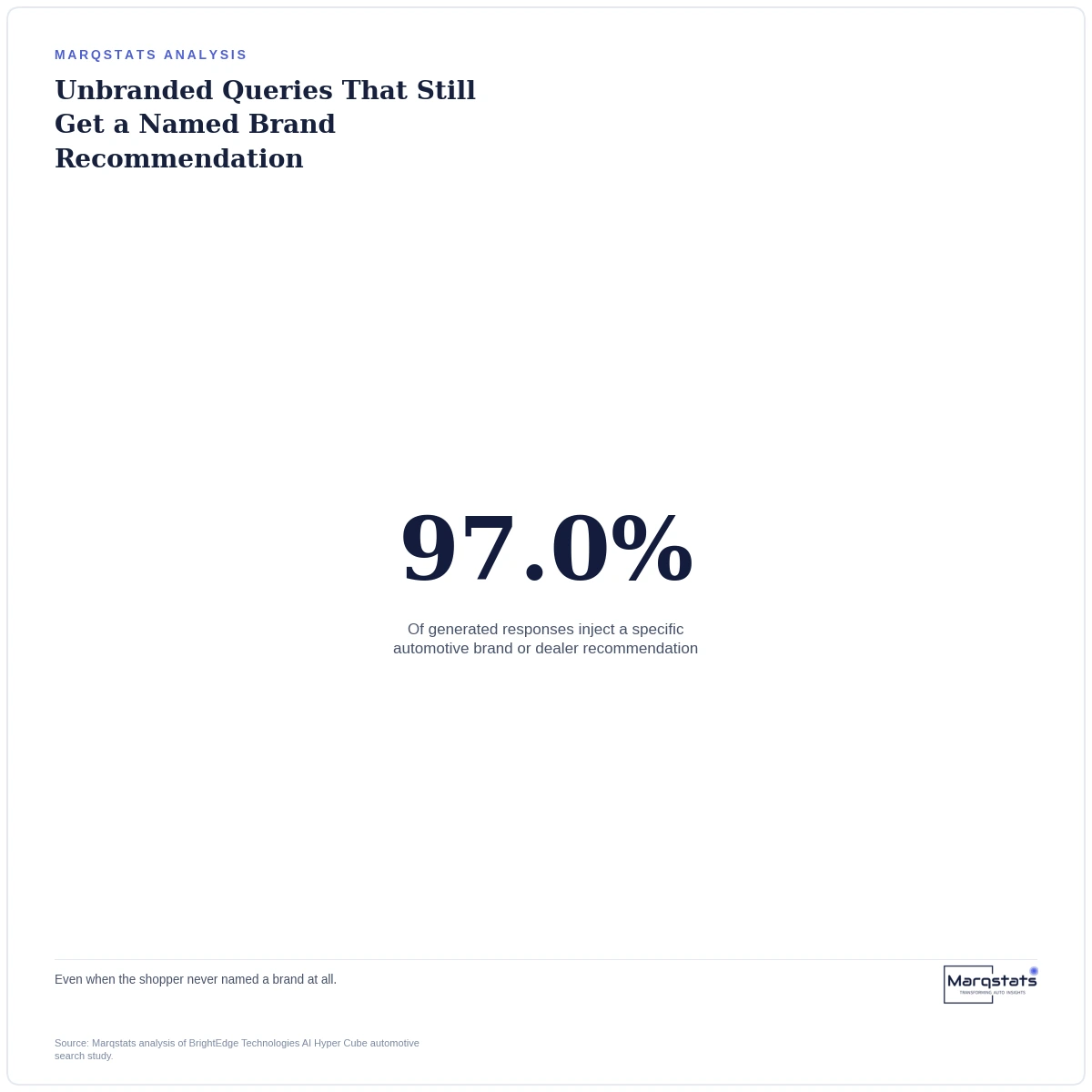
That framing assumed the answer to an unbranded question would be unbranded too: a list of vehicle categories, a general explainer, information without a specific recommendation attached. The 97.0% figure shows that assumption no longer holds. Generative systems don't answer unbranded questions with unbranded information. They answer with a specific recommendation, naming particular brands and, in many cases, specific dealerships, even when nothing in the original question suggested the consumer had already narrowed their consideration set.
The question was generic. The answer wasn't. That's the part legacy search marketing never had to account for.
— Marqstats Analyst Team
What this means for who's actually competing, and when
This reframes the competitive landscape in a genuinely consequential way. Dealerships and manufacturers are no longer simply competing to defend their own branded search traffic, protecting existing customer intent from being diverted elsewhere. They're now competing to be the specific brand or dealer a generative system chooses to recommend when a consumer hasn't expressed any preference at all. That's a fundamentally different, and considerably higher-stakes, competitive target: instead of defending an existing customer relationship, brands are now competing to be manufactured into existence as the recommended answer for a shopper who arrived with no opinion.
The same research shows branded intent does still increase predictably as consumers move closer to an actual purchase: branded prompt volume rises from 52.0% of informational queries to 64.0% of consideration-stage queries and 67.0% of transactional queries. So brand loyalty and existing customer relationships still matter, and matter increasingly, later in the purchase journey. But the earliest, highest-volume stage of research, where roughly half of all queries carry no brand signal at all, is now a genuine competitive battleground rather than passive informational territory.
Why this happens: what generative systems are actually optimizing for
The mechanism is a natural consequence of how generative answer engines are designed to function. A purely informational, brand-agnostic response, listing vehicle categories without naming specific options, is often less useful to the person asking than a concrete, actionable recommendation. Generative systems are built to synthesize a helpful, specific answer rather than an encyclopedia-style overview, and a specific answer to almost any vehicle-related question inevitably involves naming specific vehicles, and therefore specific brands and often specific local dealership inventory.
The counter-argument: does brand injection actually reflect genuine relevance, or just algorithmic pattern-matching?
A fair objection is that a generative system injecting a brand name into 97.0% of responses might not reflect a genuinely considered recommendation so much as a structural tendency of the technology to always produce a specific-sounding answer, regardless of whether a specific answer is actually the most helpful response to a genuinely open-ended question. This is a reasonable concern about interpreting the finding too literally as evidence of sophisticated recommendation logic. Whether or not the underlying mechanism reflects genuine reasoning, though, the practical commercial consequence is identical either way: a consumer asking an unbranded question receives a branded answer, and whichever brand gets named captures a meaningful advantage regardless of the underlying reason the system chose to name it.
What this means for marketing strategy and budget allocation
- Marketing teams should stop treating unbranded search content as low-priority, top-of-funnel material, given that 97.0% of generative responses to unbranded queries still name specific brands and dealers.
- Content and structured data investment should prioritize the broad, category-level questions consumers ask before narrowing their consideration set, since this is where the competitive stakes for unbranded recommendation are highest.
- Budget allocation should account for branded intent's predictable rise through the purchase funnel, from 52% at the informational stage to 67% at the transactional stage, ensuring both unbranded and branded generative visibility receive appropriate investment at each stage.
Who actually gets picked when the system has to choose
If a generative system is going to name a specific brand or dealer regardless of what the consumer asked, the obvious next question is what determines which specific entity gets chosen. This is where the broader mechanics of generative visibility become directly relevant: systems evaluating an unbranded query draw on machine-readable data completeness, multi-platform corroboration and semantic extractability across a dealership's or manufacturer's digital presence to decide who to recommend. A dealership with clean, structured, accurate inventory and pricing data, consistent across its own website and external directories, is structurally more likely to be the entity that gets named than a comparable dealership with fragmented or inconsistent digital data, even if the two dealerships are otherwise equivalent in inventory, price and service quality.
This means the 97.0% injection rate isn't simply a fixed cost every automotive brand pays equally. It's an opportunity that specific, technically well-prepared entities capture disproportionately, while less prepared competitors lose out on unbranded recommendation opportunities entirely, even for shoppers who had no prior brand preference and would have been equally open to any well-matched option.
Why this creates urgency for smaller, less brand-recognized dealers specifically
This dynamic carries a particular implication for independent and smaller dealerships that lack the manufacturer-level brand recognition major nameplates carry into a shopper's mind. Historically, these dealerships depended heavily on defending branded search traffic they'd already earned through reputation, location and existing customer relationships. The unbranded injection finding suggests a genuine new opportunity: since 48.0% of automotive queries carry no brand signal at all, and generative systems fill that gap with a specific recommendation regardless, a smaller dealership with strong technical data readiness has a real chance to be recommended to a shopper who never would have found them through a branded search in the first place. The competitive advantage here runs on data infrastructure quality rather than accumulated brand reputation, a meaningfully different and more accessible competitive axis for smaller operators.
The full market picture
Marqstats' complete United States automotive Generative Engine Optimization market analysis, including the full purchase funnel dynamics, is available in the linked report below.
Related reportUnited States Automotive Generative Engine Optimization Market Size, Share & Forecast 2026 – 2030