The wrong bottle of oil can destroy an engine's timing belt. UK regulators just proved several products were getting it wrong.
Some modern engines run their timing belt directly inside the engine oil, a design called belt-in-oil, or wet-belt. It's a genuinely clever piece of engineering that reduces friction and emissions. It also means the oil isn't just lubricating the engine anymore, it's the environment the timing belt itself has to survive in. Get the formulation wrong, and the consequences are severe.
What actually goes wrong
Wet-belt engines, including PSA/Stellantis 1.2-litre PureTech (EB2) three-cylinder petrol engines and 1.5-litre BlueHDi (DV5R) and 2.0-litre diesel powerplants, feature a timing belt submerged directly in engine oil. Conventional engine oils or non-compliant aftermarket formulations accelerate chemical degradation, tooth stripping and elastomeric dissolution of the belt material. The resulting debris clogs the oil pump strainer, causing oil starvation, vacuum pump failure, loss of braking assistance, and eventually engine seizure. It's a genuinely serious failure chain, not a minor performance issue.
The oil isn't just lubricating the engine anymore. It's the belt's entire operating environment.
— Marqstats Analyst Team
How Stellantis is tightening the rules
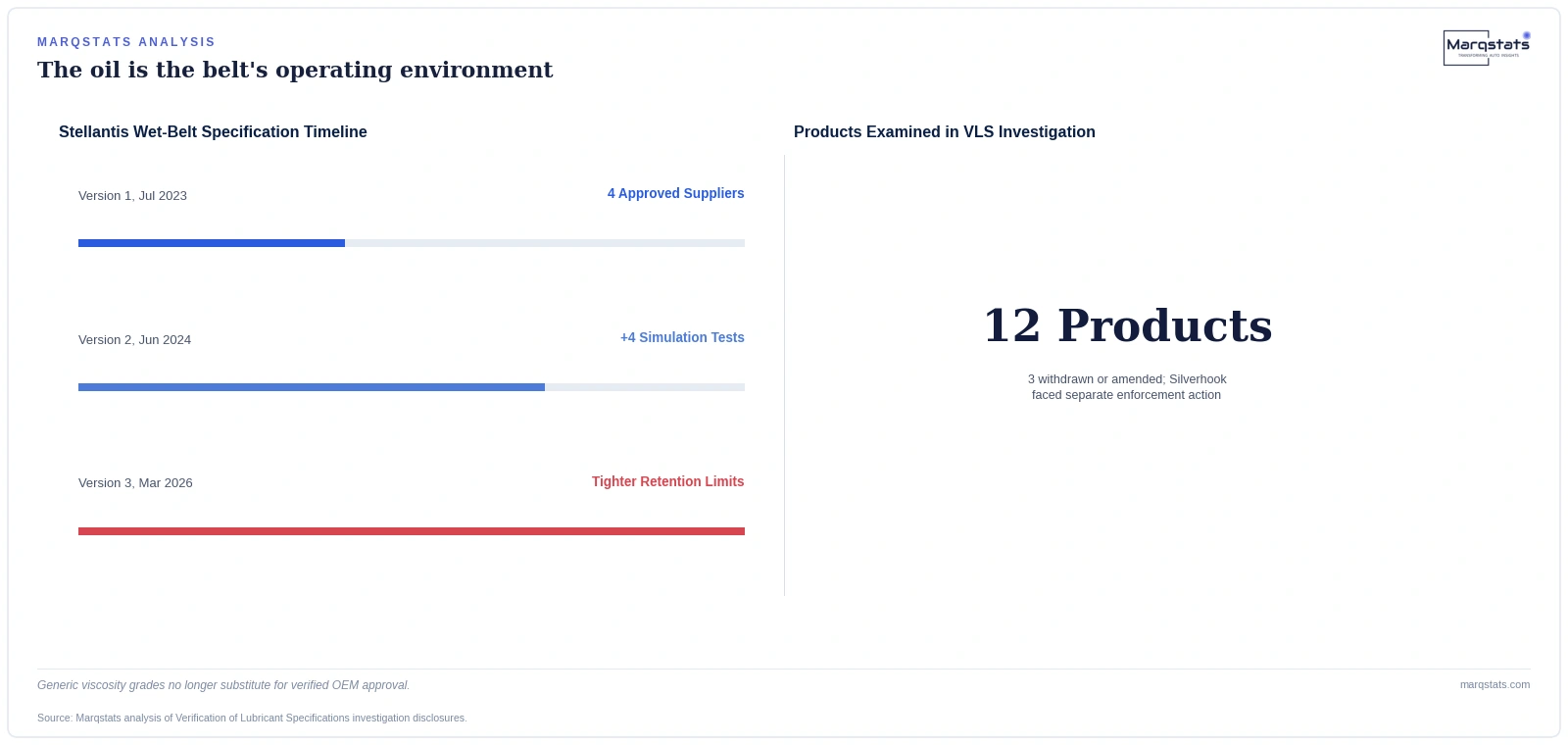
Stellantis has progressively tightened its approval framework across three releases. Version 1, from July 2023, restricted initial technical approvals to proprietary formulations from just four manufacturers: TotalEnergies, BP/Castrol, ExxonMobil, and Stellantis' own OEM genuine oils. Version 2, from June 2024, introduced four additional engine simulation tests evaluating oil oxidation, chain wear and elastomer degradation under high thermal stress, and Stellantis set a hard deadline: all marketing claims under Version 1 expire by June 2026, forcing reformulation to meet the stricter Version 2 standard. Version 3, from March 2026, tightened oxidation stability and elastomer retention parameters even further.
What the industry investigation actually found
The Verification of Lubricant Specifications, an independent body established under the United Kingdom Lubricants Association, conducted an extensive investigation examining twelve commercial engine oils claiming compliance with the Stellantis wet-belt specification. The results were genuinely consequential: Smith & Allan withdrew its Momentum C3 SWTL 5W-30 from sale entirely. SCT-Vertriebs withdrew its MANNOL Energy Formula PSA 5W-30 claim. Ravenol removed marketing claims for its SMP SAE 5W-30. Several other blenders, including Aztec Oils, the Independent Motor Trade Factors Association, Rapid Group and Granville Oil & Chemical, amended technical documentation to clarify Version 1 alignment pending Version 2 approvals.
A separate but related enforcement action targeted Silverhook specifically, whose Ultra-V 0W-30 and 0W-20 formulations failed SAE J300 and ACEA C5/C6 low-temperature pumping viscosity and yield stress limits at minus 40 degrees Celsius, a distinct technical failure from the wet-belt-specific investigation but part of the same broader pattern of formulations not meeting their marketed claims.
Why this matters for anyone running a workshop
The practical stakes here fall directly on independent garages and technicians. When a workshop mistakenly uses a generic 5W-30 ACEA C3 oil lacking specific elastomer-protection approval on a wet-belt-equipped vehicle, and the belt subsequently fails, the resulting repair bill often exceeds £2,500. That's a genuine liability exposure for any workshop that used a non-compliant product, not merely a customer service problem. The VLS investigation results function as a documented warning: generic 'suitable for use' claims on product labels aren't a reliable substitute for verified, specific OEM technical approval.
The counter-argument: does this level of technical specificity risk making routine oil changes unnecessarily complicated and expensive?
A fair concern is whether this degree of specification precision, requiring workshops to verify exact OEM approval status for a specific engine family before performing what used to be a routine oil change, adds genuine cost and complexity disproportionate to the actual risk, particularly for the majority of vehicles that aren't wet-belt equipped. This is a reasonable practical concern for workshops managing diverse vehicle fleets. What justifies the added diligence specifically for this engine category, though, is the severity and cost asymmetry involved: the incremental cost of stocking a certified, wet-belt-compliant product is genuinely small relative to a potential £2,500-plus repair bill and the liability exposure a workshop faces if it used a non-compliant product on a vehicle that subsequently fails, making the additional verification step a rational precaution specifically for this roughly 2.2 million-vehicle segment rather than a burden that needs to apply uniformly across every service transaction.
What this means for workshops and formulators
- Independent workshops servicing PSA/Stellantis wet-belt engines should verify specific, current OEM approval status for any product used, rather than relying on generic 'suitable for use' label claims.
- Lubricant formulators still marketing Version 1-approved products should complete Version 2 testing and certification well ahead of the June 2026 claim expiry deadline to retain market access.
- Motor factors distributing engine oils should proactively flag wet-belt compliance status to workshop customers, given the documented liability exposure the VLS investigation has now made explicit.
Why belt-in-oil design exists in the first place
It's worth understanding why manufacturers adopted this design at all, given the added formulation complexity it clearly creates. Submerging the timing belt in oil, rather than running it dry outside the engine as traditional timing belts do, reduces friction losses and allows for a more compact engine package, both of which contribute to fuel economy and emissions gains that matter considerably for manufacturers navigating tightening CO2 targets. The three-cylinder PureTech EB2 engine specifically has been a commercially significant powertrain for Stellantis across millions of vehicles precisely because of the efficiency gains this compact, wet-belt architecture enables.
The trade-off is that the engineering benefit only holds if the oil bathing the belt is formulated correctly. A conventional oil that's perfectly adequate for a traditional dry-belt or chain-driven engine can actively degrade a wet-belt system over time, which is precisely why Stellantis moved to such a tightly controlled approval list rather than allowing any ACEA-compliant oil to qualify.

What specifically failed in the products that were withdrawn
It's useful to be concrete about what technical failure actually looked like in the cases the VLS investigation flagged. The Silverhook enforcement cases centered on a different but related technical failure: the Ultra-V 0W-30 and 0W-20 formulations failed to meet SAE J300 and ACEA C5/C6 low-temperature pumping viscosity and yield stress limits specifically at minus 40 degrees Celsius, meaning the oil could become too thick or fail to flow properly under extreme cold conditions, a genuine safety-relevant failure mode for any vehicle operating in harsh winter climates, independent of the wet-belt compatibility question entirely.
The broader pattern across both sets of cases, the wet-belt-specific withdrawals and the Silverhook cold-temperature failures, points to the same underlying issue: products marketed with specific technical claims that didn't hold up under rigorous, standardized testing. That's precisely the gap the VLS investigation was designed to close, verifying that marketing claims actually match tested performance rather than simply trusting manufacturer self-certification.
The full market picture
Marqstats' complete UK automotive lubricants aftermarket analysis, including the full technical compliance and regulatory landscape, is available in the linked report below.
Related reportUnited Kingdom Automotive Lubricants Aftermarket Size, Share & Forecast 2026 – 2030