Thailand's 7.1 Million Pickup Trucks Are Waiting on a Single Regulatory Decision
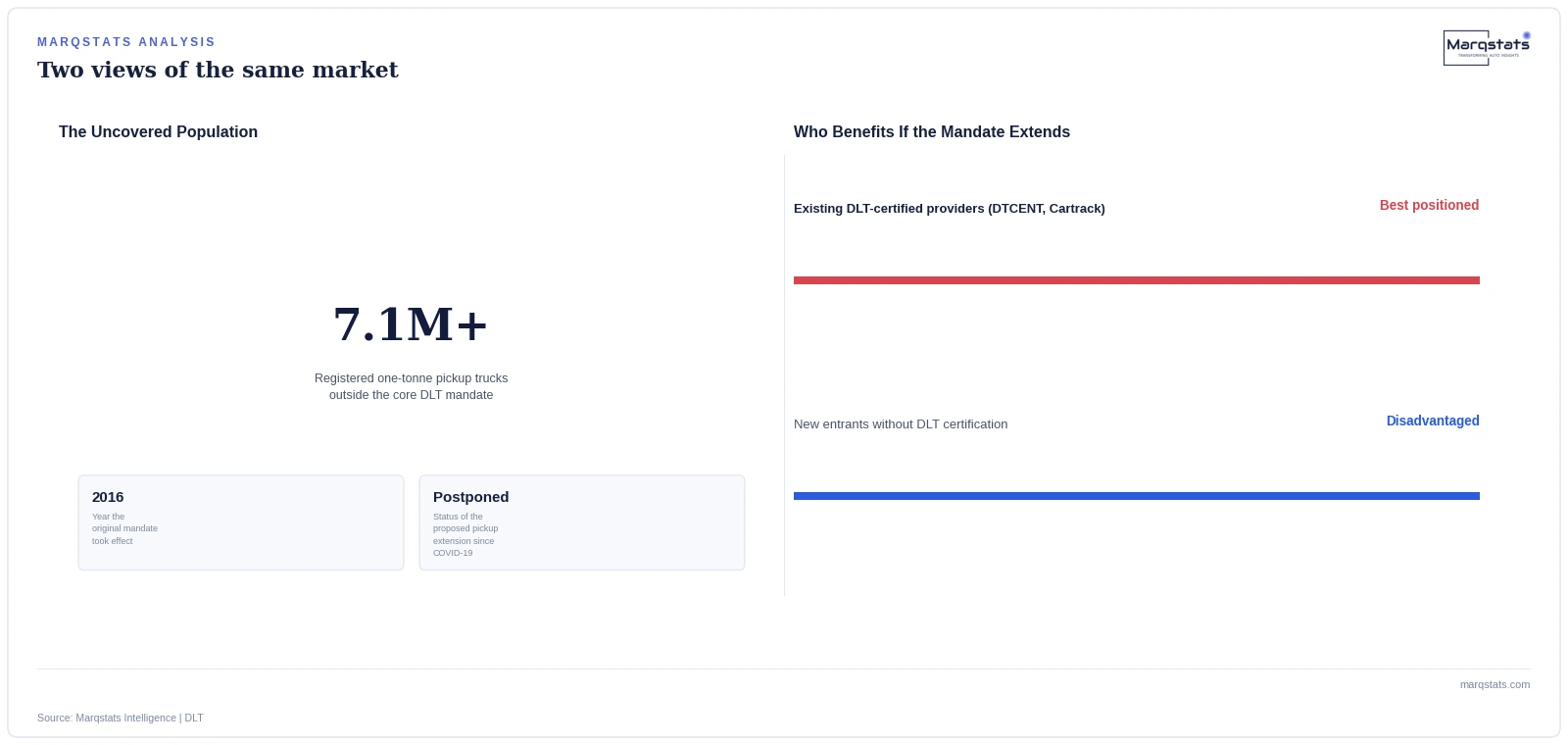
In brief: Thailand's Department of Land Transport requires GPS tracking and driver-card readers on buses, prime movers, hazardous-material haulers and trucks with ten or more wheels. It does not require this on Thailand's single largest vehicle category by historical sales volume: the one-tonne pickup truck. More than 7.1 million of these vehicles operate entirely outside the mandate that has made commercial telematics a genuine growth engine everywhere else in this market.
Why This Gap Is Bigger Than It Looks
7.1 million vehicles is not a rounding error in Thailand's automotive landscape — it is a population larger than the entire registered vehicle parc of most individual Thai provinces combined, and it represents the single largest block of commercially active vehicles in the country operating with essentially no regulatory telematics requirement whatsoever. For comparison, the DLT's entire mandated commercial fleet, spanning every bus, prime mover, hazardous-material hauler and heavy truck combined, totals just over 539,000 active connected vehicles — meaning the unmandated pickup population outnumbers the fully mandated commercial fleet by more than thirteen to one.
Why Pickups Were Left Out in the First Place
The DLT's original 2016 mandate targeted the vehicle categories with the clearest direct public-safety case: buses carrying passengers, prime movers and hazardous-material haulers whose accidents carry the highest severity, and heavy ten-wheel-plus freight trucks operating on national highways for extended hours. One-tonne pickups, despite their commercial ubiquity in Thai logistics and small business, sat below this initial severity threshold and were left for a later phase of regulatory extension.
The Extension That Never Came
The proposed extension itself was not a minor technical adjustment — it would have brought Thailand's core commercial telematics mandate in line with the practical reality that pickups carry a substantial share of the country's actual freight and small-business logistics volume, just distributed across millions of smaller vehicles rather than concentrated in large trucking fleets. A regulator weighing enforcement priorities during a global pandemic understandably deprioritized a complex new compliance burden on millions of small operators, even if the underlying safety and traceability rationale for the extension never actually went away.
That later phase was proposed. Extending the GPS and driver-card mandate to six-wheel trucks and light commercial pickups was under active regulatory discussion before the COVID-19 pandemic disrupted the process. Years later, that extension has still not been formally reinstated or enacted, leaving one of Thailand's largest commercial and personal-use vehicle categories on a purely voluntary adoption basis.
Every other commercial vehicle category in Thailand is connected because the law requires it. Pickups are connected because a buyer chose to be.
— Marqstats Analyst Team
A Named Comparison: How Heavy Trucks Prove the Mandate Works
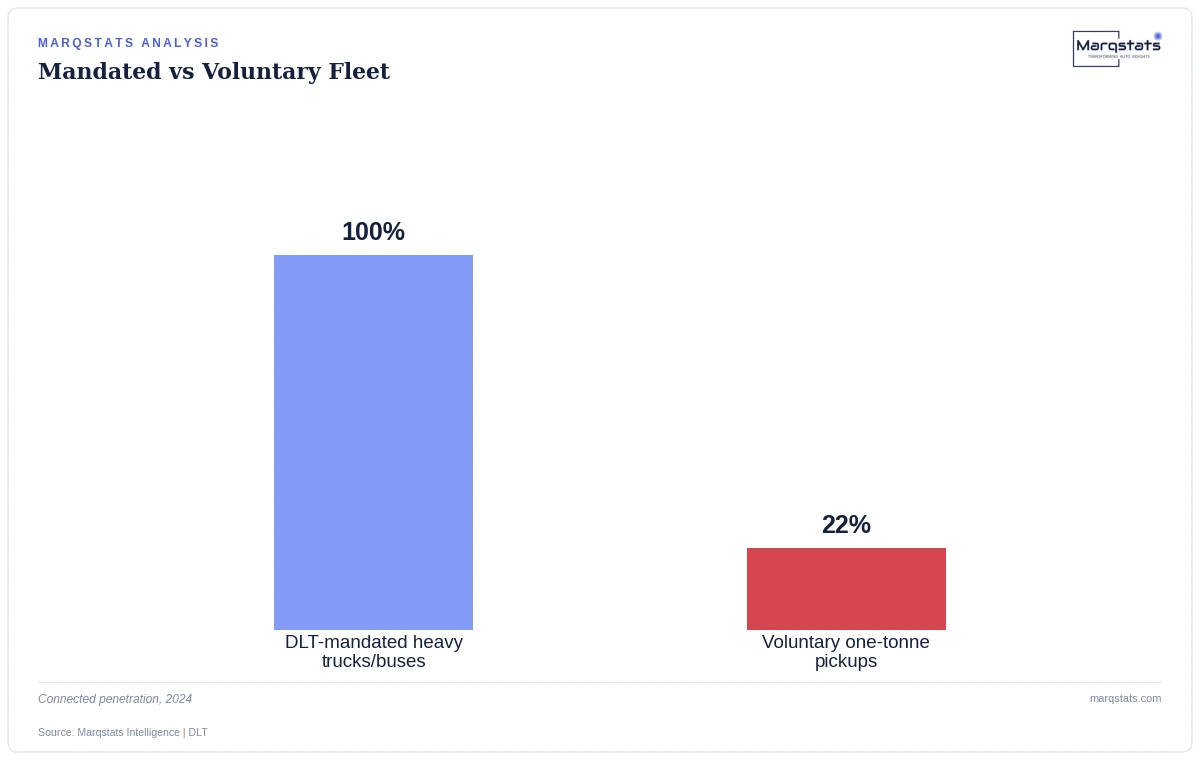
The clearest evidence that regulation, not consumer demand, drives Thai commercial telematics adoption sits right next to the pickup gap: heavy trucks and buses, mandated since 2016, run at effectively 100% connected penetration. Nobody had to convince a ten-wheel truck operator that GPS tracking was worth paying for — the DLT simply made it a precondition of annual vehicle inspection and registration renewal, and adoption followed immediately and completely. Pickup owners face no equivalent precondition, and adoption has stalled at roughly a fifth of new sales as a direct result.
What Voluntary Adoption Actually Looks Like in Practice
Without a compliance mandate forcing the issue, pickup connectivity runs almost entirely through OEM trim-level marketing rather than fleet-operator necessity. Connected features on pickups are "largely restricted to high-tier personal lifestyle trims," per the underlying research — meaning a base-model commercial pickup used for actual small-business logistics, the vehicle a mandate extension would target most directly, is precisely the configuration least likely to carry any embedded telematics at all today.
What the Voluntary Segment's Own Data Already Shows
Even within voluntary adoption, the pattern is informative. Connected features concentrate specifically in high-tier personal lifestyle pickup trims — vehicles bought partly as personal status vehicles, not pure work trucks — while base commercial trims, the vehicles actually doing daily small-business logistics work, show the lowest adoption of all. That's effectively the opposite of what a safety- or compliance-driven adoption pattern would look like, and it confirms current pickup connectivity is running almost entirely on discretionary consumer preference rather than any operational necessity a fleet-mandate extension would actually be targeting.
What Actually Happens If the Mandate Extends
The underlying research's own Accelerated Expansion scenario treats DLT mandate extension to pickups as one of its two named structural triggers, alongside 5G V2X commercialization. The mechanism is straightforward and largely outside any single company's control: a formal regulatory extension would convert a meaningful share of a 7.1 million-vehicle population from voluntary to mandatory adoption within a defined compliance window, a structural step-change fundamentally different in kind from anything achievable through OEM marketing, price discounting, or improved consumer subscription retention.
Who Is Actually Positioned to Benefit
It's worth being specific about the timeline mismatch this creates for anyone planning around it. Regulatory processes in Thailand, as in most markets, move on a timeline measured in years once formally initiated, while a telematics vendor's own sales and hardware-manufacturing capacity planning typically operates on a much shorter cycle. A provider that waits for a formal mandate announcement before beginning to build DLT certification and manufacturing capacity risks missing the first wave of compliance-driven demand entirely, since certification itself is not instantaneous — the providers most likely to capture early mandate-driven volume are those already investing in certification readiness well before any announcement actually lands.
Commercial telematics providers already certified for DLT compliance on other vehicle categories — D.T.C. Enterprise, Cartrack Thailand, and the smaller specialist providers serving heavy trucks and buses today — are the parties best positioned to capture pickup-mandate volume quickly, since their hardware, software platforms and DLT certification processes would require adaptation rather than being built from scratch. A new entrant without existing DLT certification experience would face a genuine time disadvantage in any sudden mandate-driven demand surge.
What This Means for Fleet Insurers Specifically
Commercial motor insurers underwriting pickup fleets face a genuinely asymmetric risk picture today: a policyholder's heavy trucks are fully monitored by regulatory requirement, while their pickup fleet, often a larger share of total vehicles by count, carries essentially no telematics visibility at all unless the operator voluntarily opted in. An insurer that builds its own pricing incentives around voluntary pickup telematics adoption — premium discounts for fitted vehicles, for instance — could plausibly close part of this gap faster than waiting on DLT regulatory action, effectively replicating the mandate's enforcement logic through commercial incentive instead of statute.
What Regulators Elsewhere in the Region Might Learn From This
Thailand's own experience — a clean, binary before/after comparison between mandated heavy trucks at 100% adoption and voluntary pickups at 22% — is about as clear a natural experiment in regulatory-mandate effectiveness as this coverage set has documented anywhere. Any Southeast Asian regulator weighing whether to extend a similar commercial telematics requirement to a currently voluntary vehicle category has, in Thailand's own heavy-truck data, a fairly direct answer to what adoption would look like once the mandate actually takes effect: near-total and essentially immediate, exactly as it was for Thai buses and prime movers in 2016, a template any neighboring regulator could reasonably expect to replicate given broadly comparable enforcement mechanisms.
None of this is to say a mandate extension is imminent or guaranteed — only that the underlying case for it, on Thailand's own evidence, is stronger than the years of regulatory silence on the question might otherwise suggest to an outside observer unfamiliar with the specific COVID-era postponement history that originally shelved the proposal indefinitely.
Outlook: One Trigger, Not Three
This market does not support a three-scenario outlook on the pickup-mandate question specifically. The single evidenced trigger is formal DLT regulatory action extending the existing GPS and driver-card requirement to six-wheel trucks and one-tonne pickups — without it, expect voluntary adoption to continue its slow, trim-level-marketing-driven trajectory rather than any structural acceleration.