A fleet of 1,000 cars driving nonstop for 150 years. That's what properly testing one autonomous vehicle actually requires.
In brief:
- Validating a Level 2+ or Level 3 autonomous system across required real-world driving distributions demands over 10 billion road kilometers.
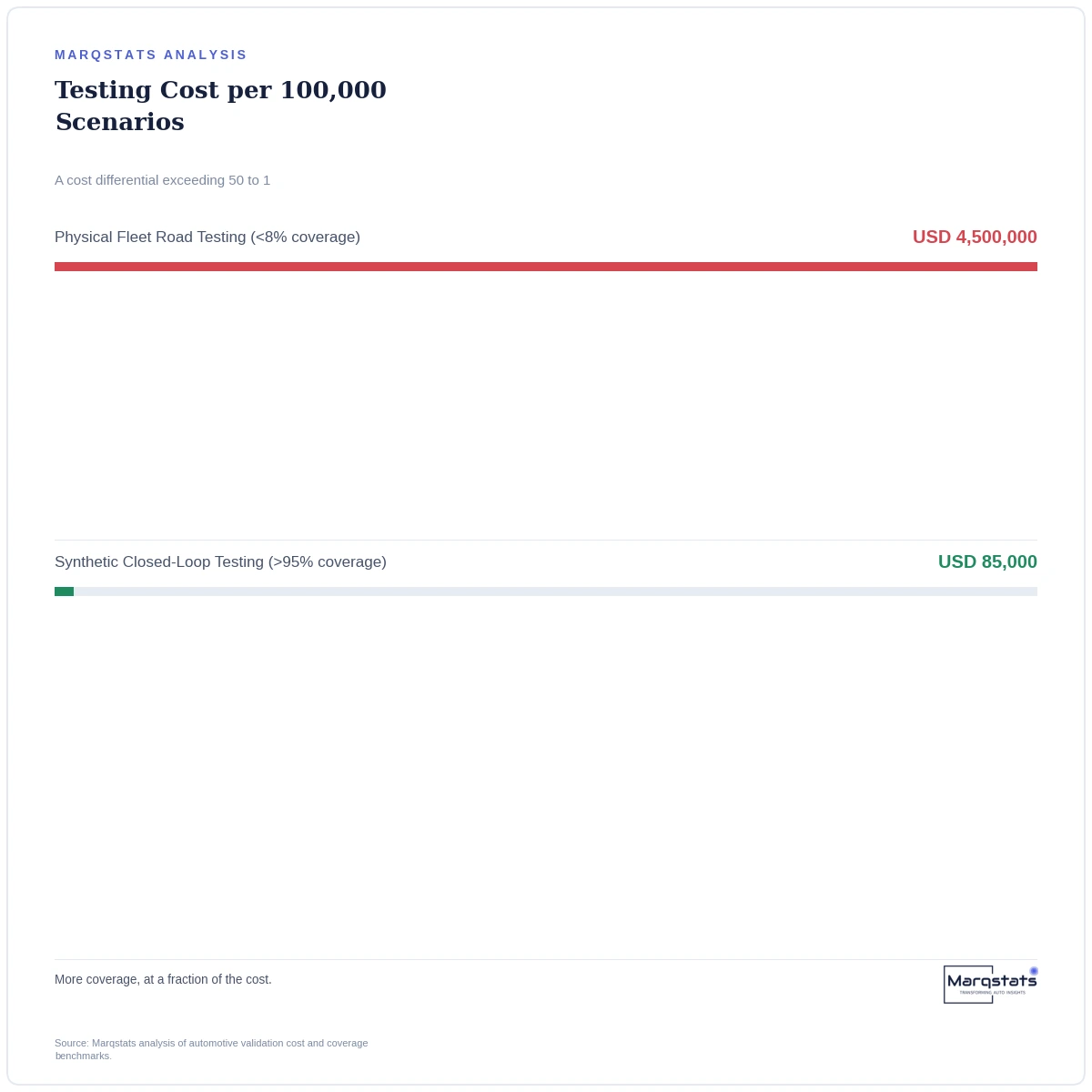
- Synthetic closed-loop digital twin testing achieves over 95% scenario coverage at USD 85,000 per 100,000 scenarios.
- Physical fleet road testing achieves under 8% coverage at USD 4,500,000 per 100,000 scenarios - a cost differential exceeding 50 to 1.
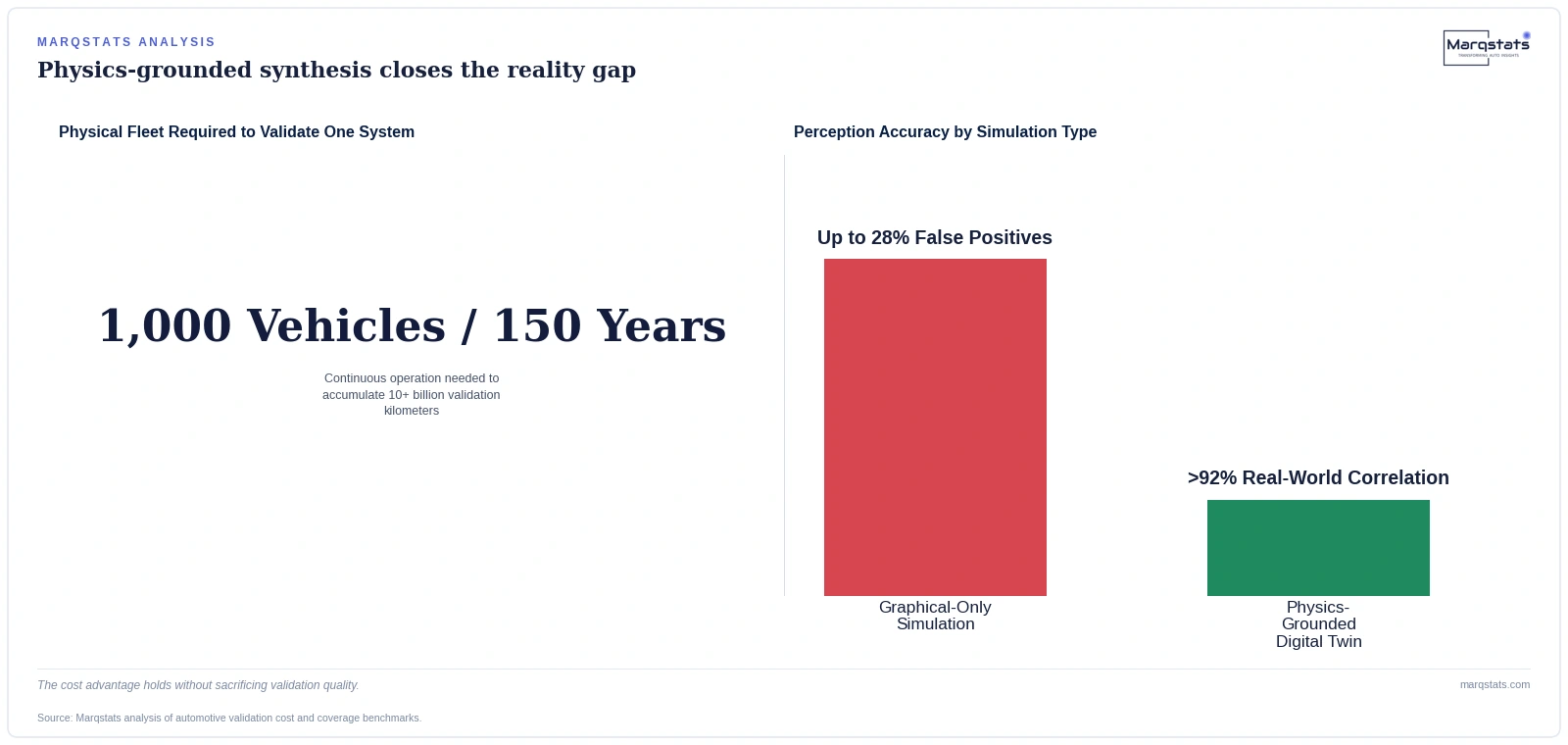
Run the numbers on what it would actually take to validate a Level 2+ or Level 3 autonomous driving system purely through physical road testing, and the scale becomes absurd almost immediately. Regulators and safety researchers estimate that adequately covering the real-world driving distribution these systems will encounter requires more than 10 billion kilometers of accumulated driving data. A fleet of 1,000 test vehicles, driving continuously, twenty-four hours a day, without a single day of maintenance downtime, would need to operate for more than 150 years to accumulate that distance. This isn't a rounding error in a spreadsheet - it's a fundamental physical impossibility for any realistic test program.
Why physical testing alone was never going to work
This isn't a hypothetical inefficiency - it's the actual reason the industry pivoted toward synthetic validation in the first place. Physical proving grounds, no matter how well-designed, can evaluate fewer than 15% of the complex edge cases regulators require, without risking damage to expensive test hardware or, more importantly, without exposing rare and dangerous scenarios to physical vehicles operating on real roads with real consequences. A pedestrian stepping unexpectedly from behind a parked truck in heavy rain isn't a scenario you can safely or repeatedly stage on a physical test track.
The economics tell the same story from a different angle. Comparing testing methodologies directly: physical fleet road testing achieves under 8% operational scenario space coverage at a cost of USD 4,500,000 per 100,000 scenarios, once fleet fuel, drivers and telemetry maintenance are included. Synthetic closed-loop digital twin testing achieves over 95% coverage, driven by adversarial parametric variation, at a cost of just USD 85,000 per 100,000 scenarios, using purely cloud-native compute clusters with zero hardware capital exposure.
More coverage, at roughly one-fiftieth the cost. That's not a marginal efficiency gain, it's a different order of magnitude entirely.
— Marqstats Analyst Team
Why regulators built this requirement into law, not just best practice
China's Ministry of Industry and Information Technology has formalized this reality into statutory requirement: conditional Level 3 vehicle access permits require comprehensive scenario-based verification, and manufacturers pursuing certification must generate over 10 million procedural synthetic scenario variations per platform submission. This isn't a regulator simply tolerating simulation as a supplementary tool - it's a regulator recognizing that physical testing alone cannot, even in principle, achieve the coverage a rigorous safety case requires.
Japan's Ministry of Land, Infrastructure, Transport and Tourism and India's Automotive Research Association of India have followed comparable paths, integrating scenario-based virtual testing directly into national type-approval workflows rather than treating it as an optional supplement to physical trials.
What China's own Level 3 permits actually reveal about the balance
It's worth being precise here: even China's fastest-moving regulatory approvals didn't abandon physical testing entirely in favor of pure simulation. When the Ministry of Industry and Information Technology granted the country's first Level 3 conditional autonomous driving commercial access permits to Changan Automobile and BAIC's Arcfox unit on 15 December 2025, that approval followed more than 5 million kilometers of real-world testing across 185 driving scenario categories - a substantial physical validation effort, even if a small fraction of the 10 billion kilometer theoretical requirement. Synthetic testing didn't replace physical testing outright; it made the physical testing that did happen sufficient to close the remaining gap, rather than requiring an impossible physical-only validation program.
The counter-argument: could regulators simply be wrong to require this much coverage?
A fair objection is that the 10-billion-kilometer benchmark itself, and the resulting emphasis on synthetic coverage, might reflect an overly conservative regulatory standard rather than a genuinely necessary safety threshold - perhaps a lower coverage bar would still produce acceptably safe systems, making the case for synthetic testing's necessity somewhat overstated. This is a reasonable question to raise, and reasonable people can disagree about where exactly the safety-coverage line should sit. What's harder to dispute is the relative economics once any meaningful coverage target is set: whatever the right coverage threshold turns out to be, achieving it through physical-only testing would cost dramatically more than achieving the same threshold through synthetic methods, given the roughly 50-to-1 cost gap demonstrated at current coverage levels. The debate over how much coverage is enough doesn't change which methodology is cheaper for delivering any given amount of it.
What this means for automakers and regulators
- Automakers pursuing Level 3 or higher automation should treat synthetic scenario coverage capability as a core regulatory compliance requirement, not a discretionary engineering investment.
- Regulators in jurisdictions without formal virtual homologation standards should evaluate China's MIIT framework as a template, given the demonstrated impossibility of adequate physical-only coverage.
- Investors evaluating autonomous driving programs should treat a company's synthetic testing infrastructure maturity as a leading indicator of realistic regulatory timeline feasibility.
Why the reality gap keeps synthetic testing honest
None of this means synthetic testing is a free lunch technically. Neural networks trained purely on synthetic sensor data often suffer measurable performance degradation when deployed to physical vehicles operating on real roads, a phenomenon the industry calls the algorithmic reality gap. Physical approximations in rendering pipelines, simplified surface reflection properties, atmospheric light scatter, and sensor noise characteristics, mean that purely graphical, gaming-engine-style simulation can generate false-positive rates of up to 28% in perception algorithm training when compared against physical test track validation.
This is precisely why the more sophisticated digital twin platforms distinguish themselves from commodity rendering engines by applying hardware-calibrated material properties, physically based ray tracing, and statistical sensor noise injection. Co-registering real vehicle test logs with these physics-grounded synthetic twins achieves correlation metrics exceeding 92% across camera pixel exposures, LiDAR return intensities, and radar point-cloud distributions - a meaningfully different result than the false-positive-prone output of simpler graphical tools, and the reason the 50-to-1 cost advantage doesn't come at the expense of genuine validation quality when implemented correctly.
Why the marketing numbers around this technology deserve skepticism
It's worth pairing this genuinely dramatic cost advantage with a note of caution about how the broader industry sometimes oversells digital twin synthesis specifically. Widespread claims that digital twin adoption eliminates 90% of physical prototype requirements trace back to early academic hardware-in-the-loop experiments conducted in 2018 - a figure that has circulated widely in marketing materials since, despite the empirical baseline savings actually observed across contemporary multi-physics vehicle programs sitting meaningfully lower, in the 35% to 50% range. The underlying testing-cost economics documented here are genuinely strong on their own merits; they don't require inflated secondary claims about prototype elimination to make a compelling case for adoption.
The full market picture
Marqstats' complete Asia Pacific automotive digital twin synthesis software market analysis, including the full regulatory landscape and a three-scenario forecast through 2030, is available in the linked report below.
Related reportAsia Pacific Automotive Digital Twin Synthesis Software Market Size, Share & Forecast 2025 – 2030