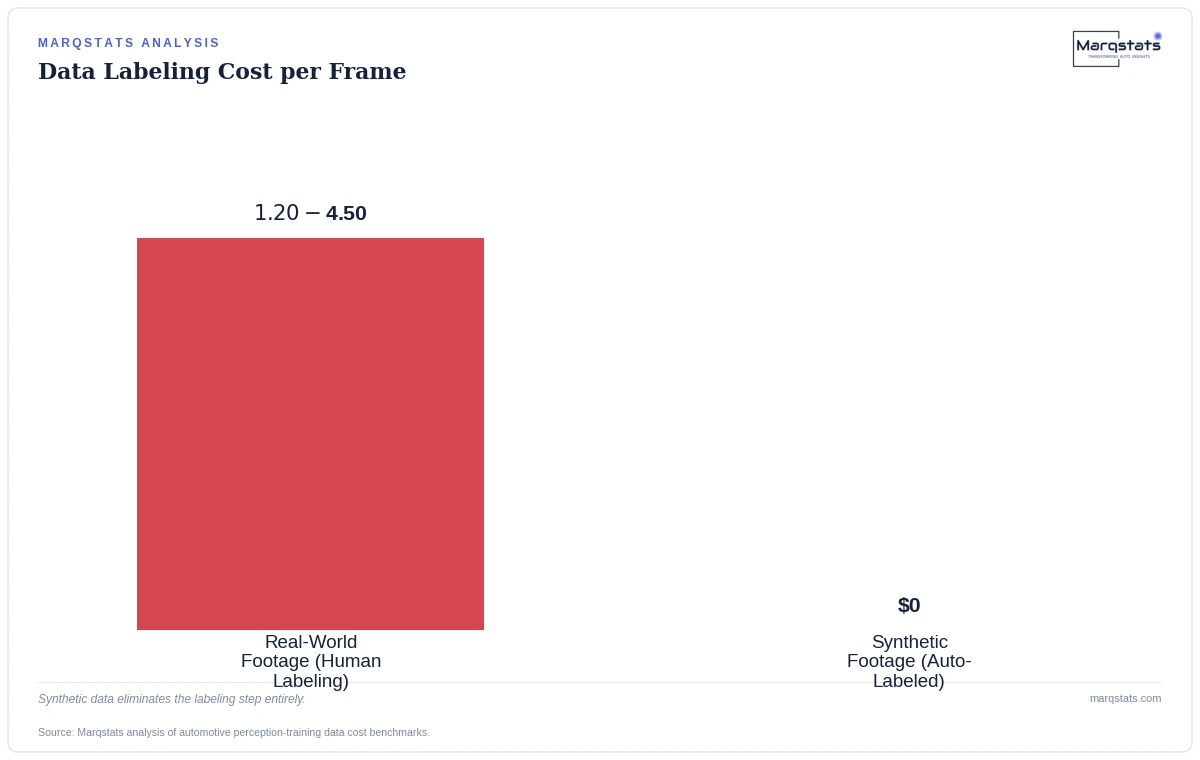
Labeling a single frame of driving footage can cost up to $4.50. Synthetic footage comes labeled for free.
Training a self-driving car's perception system requires more than just video and sensor data - it requires that data to be labeled. Someone, or something, has to identify exactly where every car, pedestrian, cyclist and traffic sign appears in every single frame, precisely enough that a machine learning model can learn to recognize them too. For real-world footage, that labeling work is expensive, slow, and entirely separate from the cost of collecting the footage in the first place.
What labeling actually involves
Manually annotating real camera and lidar data means a human worker, or a human reviewing an AI-assisted first pass, drawing precise three-dimensional bounding boxes around every relevant object in a frame, generating panoptic segmentation masks that classify every pixel by category, and calculating optical flow vectors describing how objects move between consecutive frames. This is detailed, exacting work - a mislabeled pedestrian or an imprecise bounding box can teach a perception model the wrong lesson, with real safety consequences down the line.
That precision is exactly why it's expensive: USD 1.20 to USD 4.50 per frame, and a modern vehicle's camera and sensor suite can generate many frames per second of driving. Multiply that across the volume of data a serious perception-training program requires, and labeling costs become a major line item entirely separate from the cost of physically collecting the footage.
You don't just pay to collect the footage. You pay again, frame by frame, to tell the computer what's actually in it.
— Marqstats Analyst Team
Why synthetic data skips this step entirely
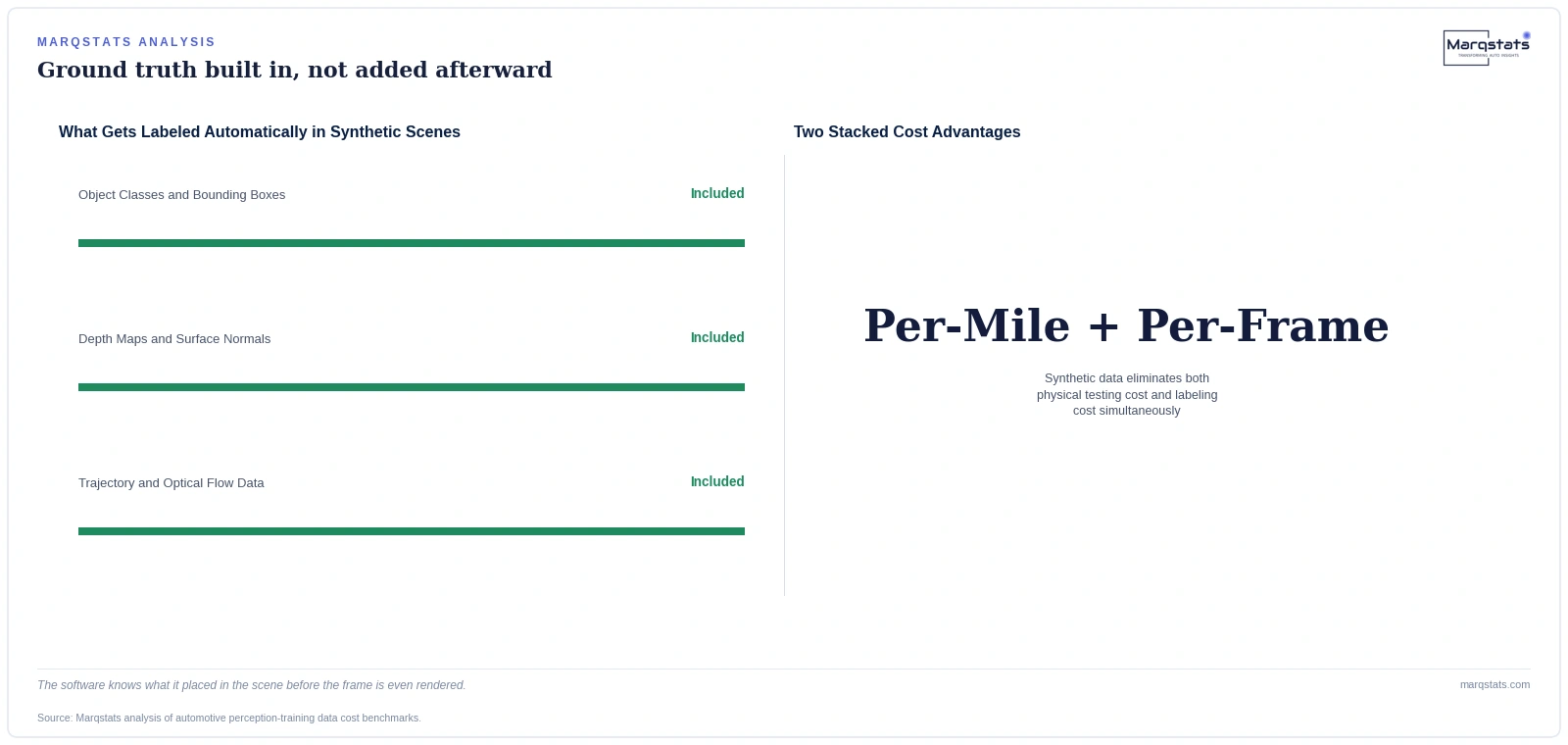
A digital twin synthesis platform doesn't record the world and then figure out what's in it after the fact - it builds the scene from a known, programmed specification in the first place. When a synthetic scenario engine places a pedestrian, a parked car, or a road sign into a virtual scene, the software already knows exactly where that object is, what category it belongs to, and how it will move, because the software placed it there.
This means every synthetic frame arrives already labeled, with perfect ground truth: exact object classes, precise depth maps, surface normals and trajectory data, all generated automatically as a byproduct of creating the scene, at zero additional marginal cost per frame. There's no separate labeling step to pay for, because the labeling information existed before the frame was ever rendered.
Why this compounds with the cost-per-mile advantage, rather than duplicating it
It's worth being clear that this labeling cost elimination is a genuinely separate savings from the per-mile testing cost advantage synthetic simulation also offers. One advantage comes from not needing physical vehicles, safety drivers, fuel and depot logistics to generate the driving scenario in the first place. The other comes from not needing human labelers to make the resulting data usable for training. A real-world mile of driving carries both costs; a synthetic mile of driving carries neither. For the perception-training application specifically, currently the largest single functional segment in the broader digital twin synthesis software market, this stacked advantage is a major part of why simulation-based approaches have scaled so quickly relative to physical data collection.
The counter-argument: does perfect synthetic labeling actually match real-world complexity?
A fair objection is that perfect, zero-cost synthetic labeling might be too good to be genuinely useful - real-world sensor data contains messiness, ambiguity, and edge cases in how objects appear that a synthetic scene, built from clean programmatic specifications, might not fully capture, potentially producing training data that teaches a model to recognize an idealized version of the world rather than the genuinely confusing one it will actually encounter. This is a legitimate and widely acknowledged concern in the field, generally described as the sim-to-real domain transfer gap. Advanced synthesis platforms address it by deliberately injecting realistic sensor noise, optical distortion, and atmospheric effects into otherwise perfectly labeled scenes, aiming to combine synthetic labeling's cost advantage with physically realistic imperfection. How completely this actually closes the gap remains an open, largely unaudited question, since no standardized public metrics currently quantify sim-to-real transfer accuracy across the industry.
What this means for anyone building or evaluating perception training pipelines
- Teams budgeting for perception model training should account for labeling cost as a distinct, often underestimated line item when comparing real-world data collection against synthetic alternatives.
- Evaluate any synthetic data vendor's approach to injecting realistic sensor imperfection specifically, since perfectly clean synthetic labels alone do not guarantee real-world transfer performance.
- Track the development of standardized sim-to-real transfer accuracy metrics, since their current absence remains one of the most significant unaudited claims underlying the broader shift toward synthetic training data.
The full market picture
Marqstats' complete United States automotive digital twin synthesis software market analysis, including the full ADAS and autonomous vehicle sensor synthesis segment breakdown, is available in the linked report below.
Related reportUnited States Automotive Digital Twin Synthesis Software Market Size, Share & Forecast 2025 – 2030