A Powertrain Choice That Should Split the Difference, but Doesn't
That assumption feels reasonable at first glance -- a hybrid system splitting the difference between two simpler architectures ought to land somewhere in the middle on cost too, not become the most expensive option of the three.
Plug-in hybrids are usually sold as a compromise vehicle — electric range for daily commuting, a combustion engine for longer trips, and presumably maintenance costs somewhere between a pure EV and a pure petrol car. Empirical Swiss workshop data tells a genuinely different story.
The Numbers Behind the Reversal
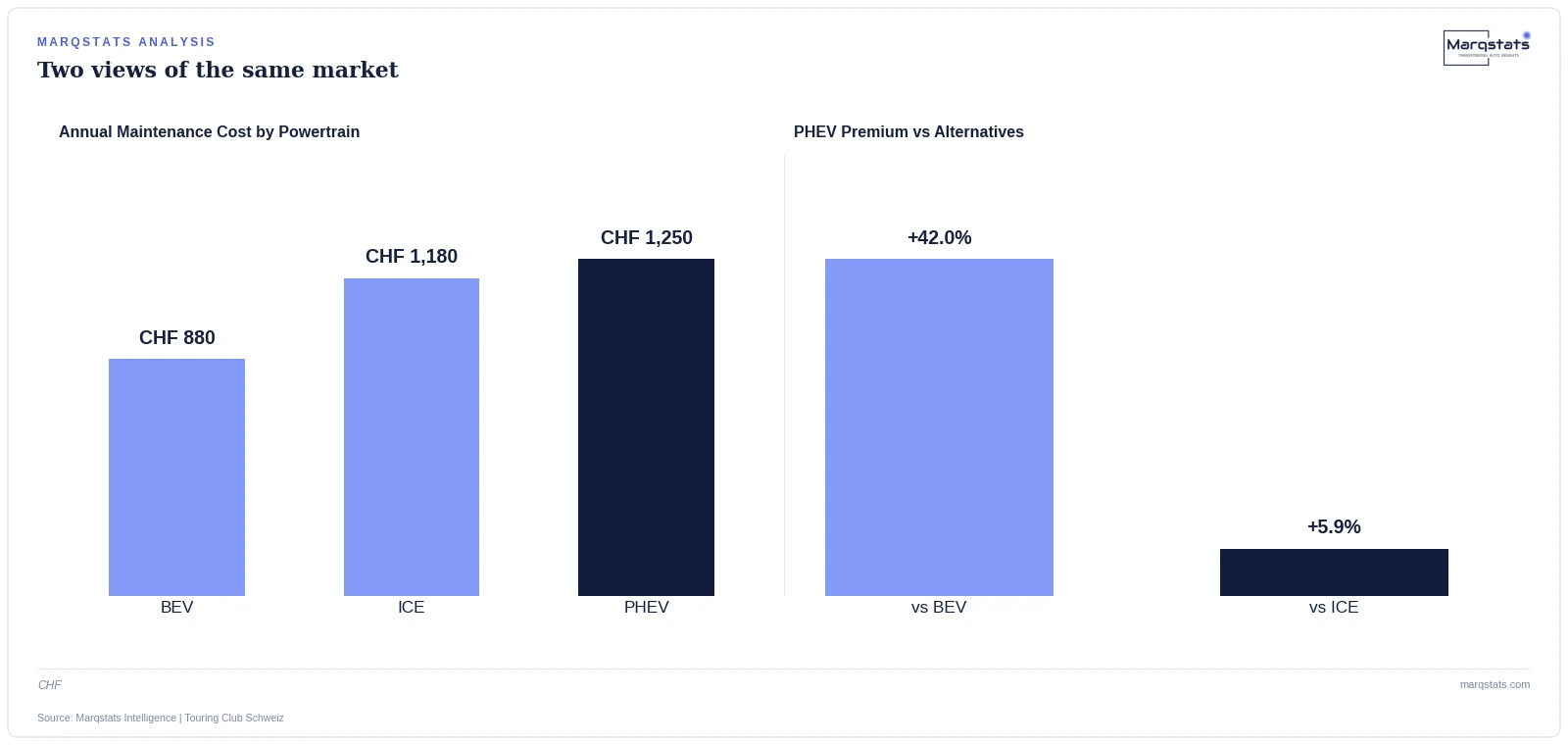
Touring Club Schweiz's standardized cost benchmarks show average annual PHEV maintenance reaching CHF 1,250 — 42.0% more than a pure battery electric vehicle at CHF 880, and 5.9% more than a conventional petrol or diesel vehicle at CHF 1,180.
Why the Compromise Doesn't Pay Off Mechanically
The mechanism is simple once you look at what a PHEV actually is under the skin: a complete combustion engine, transmission and exhaust system, plus a complete high-voltage battery, electric drive unit and thermal management system, bolted together in the same vehicle. A PHEV owner still needs oil changes, exhaust servicing and emissions testing — the pure BEV owner skips all of that entirely. But the PHEV owner also can't skip the thermal coolant flushes, onboard charger servicing and elevated tire wear from carrying battery mass that a pure ICE owner never has to think about.

A Named Comparison: Why This Differs From Simple Additive Cost Logic
It's tempting to assume a PHEV's cost should simply add a small electric-system premium on top of standard ICE maintenance. The actual premium is larger than that framing suggests, and the reason is architectural: PHEV battery packs are smaller than pure BEV packs but still require the same categories of specialized service (thermal loops, HV diagnostics, SoH testing), meaning the fixed cost of maintaining "a high-voltage system" doesn't scale down proportionally with a smaller battery — it's a largely fixed servicing overhead layered directly on top of full combustion maintenance.
Why This Gap Isn't Likely to Close Soon
There's no obvious engineering path that shrinks this gap in the near term. As long as PHEV platforms retain both a full combustion drivetrain and a full high-voltage system by design, the underlying cost driver -- maintaining two complete propulsion architectures at once -- remains structural, not a temporary transitional inefficiency.
What This Means for Anyone Choosing a Powertrain
The practical takeaway: anyone comparing total cost of ownership across powertrains in Switzerland should treat PHEV maintenance cost as a genuine premium category, not a middle-ground compromise — and workshops should price and market PHEV service packages accordingly, rather than assuming PHEV owners expect BEV-adjacent pricing.