Three Tiers, One Very Narrow Top
It's a structure worth understanding precisely, since conflating the three tiers -- treating any "high-voltage certified" technician as equally qualified for any job -- genuinely misrepresents what each credential actually authorizes.
Switzerland's AGVS operates a three-tier certification system for anyone working on high-voltage vehicle systems. The bottom two tiers are reasonably accessible. The top tier is genuinely scarce.
What Each Level Actually Permits
Each tier builds directly on the one below it.
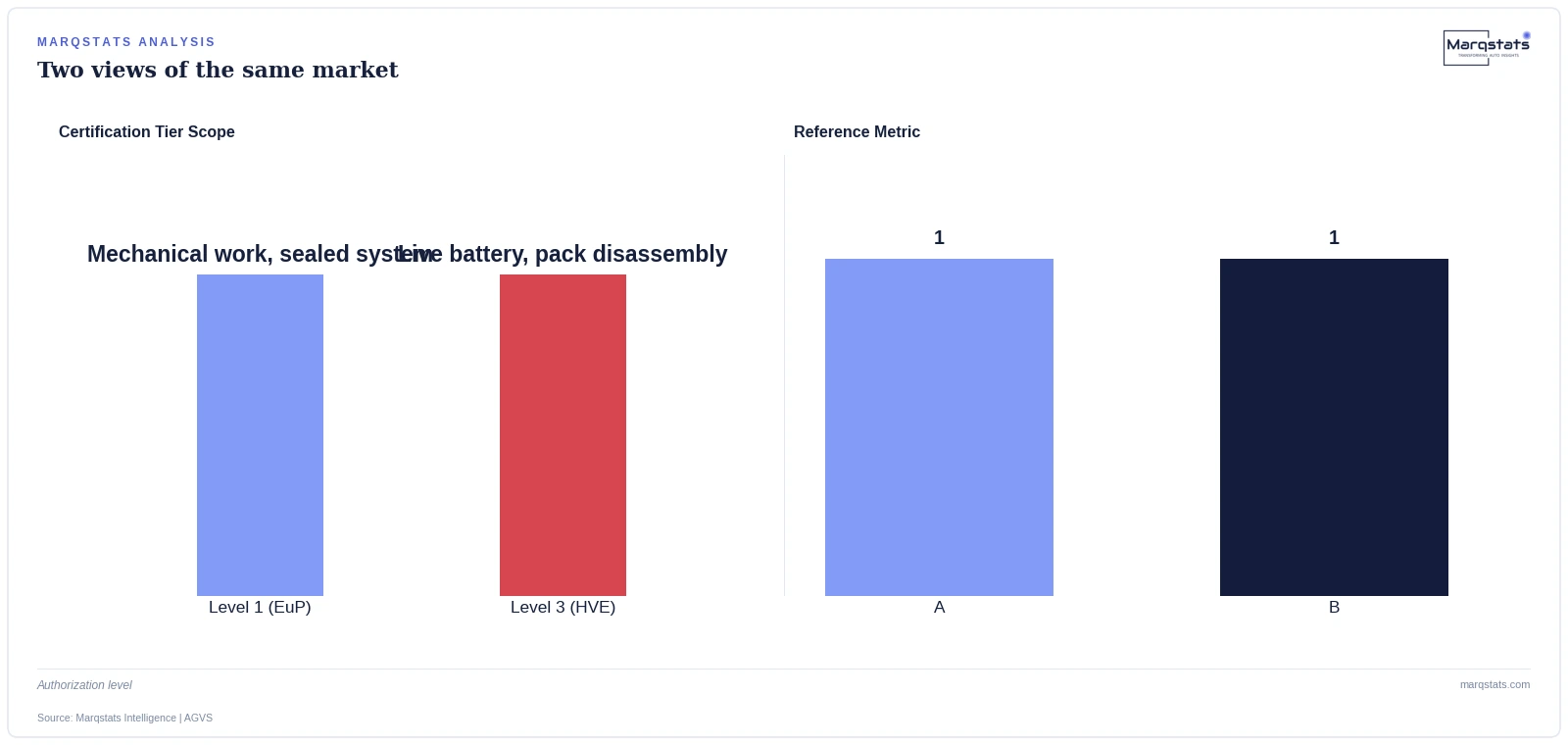
Level 1 (EuP) lets non-electrical staff — tire fitters, bodywork specialists — work mechanically around an intact, sealed high-voltage system. Level 2 (Fachkundige Person Hochvolt) authorizes trained mechatronics professionals to de-energize systems and replace modular sub-assemblies like DC-DC converters. Level 3 (Hochvoltexperte) is the only tier authorized to work on live, energized battery enclosures and dismantle sealed packs for module-level cell replacement.
Why So Few Technicians Reach the Top Tier
It's worth being specific about why this bottleneck matters commercially, not just technically -- Level 3 work carries genuinely high margins precisely because so few providers can legally offer it, making HVE capacity a real competitive asset for whichever workshop network manages to build it.
Level 3 certification requires extensive electrical engineering credentials well beyond standard automotive training, plus access to explosion-proof workshop facilities most individual garages simply don't have the capital to build. That combination genuinely limits how many technicians in the entire country can legally perform the most complex, highest-value repair work.
A Named Comparison: Why Dealers Responded by Centralizing, Not Distributing
That choice reveals something useful about scarce-credential economics more broadly.

Faced with this scarcity, major dealer groups didn't try to put a Level 3 technician in every local branch — that's economically unworkable given how few exist. AMAG instead built exactly three regional competence hubs nationwide, concentrating its scarce Level 3 talent and capital-intensive tooling into a handful of specialized locations rather than spreading it thin across ninety-plus dealership sites.
Why the Bottleneck Is Unlikely to Ease Quickly
Training a new Level 3 technician takes years, not months, and the explosion-proof facility requirements represent a genuine capital commitment few individual garages can justify on their own, meaning this specific scarcity is likely to persist well into the forecast period covered by this analysis.
What This Means for the Independent Aftermarket
The practical takeaway: independent workshops without a realistic path to Level 3 certification should focus commercial strategy specifically on Level 1 and Level 2 work — mechanical servicing, module-level sub-assembly replacement, de-energized diagnostics — and build referral relationships with regional HVE-equipped facilities for the small share of jobs genuinely requiring live battery work, rather than attempting to build Level 3 capability in-house.