
The Assumption Electrification Usually Earns
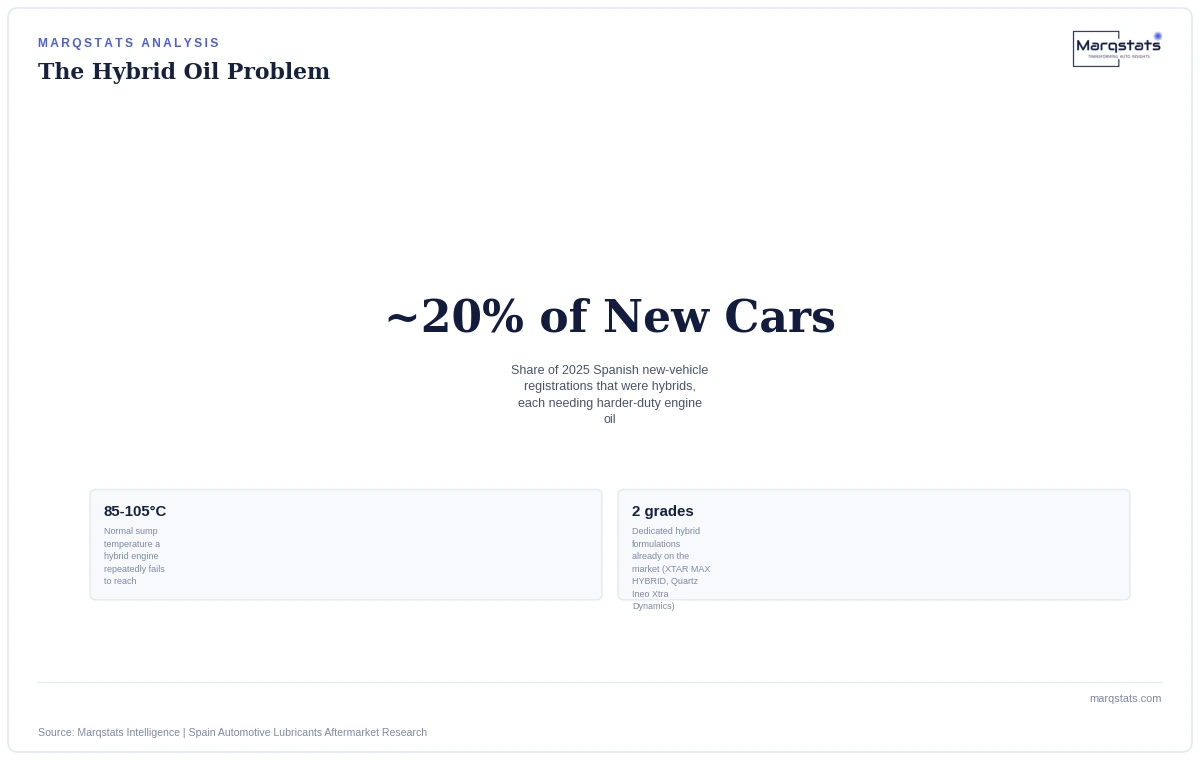
Vehicle electrification is generally framed as good news for anyone worried about oil demand: fewer combustion-only kilometres, less crankcase oil sold. Pure battery-electric vehicles earn that framing outright, since they eliminate engine oil entirely. Hybrids, nearly 20% of new Spanish vehicle registrations in 2025, do not. Their combustion engine still needs oil, and the way that engine actually operates makes the job harder for the oil than a standard combustion engine's does.
Why Stop-Start Is Worse Than Just Off or Just On
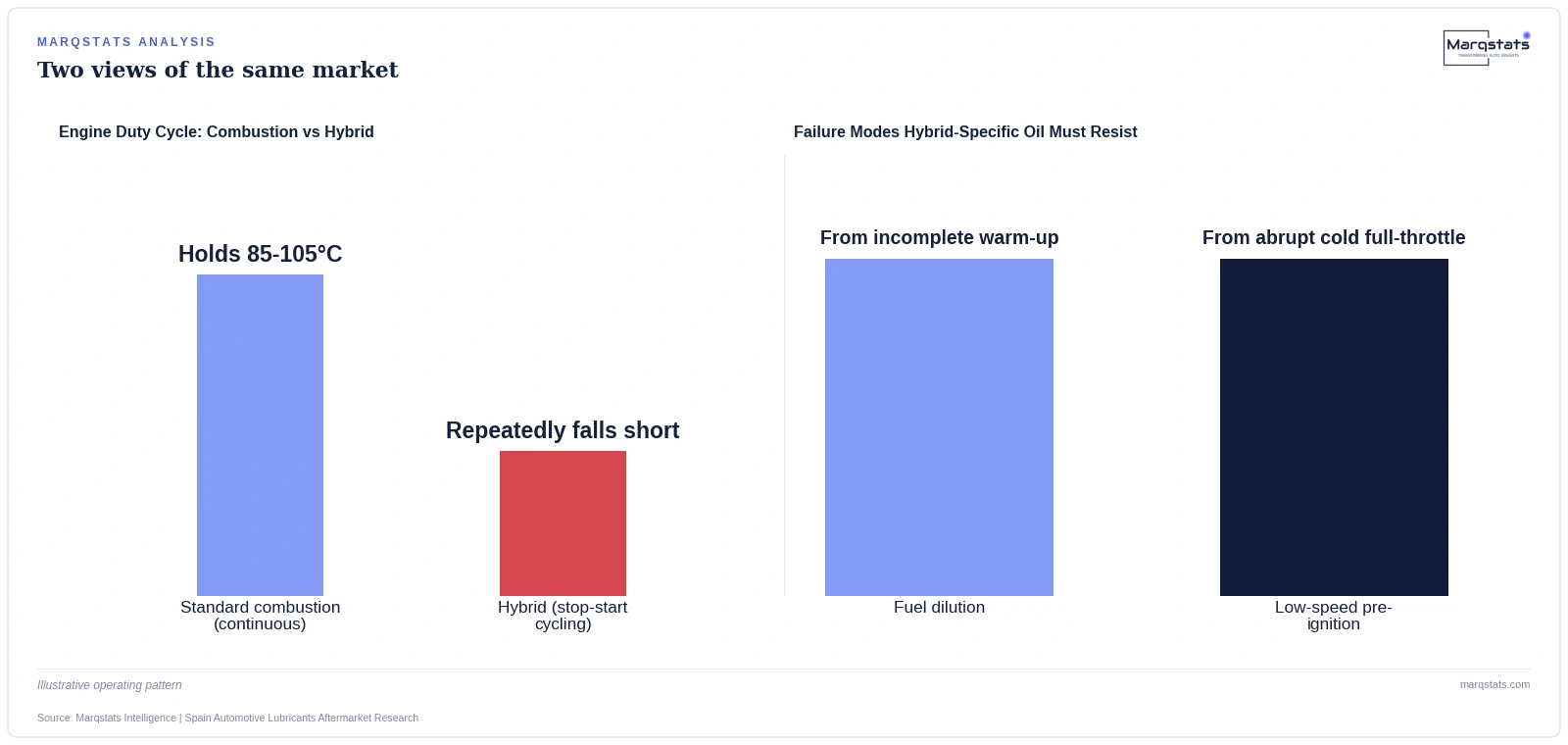
In a conventional car, the engine runs continuously once warmed up, holding sump temperature in the 85°C to 105°C range where an engine oil's additive package is formulated to work. A hybrid's combustion engine, under urban driving, cycles on and off repeatedly as the vehicle switches between electric and combustion power, and frequently shuts down again before the sump ever reaches that steady-state temperature. An engine that keeps almost-warming-up and then stopping is tribologically a harder environment than one that is simply cold, or simply hot.
What Actually Goes Wrong in the Crankcase
That incomplete warm-up cycle traps unburned fuel and atmospheric moisture in the crankcase instead of burning or evaporating them off, the way a fully warmed engine would. Over repeated cycles, this accelerates oil oxidation, promotes acid buildup, and can lead to emulsion sludge formation, the same kind of degradation a badly maintained short-trip commuter car develops, except built into the hybrid's normal duty cycle by design, not by neglect. On top of that, hybrids generate acute boundary-lubrication stress at moments a conventional car rarely sees: a cold combustion engine firing abruptly under full throttle, for instance at a highway on-ramp, with no gradual warm-up runway before peak load hits.
How Blenders Are Actually Responding
This is not a theoretical formulation challenge; specific products already address it. Moeve markets a dedicated XTAR MAX HYBRID line in 0W-16 and 0W-20 grades, and TotalEnergies sells Quartz Ineo Xtra Dynamics 0W-20, both built around balanced zinc dialkyldithiophosphate (ZDDP) additive packages and ashless anti-wear compounds specifically tuned to resist low-speed pre-ignition and fuel dilution, failure modes a standard combustion-engine 0W-20 was never formulated to handle at this frequency.
What This Means for Anyone Stocking or Recommending Oil
The practical takeaway: a hybrid is not just a smaller-volume version of the combustion car it replaced, it is a chemically distinct servicing category, and treating it as interchangeable with standard low-viscosity synthetic stock risks under-protecting an engine that is already operating in a harder environment than its combustion-only counterpart. Workshops and distributors should stock hybrid-specific formulations as a separate SKU rather than substituting a generic 0W-20, and should flag hybrid ownership to customers as a reason for adherence to shorter, not longer, service intervals despite the reduced combustion mileage.