
A Shortage That Starts Before Technicians Ever Reach a Workshop
The scale of this gap becomes clearer once it's traced back to where automotive technicians actually get trained in the first place.
It's worth understanding exactly where in the training pipeline this bottleneck originates before assuming it's simply a matter of workshops being slow to invest in certification.
South Africa's national Technical and Vocational Education and Training system is the primary pipeline producing the country's automotive technicians. Industry surveys found that pipeline was almost entirely unprepared for electric vehicles.
What the RMI Survey Actually Found
These are specific, documented survey figures, not a general industry impression.
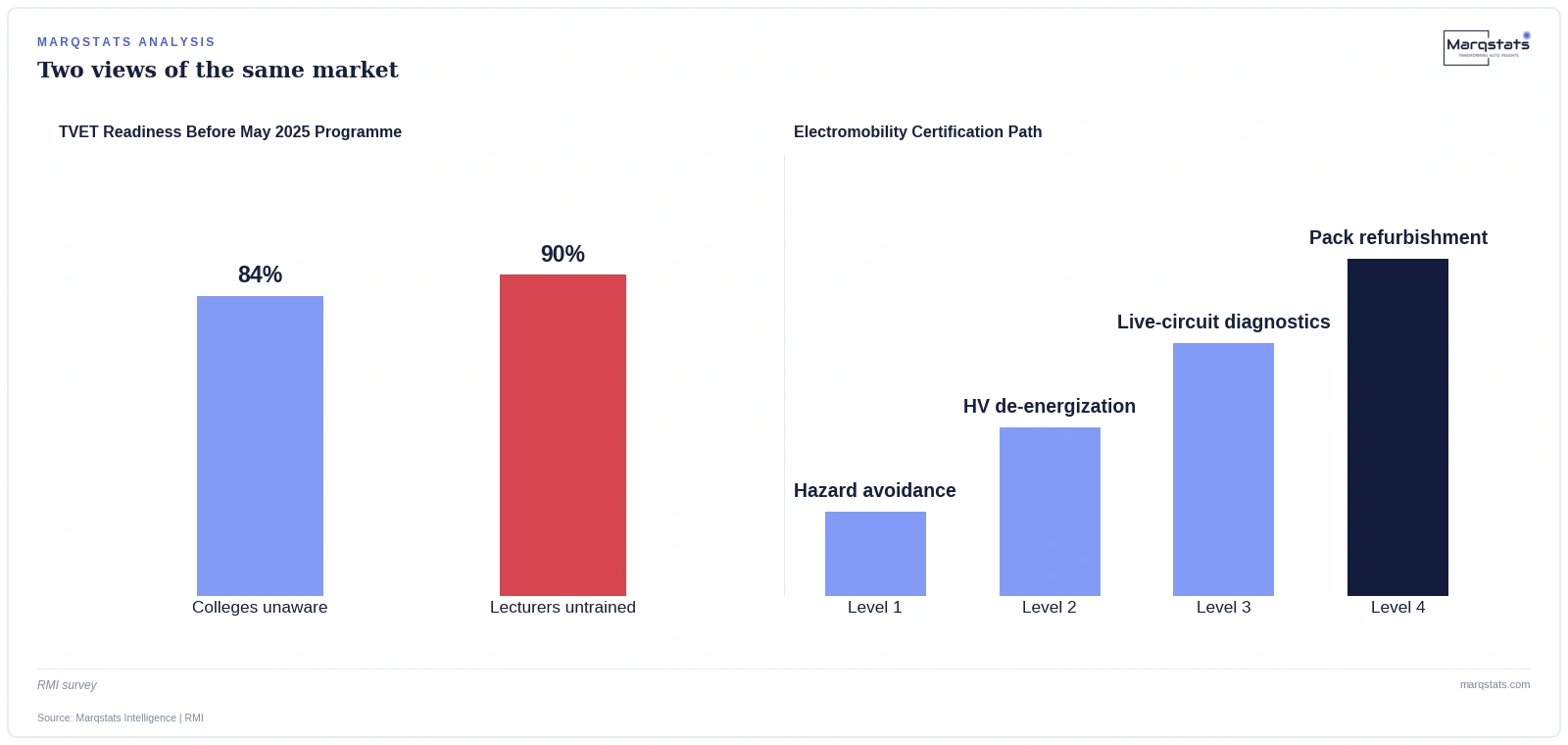
Industry surveys conducted by the Retail Motor Industry Organisation (RMI) found that 84% of TVET colleges were unaware of the specific technical proficiencies required for hybrid and electric drivetrains, and nearly 90% of technical lecturers had never received formal training on high-voltage architectures. That's not a gap in individual technician skill -- it's a gap in the institutions meant to be teaching those skills in the first place.
Why This Compounds Into a National Servicing Bottleneck
It's worth tracing this specific gap through to what it means for a car owner or fleet operator trying to get a vehicle serviced today.
Under Competition Commission guidelines, independent workshops are legally entitled to service EVs and access OEM technical data. But high-voltage systems operating at 400V to 800V require certified, insured technicians under Clause 5.4.6 of those same guidelines -- meaning the legal right to compete and the workforce capacity to actually do so were, until recently, two genuinely different things.
A Named Comparison: The Institutional Response Now Underway
Recognizing which specific response is actually underway changes how quickly this national gap should genuinely be expected to close.
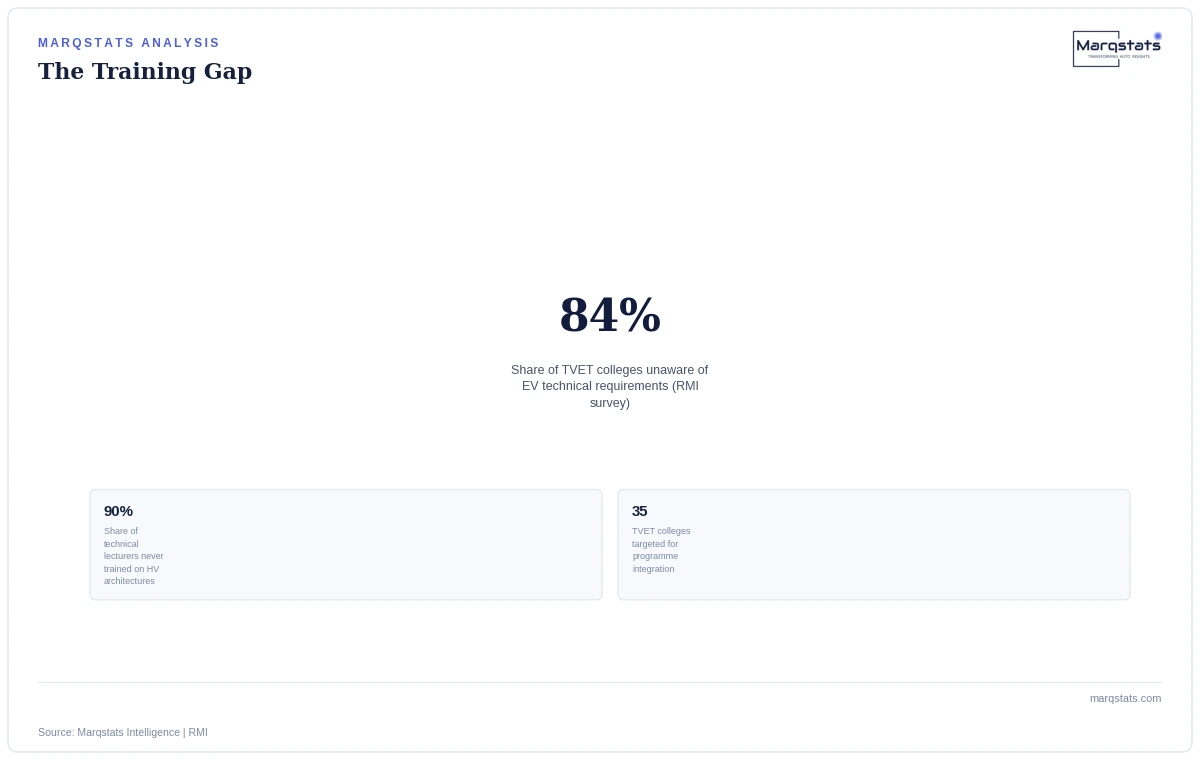
In May 2025, the Quality Council for Trades and Occupations (QCTO) formally appointed merSETA to lead development of South Africa's first national Electromobility Occupational Skills Programme, in collaboration with the RMI. The programme was formally contracted for curriculum development in October 2025 and establishes a four-tier certification path, from non-electrical hazard avoidance through cell-level battery pack refurbishment, scheduled for integration across 35 automotive TVET colleges nationally.
Why This Timeline Genuinely Matters for Workshop Planning
Certification pipelines take real time to reach scale regardless of how quickly the programme itself was designed and launched, meaning this specific labor constraint should be treated as a multi-year structural feature of the market rather than a gap likely to close within a single training cycle.
What This Means for Workshops Right Now
The practical takeaway: independent workshops and franchised dealers alike should treat early technician certification through the new programme as a genuine competitive advantage specifically, given how directly the current 84%-unaware TVET baseline positions certified capacity, not customer demand, as this market's binding near-term constraint.