A dealer can rank #1 on Google and still be invisible to an AI shopping assistant. Here's the data behind that gap.
In brief:
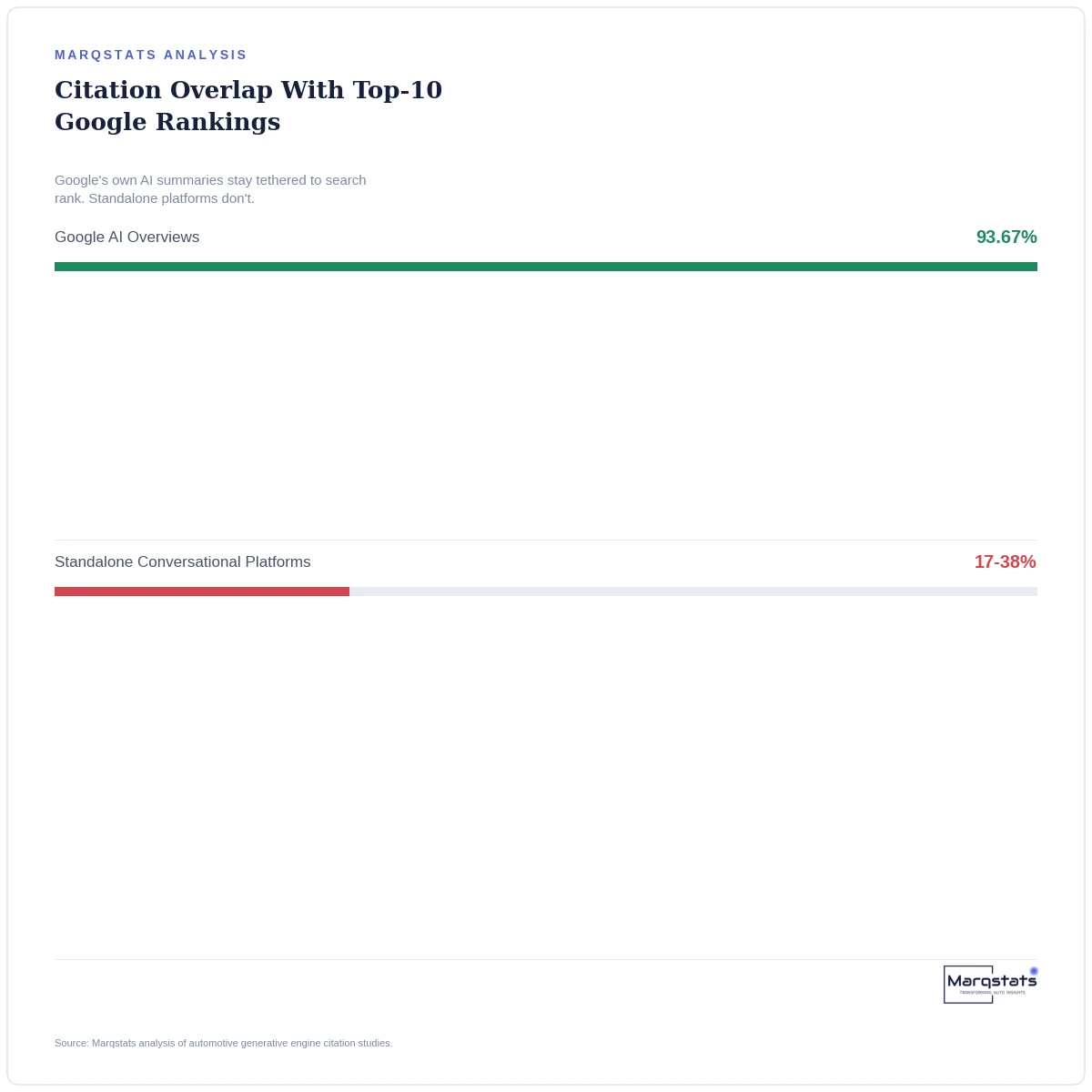
- 93.67% of Google AI Overviews still reference at least one top-ten organic search result.
- Cross-platform citation overlap between top-ten Google rankings and answers from leading conversational answer engines has collapsed to between 17% and 38%.
- AI-referred car buyers convert at 14.2% on dealer websites, compared to 2.8% for traditional organic search visitors, a 5.07-fold advantage.
For two decades, search engine optimization worked on a fairly simple premise: rank in the top few Google results, and you capture the traffic. That premise still holds, partially, inside Google's own AI-generated summaries. It does not hold once a car shopper leaves Google entirely and asks a standalone conversational answer engine for advice instead. That distinction, still true inside Google but no longer true everywhere else, is the single most important thing an automotive marketing team can understand about the current search landscape.
Two different systems, two very different answers
Google's own AI Overviews are, in a meaningful sense, still tethered to traditional search results. The evidence is clear: 93.67% of the time, an AI Overview references at least one page that also ranks in the top ten organic results. A strong Google ranking still buys you meaningful odds of appearing inside Google's own generated summary.
Step outside Google's ecosystem, though, and the picture changes considerably. When researchers compared the sources cited by leading standalone conversational answer engines against the same top-ten Google rankings, the overlap collapsed to somewhere between 17% and 38%. In other words, a page ranking first on Google has, at best, roughly a one-in-three chance of being the source a separate conversational platform actually cites when answering a similar question.
Two systems, both claiming to summarize the best answer, and they agree on the source less than 40% of the time.
— Marqstats Analyst Team
Why this isn't just an academic curiosity for automotive retailers
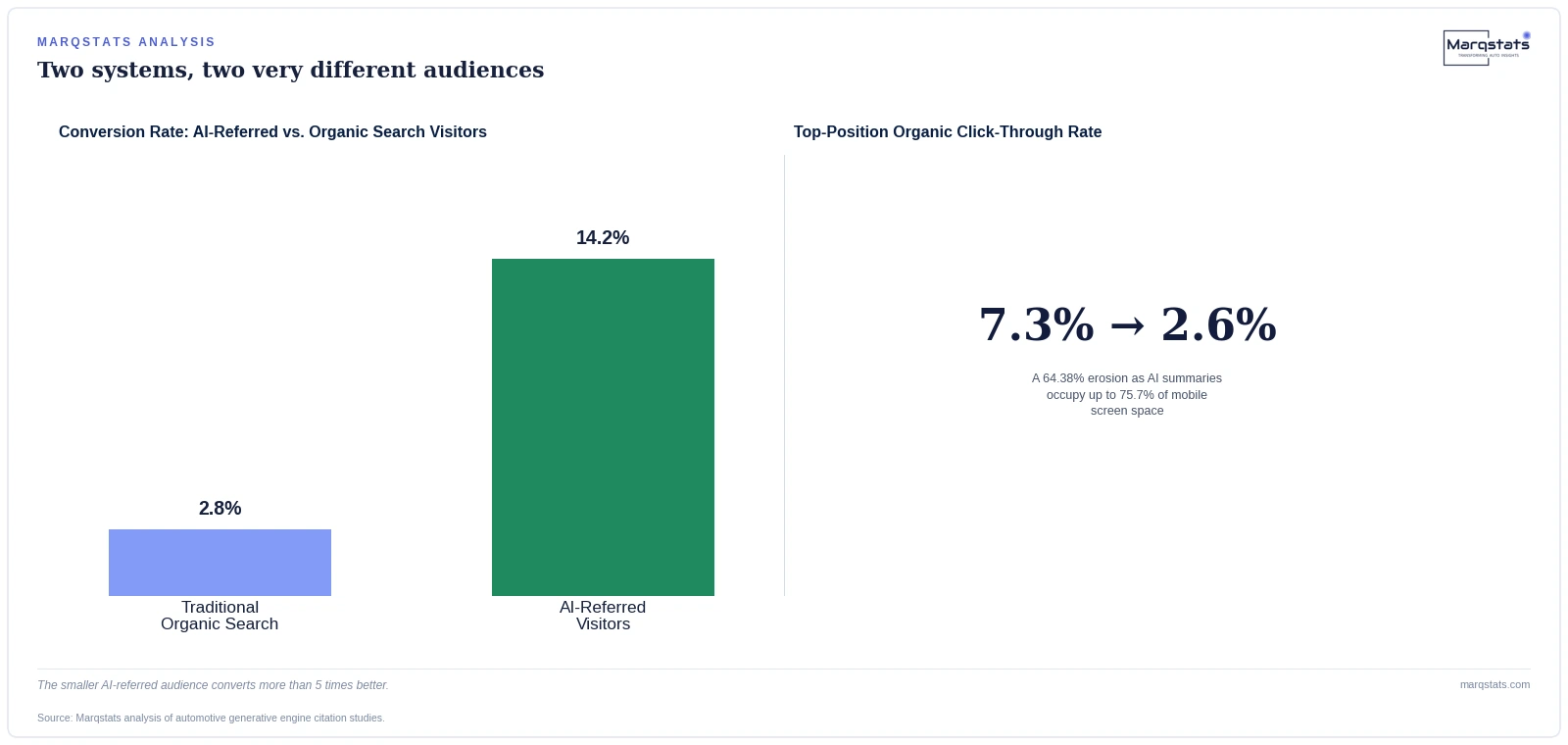
The gap matters because the traffic on the other side of it converts unusually well. Shoppers referred to a dealer's website by a conversational platform convert at 14.2%, compared to just 2.8% for visitors arriving through traditional organic search, a 5.07-fold difference. These aren't marginal, low-intent browsers. A shopper who asked a conversational assistant a specific question, received a synthesized recommendation, and clicked through to a dealer's site has already done a meaningful amount of research and narrowing before arriving.
A dealership that optimizes exclusively for traditional Google rankings, in other words, is optimizing for a channel that still matters, but is no longer sufficient on its own. The 17% to 38% overlap figure means a page can be genuinely excellent by traditional search standards and still be functionally invisible to a meaningful share of high-converting conversational traffic. Genuinely excellent by one system's standards is not the same as genuinely excellent by both.
What actually explains the disconnect
The mechanism isn't mysterious once you understand how these systems differ structurally. Google's AI Overviews are built directly on top of Google's own search index and ranking signals - they're a summarization layer sitting atop the same infrastructure that produces traditional blue-link results. Standalone conversational answer engines, by contrast, often draw from their own independent crawling, indexing, and source-weighting systems, which don't necessarily prioritize the same signals Google's ranking algorithm does. A page can rank well on Google because of backlink authority and domain age, factors that matter less to a system evaluating structured data completeness, factual citation density, or how cleanly a page's content can be parsed and summarized.
The counter-argument: is this decoupling actually as consequential as it sounds?
A fair objection is that a 17% to 38% overlap range, while lower than 100%, still represents meaningful correlation - it's not as though traditional search rankings predict conversational citations at random, and a business with genuinely strong, well-structured content might reasonably expect to perform reasonably well across both channels simultaneously without needing an entirely separate optimization strategy. This is a reasonable point, and the two channels aren't fully independent. What the data suggests, though, is that treating them as interchangeable, assuming strong traditional SEO automatically confers strong conversational visibility, is a genuinely risky assumption given how wide the gap actually runs. Even at the high end of the range, roughly 6 in 10 citations inside conversational answers come from sources that don't rank in Google's own top ten - a large enough share that ignoring it means forfeiting a substantial, high-converting audience.
What this means for dealerships and marketing teams
- Treat conversational platform citation performance as a distinct metric from traditional search ranking, tracked and optimized separately rather than assumed to follow automatically from strong SEO.
- Audit whether your site's content is structured in a way that's easy for automated systems to parse and cite accurately, independent of its traditional search ranking position.
- Prioritize the specific content techniques shown to improve conversational citation rates, such as including authoritative quotations and verifiable statistics, since these operate on different mechanics than traditional ranking factors.
Why the screen itself has already shrunk what search used to deliver
Even the traffic that does survive the overlap is worth less than it used to be, because of a separate but related shift: AI-generated summaries and featured snippets now physically dominate the search results page. Independent screen real estate audits show these elements occupy 67.1% of desktop screen area and 75.7% of mobile screen real estate on complex vehicle-related queries. That's the majority of what a shopper sees before scrolling past any traditional organic listing at all.
The consequence shows up directly in click-through rates. Top-position organic listings, the kind that would once have reliably captured the largest share of clicks, have seen their click-through rate fall from 7.3% to 2.6% on these queries - a 64.38% erosion. A page can hold the coveted first organic position and still see the majority of its historical traffic simply absorbed by the summary sitting above it, before a shopper ever scrolls down far enough to see it.
What actually moves the needle inside conversational answers
Large-scale controlled testing across 10,000 queries and 25 domains offers a genuinely useful roadmap for what closes the citation gap. Adding authoritative quotations to a page elevates its visibility inside generative summaries by 41.0%. Including specific statistical data lifts visibility by 32.0%. Citing factual sources yields a 30.0% to 34.4% visibility expansion. These are substantial, measurable effects - and notably, they're not the same techniques that drive traditional search rankings, which explains part of why the two channels have diverged.
Equally informative is what actively hurts conversational visibility: the same keyword-repetition techniques that once formed the backbone of traditional search engine optimization produce an 8.81% reduction in generative visibility. A page written to satisfy a traditional ranking algorithm's keyword-density expectations can actively work against it inside a conversational summarization system that penalizes exactly that pattern.
The full market picture
Marqstats' complete global automotive Generative Engine Optimization market analysis, including the full citation mechanics and a two-scenario forecast through 2030, is available in the linked report below.
Related reportGlobal Automotive Generative Engine Optimization Market Size, Share & Forecast 2026 – 2030