A traffic rule, not a tax break, is Sao Paulo's biggest EV incentive
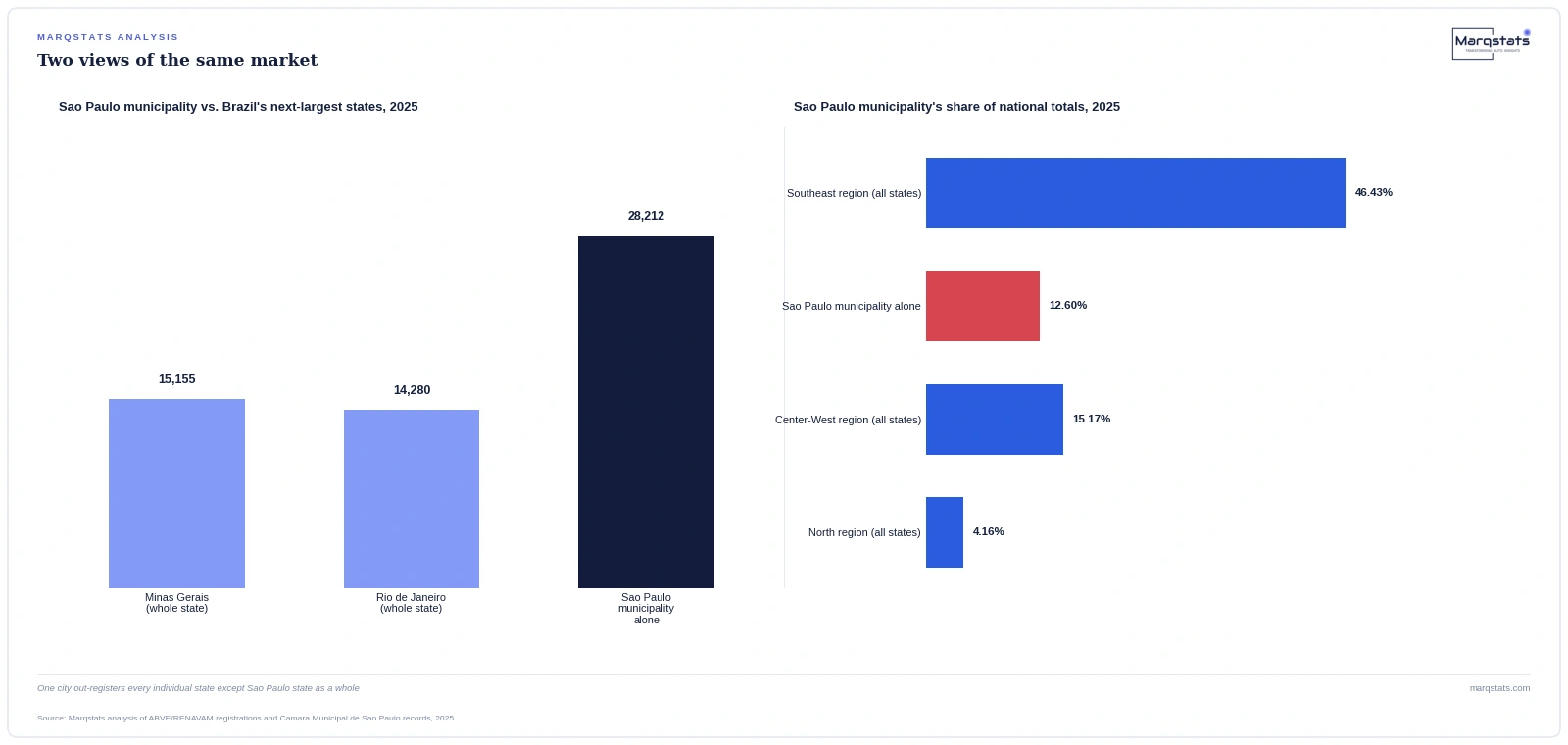
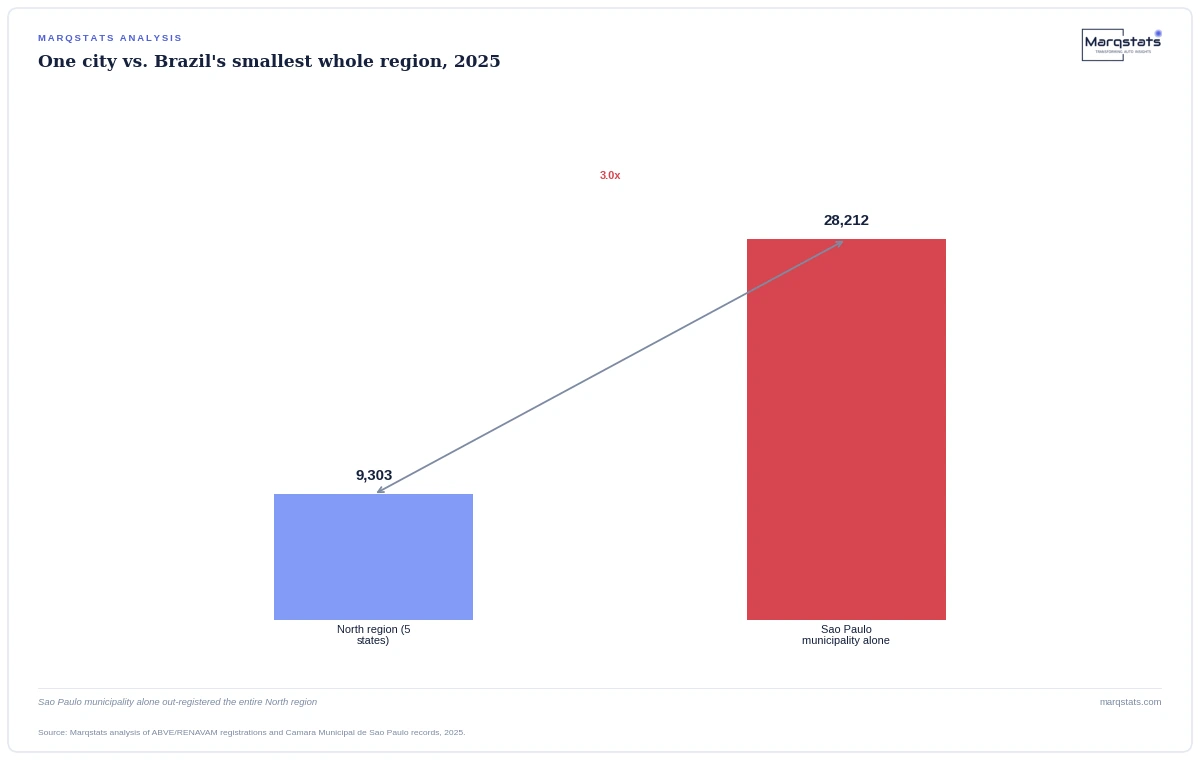
Sao Paulo's municipal peak-hour driving restriction, known as rodizio, bans a fifth of the city's vehicle fleet from its expanded downtown zone on any given weekday, rotating by license-plate digit. Since 2015, electrified vehicles registered in the city have been exempt. That exemption, not any state tax break, is the incentive doing the most work in Brazil's largest vehicle market: 28,212 electrified vehicles were registered in the municipality of Sao Paulo in 2025, 12.60% of Brazil's entire national total, from a single city.
The exemption was set to expire on 31 December 2024. On 21 November 2024, the Camara Municipal de Sao Paulo voted 39-0 to extend it, along with a related municipal-IPVA-quota rebate, through 31 December 2030 — removing the near-term expiration risk that might otherwise have depressed 2025 purchase decisions.
Sao Paulo, as one of the world's largest metropolises, cannot fall behind other global cities on transport electrification and decarbonization.
— Rodrigo Goulart, Sao Paulo city councilman, sponsor of the 2024 extension bill
What the exemption actually covers, and what it doesn't
Lei no 15.997/2014 exempts electric, hydrogen and hybrid vehicles registered in the municipality of Sao Paulo from rodizio, which otherwise runs Monday to Friday, 7am to 10am and 5pm to 8pm, across the city's expanded center. The exemption is conditional on registration: a vehicle plated outside Sao Paulo state does not qualify, even if it is driven in the city every day. That single condition is doing real work in pulling registrations toward the capital that might otherwise land in a neighboring municipality.
The law does not distinguish between a compact hybrid and a large plug-in luxury SUV. Any hybrid, plug-in or otherwise, qualifies for the same exemption as a fully electric vehicle, which means a heavier, higher-emission plug-in hybrid crossover gets the identical traffic privilege as a battery-electric hatchback. Brazilian commentators have criticized this design specifically: the rule rewards powertrain category, not actual emissions performance.
Two different incentives, easy to conflate
Coverage of Sao Paulo's electrified-vehicle incentives often blends two legally separate benefits into one. The rodizio exemption is a municipal traffic rule under Lei no 15.997/2014. Separately, the city returns its share of state IPVA revenue to owners of qualifying electrified vehicles registered locally — a municipal-IPVA-quota rebate, not a reduction in the state tax itself, which Sao Paulo state continues to charge at the full 4% rate with no blanket state exemption. Both benefits were extended together in the November 2024 vote, and both require the vehicle to be plated in the city, which is why they reinforce each other rather than operating independently.
The state-level picture matters here because it is easy to assume Sao Paulo state is generous on EV taxation simply because its capital city is generous on EV traffic rules. It is not. Sao Paulo state charges the standard IPVA rate on electrified vehicles; the concession lives entirely at the municipal level, and only for vehicles registered inside the city limits.
Is this really a subsidy, or just fair treatment for cleaner vehicles?
The strongest objection to calling this a hidden subsidy is that it isn't hidden, and it isn't obviously a subsidy: exempting lower-emission vehicles from a congestion rule aimed at pollution and traffic is a defensible transport-policy choice on its own terms, independent of any effect on vehicle sales. Many cities worldwide grant similar carve-outs, and Sao Paulo's version is a matter of public legislative record, passed by unanimous vote and covered in local press. Framing it as "hidden" risks overstating how obscure the mechanism actually is to anyone who follows Sao Paulo municipal politics.
That is fair as far as it goes, but it does not change the practical effect for a market analyst. Whether or not the exemption is well known inside Sao Paulo, it rarely appears in national or international coverage of Brazil's electrified-vehicle growth, which tends to credit federal tariff policy or Programa Mover almost exclusively. A single municipality generating 12.60% of the country's registrations, through a mechanism with no federal or state equivalent, is a material fact for anyone forecasting where Brazilian PHEV and BEV demand will concentrate — regardless of how open the underlying law has always been.
- The exemption applies only to vehicles registered inside Sao Paulo municipality, not the wider state.
- It covers electric, hydrogen and hybrid vehicles alike, without distinguishing plug-in from conventional hybrids.
- It is legally distinct from the separate municipal-IPVA-quota rebate, though both were extended in the same November 2024 vote.