The most successful second-life battery projects skip the step everyone assumes is required
In brief:
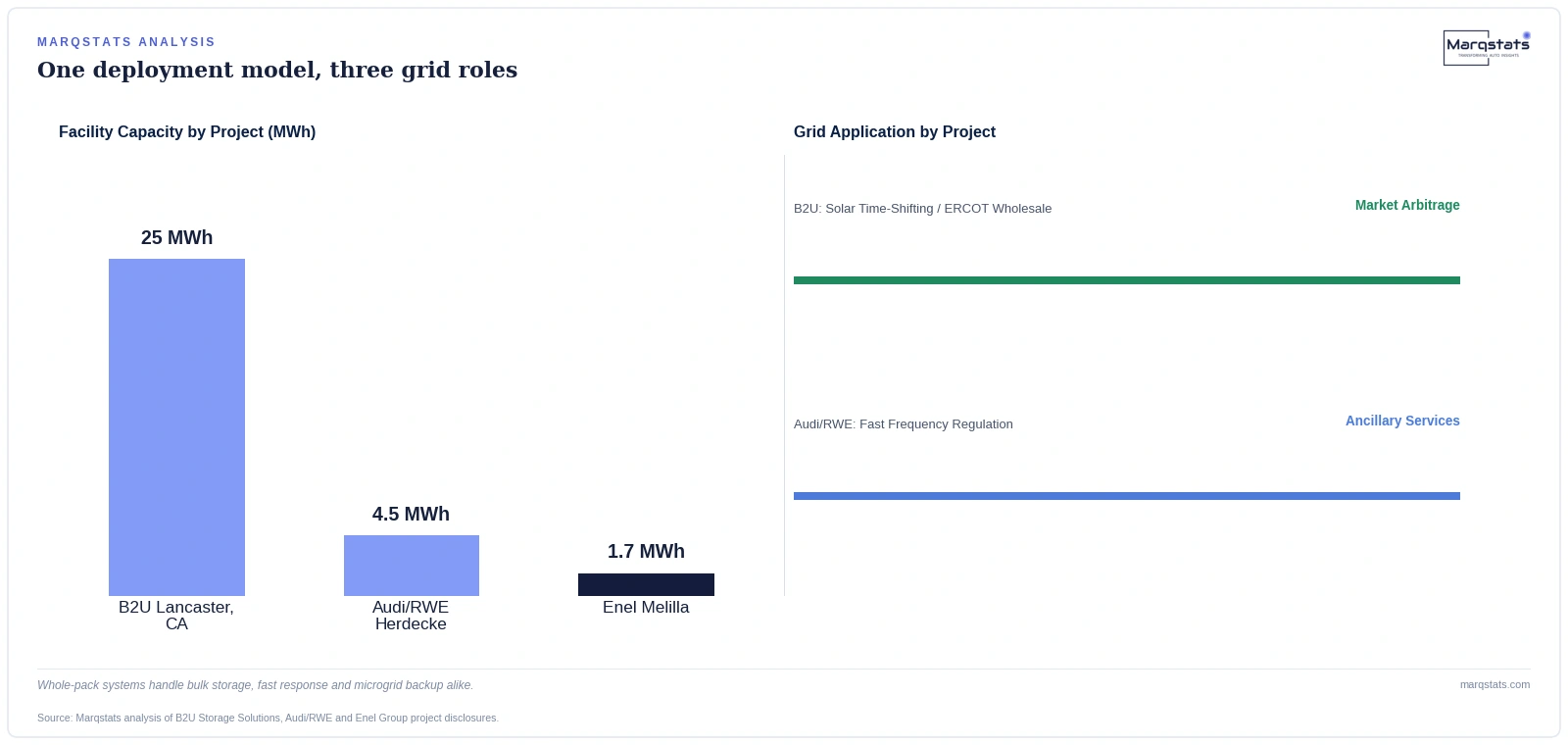
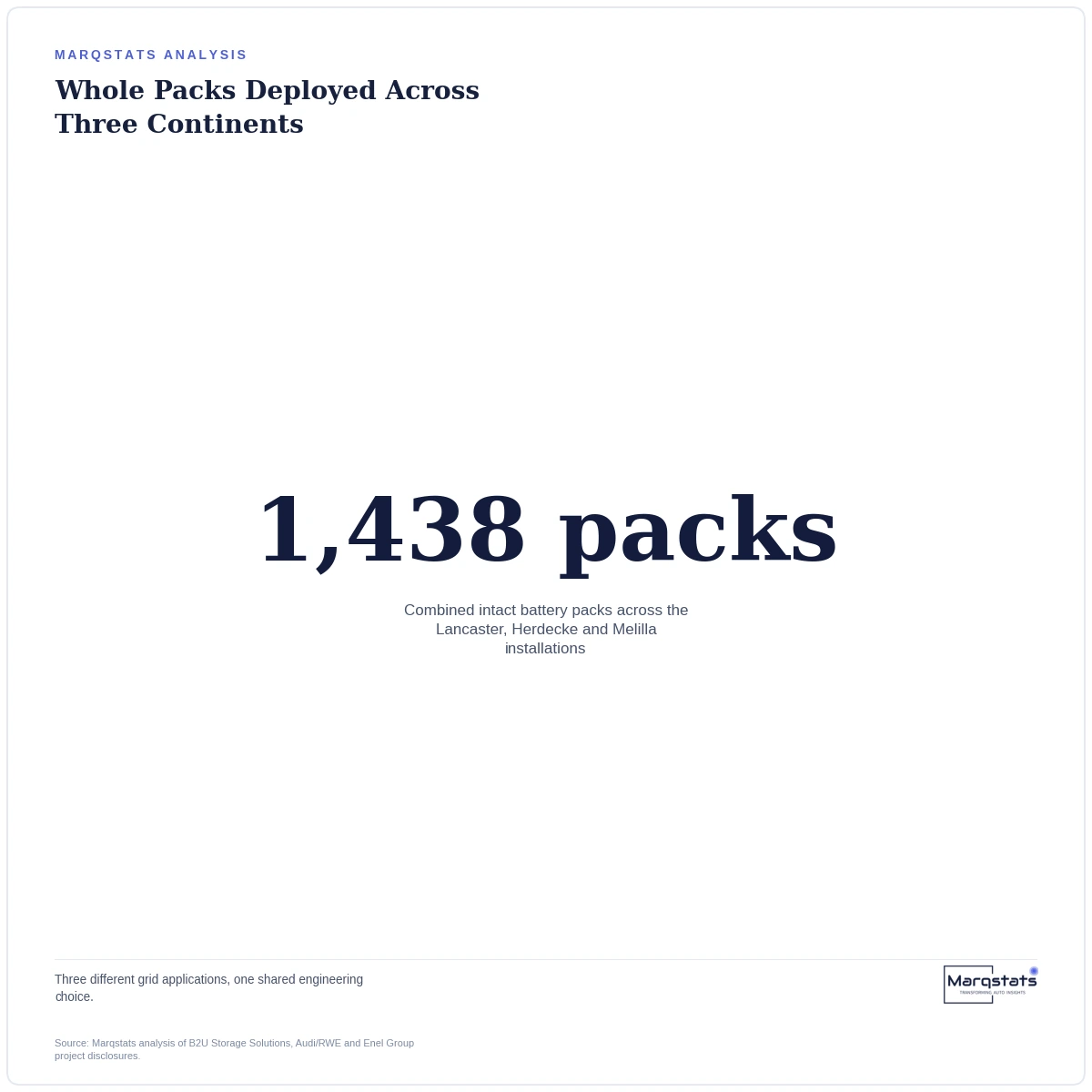
- B2U Storage Solutions operates a 25 MWh facility in Lancaster, California using 1,300 intact Honda and Nissan battery packs.
- Audi and RWE integrated 60 whole e-tron development packs into a 4.5 MWh installation at Germany's Herdecke plant.
- Enel Group, Endesa and Nissan deployed 78 intact Leaf packs into a 4 MW / 1.7 MWh microgrid facility in Melilla, Spain.
A DIY builder taking apart a salvaged EV battery pack does it because they have to - a residential 48V system needs specific voltage and form factor, and that means extracting individual modules, sorting them by health, and reassembling them into a new configuration. It's genuinely labor-intensive work: diagnostic screening, cell matching, custom enclosure fabrication.
The largest industrial second-life storage projects in the world have quietly figured out how to skip almost all of that. They don't disassemble the pack. They deploy it whole.
Why keeping the pack intact is the smarter engineering choice at scale
An EV battery pack arrives from the factory as a fully engineered system: structural enclosure, integrated liquid thermal management, high-voltage contactors, and a battery management system that already knows how to monitor and protect the cells inside it. Disassembling that system into individual modules means throwing away most of that engineering and rebuilding equivalent functionality from scratch - a new enclosure, a new cooling loop, a new BMS architecture. None of this is trivial engineering to replicate outside a factory setting, which is precisely why rebuilding it module by module is so labor-intensive for an individual DIY builder.
For a utility-scale deployment involving hundreds or thousands of packs, that rebuilding cost multiplies enormously. Keeping the pack intact and simply wiring multiple whole packs together into a containerized installation preserves the original engineering investment and reduces manual labor to a minimum - install, connect, integrate with a site-level energy management system, and the pack's own internal systems handle the rest. Multiply a few hours of avoided disassembly labor per pack across a thousand-pack installation, and the aggregate savings become substantial enough to materially change a project's total cost of deployment.
Why rebuild the thermal management system when the factory already built you a perfectly good one?
— Marqstats Analyst Team
Three real projects, three different grid applications
B2U Storage Solutions' Lancaster, California facility pairs 1,300 Honda and Nissan packs with solar generation, storing midday solar output for evening discharge - a straightforward time-shifting application well suited to whatever residual capacity the packs happen to retain. The company's second facility in Texas, expanded to 28 MWh, participates directly in ERCOT's wholesale electricity market, demonstrating that whole-pack second-life storage can compete in a genuinely commercial, market-priced environment rather than only in subsidized demonstration projects.
Audi and RWE's Herdecke installation serves a more technically demanding application: grid frequency regulation, which requires rapid, precise charge and discharge response to help stabilize grid frequency in real time. Deploying 60 intact e-tron development packs for this purpose demonstrates that whole-pack systems can meet fast-response ancillary service requirements, not just slower bulk energy storage.
Enel, Endesa and Nissan's Melilla project serves a third distinct purpose: emergency backup power for an isolated microgrid, specifically valuable in a location like Melilla, a Spanish exclave with limited grid interconnection to the mainland. Combining 78 intact Leaf packs (a mix of 48 used and 30 new units) into a 4 MW facility shows the whole-pack model working even in a blended new-and-used configuration.
What this means for how the rest of the industry should think about scale
These three projects, spanning California, Germany and Spain, collectively demonstrate that the whole-pack deployment model works across genuinely different grid applications - solar time-shifting, frequency regulation, and microgrid backup - not just one narrow use case. That breadth is itself informative: it suggests the model's advantages (reduced labor, preserved engineering, faster deployment) generalize across the industry rather than being specific to any single project's circumstances.
The counter-argument: does this approach waste usable capacity that module-level sorting would capture?
A reasonable objection is that deploying whole packs without disassembly means accepting whatever mix of healthy and degraded cells happens to exist within each pack, rather than sorting and grouping only the healthiest cells together the way module-level DIY builders do - potentially leaving usable capacity stranded inside packs that get retired early because of a few weak cells dragging down the whole unit's performance. This is a legitimate technical trade-off. The whole-pack model optimizes for deployment speed and labor cost, not for extracting maximum theoretical capacity from every individual cell. For a utility-scale operator prioritizing installed cost per MWh and speed to revenue, that trade-off makes sense; for an individual DIY builder with more time than capital, module-level sorting remains a more capital-efficient use of a single pack's remaining value.
What this means for project developers and salvage aggregators
- Project developers evaluating second-life storage should default to whole-pack deployment architectures unless a specific application genuinely requires module-level customization.
- Salvage aggregators should prioritize direct bilateral supply agreements with utility-scale integrators over retail module sales, since intact-pack buyers can absorb significantly higher volumes with lower per-unit transaction cost.
- Grid operators evaluating second-life storage proposals should ask specifically whether a project uses whole-pack or disassembled architecture, since the two approaches carry meaningfully different cost, timeline and performance profiles.
How this reshapes what salvage aggregators actually sell
This industrial preference for intact packs has a direct, measurable consequence upstream in the supply chain: it changes what a salvage aggregator's most valuable product actually is. A dismantler selling loose, individually tested modules to DIY hobbyists is doing meaningfully more processing work, at meaningfully lower volume per transaction, than one selling whole, undamaged packs directly to a utility-scale buyer under a bilateral supply agreement. The market's own data shows this shift already happening structurally: industrial integrators increasingly bypass retail salvage auctions entirely, establishing direct relationships with automotive OEMs specifically to secure homogeneous, intact pack architectures at scale, rather than buying mixed, already-disassembled inventory from public auction platforms.
This has a knock-on effect on DIY availability specifically. As more automotive OEMs and industrial integrators establish direct off-take agreements for intact packs, the volume of packs reaching public salvage auctions in disassembleable, DIY-accessible form could plausibly shrink further, compounding the segment's decline from a supply-availability angle in addition to the pure cost-economics reversal.
The homogeneity requirement most DIY builders never have to think about
One detail underlying all three case studies deserves attention: each project uses packs from a single automotive source (Honda and Nissan at Lancaster, Audi e-tron at Herdecke, Nissan Leaf at Melilla), rather than a mixed assortment of whatever happened to be available. This homogeneity is a deliberate design choice, not a coincidence. Packs from a single platform share consistent voltage curves, communication protocols and physical form factors, which dramatically simplifies integrating hundreds or thousands of units into a single coordinated system. A DIY builder working with whatever salvage pack they could find rarely has this luxury, and mixing chemistries or platforms within a single system introduces real technical complexity that industrial-scale, single-source procurement avoids entirely.
The full market picture
Marqstats' complete global second-life EV battery residential and DIY storage conversion market analysis, including the full industrial deployment landscape and a three-scenario forecast through 2030, is available in the linked report below.
Related reportGlobal Depreciated EV Battery Residential and DIY Storage Conversion Market Size, Share & Forecast 2026 – 2030