One EV battery chemistry catches fire around 150°C. Another needs nearly double that.
Not all lithium-ion batteries fail the same way. The chemistry inside the cell determines both how hot it needs to get before something goes wrong, and how bad things get once it does. For anyone considering a home battery bank, especially one built from salvaged EV parts, understanding this difference matters as much as understanding price.
What actually happens inside a failing battery
Thermal runaway is the technical term for what most people just call a battery fire: an uncontrollable, self-sustaining chemical reaction inside the cell, triggered by an internal short circuit, physical damage, severe overcharging, or simply getting too hot. Once it starts, the reaction generates its own heat faster than it can dissipate, which drives the reaction further, which generates more heat - a runaway feedback loop.
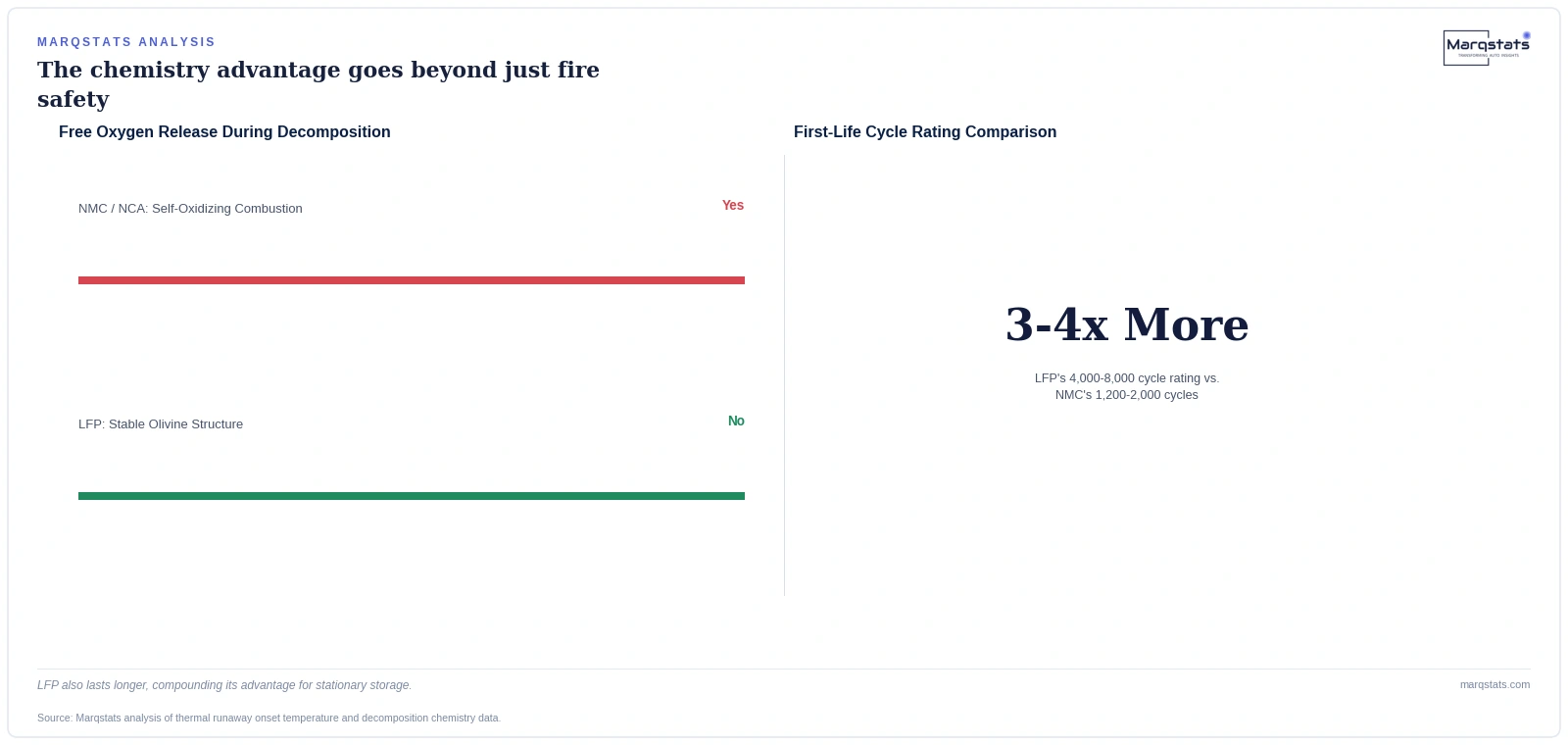
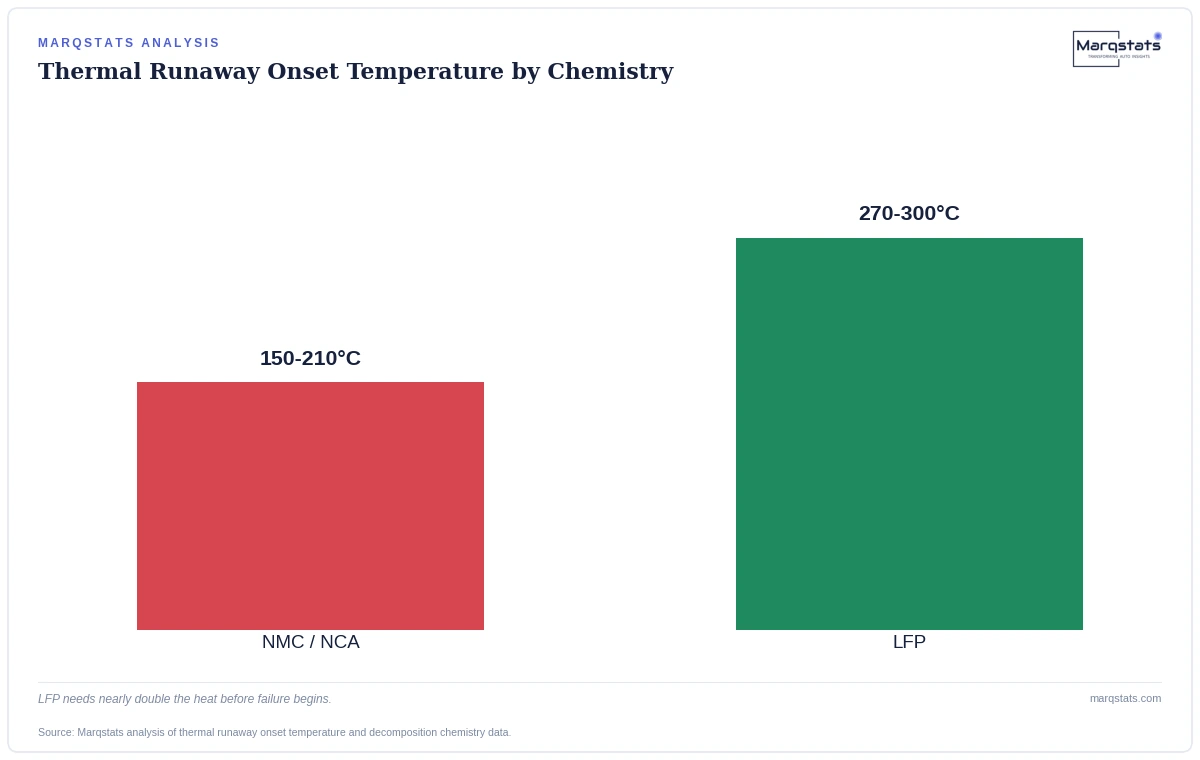
How that loop unfolds, and how dangerous it is, depends heavily on the cathode chemistry. Nickel-Manganese-Cobalt and Nickel-Cobalt-Aluminum formulations, which dominated the first generation of EVs and the first wave of DIY salvage conversions, begin this process at a relatively low 150°C to 210°C. As the cell's layered metal-oxide structure breaks down, it releases free oxygen directly inside the sealed cell - and that oxygen immediately reacts with the flammable liquid electrolyte, driving a self-oxidizing combustion that keeps burning even without outside air.
NMC batteries carry their own oxygen supply into the fire. LFP batteries don't.
— Marqstats Analyst Team
Why LFP behaves so differently
Lithium Iron Phosphate uses a fundamentally different crystal structure - an olivine lattice held together by strong phosphorus-oxygen covalent bonds. That structure stays stable up to roughly 270°C to 300°C, meaningfully hotter than NMC's failure point. And critically, when LFP is finally pushed into thermal decomposition through severe abuse, it does not release free oxygen the way NMC does. The cell may still vent hot, flammable gas through its safety pressure relief valve, but it doesn't carry the same self-sustaining, oxygen-fed combustion cascade that makes NMC and NCA fires so difficult to extinguish.
Why this matters specifically for home battery storage
A car's battery pack sits inside a metal chassis, generally away from people and often outdoors or in a detached garage. A DIY home battery bank frequently sits inside an occupied structure - a basement, an attached garage, a shed near the house. The consequences of a thermal event scale very differently depending on proximity to people and structures, which is exactly why fire codes and insurance underwriters treat indoor residential battery storage far more cautiously than automotive applications.
This is also why the shift toward LFP in new residential storage products isn't just a cost story - it's a genuine safety upgrade independent of price. A residential system built around new LFP cells starts from a meaningfully safer chemistry baseline than a salvage build using older NMC or NCA automotive modules, before even accounting for the fact that a used automotive cell has also already absorbed thousands of charge cycles of wear.
The counter-argument: does LFP's safety edge mean any LFP system is automatically safe?
It's worth being careful here - LFP's superior thermal stability reduces one specific risk factor, but it doesn't eliminate fire risk entirely, and a poorly designed or poorly installed system using any chemistry, including LFP, can still fail badly. Overcharging, physical damage, and poor thermal management remain real risks regardless of cathode chemistry. LFP's advantage is that it gives you a wider safety margin and a less catastrophic failure mode if something does go wrong - not immunity from ever going wrong in the first place.
What this means for anyone evaluating a home battery system
- Ask specifically about cathode chemistry, not just brand or capacity, when evaluating any home battery product or DIY build.
- Treat older NMC or NCA salvaged automotive modules with proportionally greater caution around installation location and ventilation than a new LFP-based system.
- Understand that LFP's safety advantage reduces but does not eliminate fire risk - proper installation, certified components and correct operating limits still matter regardless of chemistry.
The full market picture
Marqstats' complete global second-life EV battery residential and DIY storage conversion market analysis, including the full chemistry and degradation risk profile, is available in the linked report below.
Related reportGlobal Depreciated EV Battery Residential and DIY Storage Conversion Market Size, Share & Forecast 2026 – 2030