A Certification Gap With Real Legal Teeth
This isn't a soft industry recommendation -- it's a hard legal requirement with a specific number attached to who currently meets it.
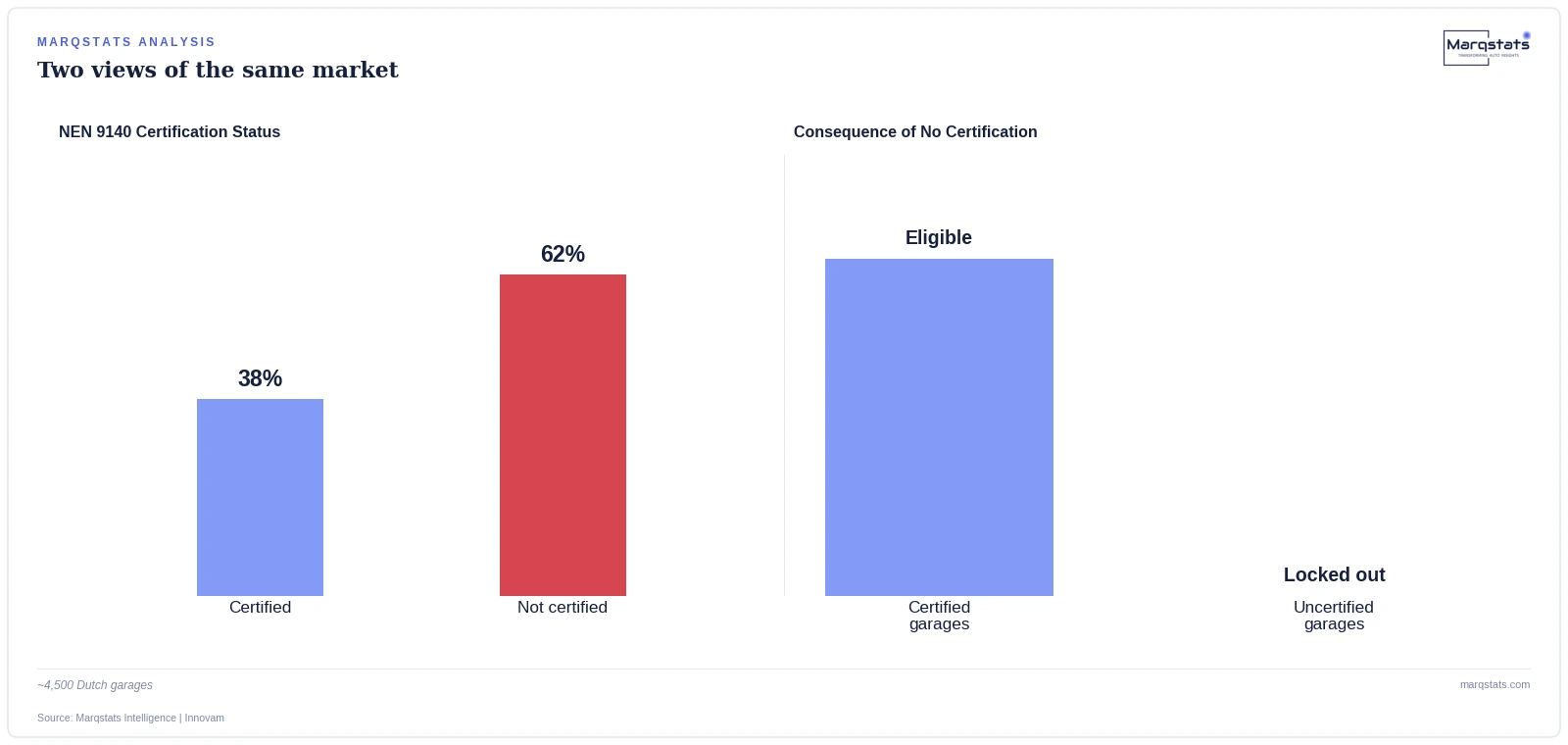
In brief: high-voltage safety standard NEN 9140 requires workshop technicians to hold formal certification (EV-VOP or EV-VP) to perform even basic brake or suspension work on a BEV -- and only 38% of the roughly 4,500 active garage businesses in the Netherlands currently employ someone who holds it.
Why This Rule Reaches Further Than It Sounds
The phrase "basic brake or suspension work" is doing a lot of work here, and it's worth being explicit about what it excludes.
Not just battery work. Brake work. Suspension work. Basic work.
— Marqstats Analyst Team
This isn't a niche requirement limited to high-voltage battery repairs -- it covers routine mechanical work that any competent technician could safely perform on an ICE vehicle without special training. On a BEV, the same job requires certification, because the proximity of high-voltage components changes the safety calculus even for otherwise ordinary mechanical tasks.
A Named Comparison: Why Independent Garages Feel This Hardest
The financial logic behind who can and can't clear this bar is worth spelling out.
Independent garages failing to invest EUR 1,500 to EUR 3,000 per technician in NEN 9140 training are legally locked out of lease fleet maintenance networks entirely. For a single-location independent garage, that's a genuine capital decision weighed against uncertain fleet-contract payoff -- a decision a large formula network with dozens of locations and lease-company relationships already in place doesn't have to make the same way.

Why Lease Companies Feel This Pressure Too
The certification gap doesn't just constrain garages -- it constrains the companies trying to find garages to work with.
Lease companies control roughly 50% of the active BEV passenger fleet in the Netherlands, and with only 38% of garages certified to handle that fleet's routine maintenance, those companies face genuine capacity constraints of their own -- shifting work toward consolidated formula networks not necessarily because those networks offer better service, but because they're simply among the few compliant options available at scale.
What This Means for Independent Garages and Lease Fleet Managers
The practical takeaway: independent garages should treat NEN 9140 certification as a near-term competitive necessity specifically, not an optional upgrade, given how directly this single compliance gap already determines which businesses can compete for the roughly half of the BEV fleet controlled by lease companies.