
A Small Fleet That Buys a Third of the Oil
Vehicle counts and lubricant demand rarely move together this unevenly. Mexico's heavy-duty fleet shows exactly how far the two can diverge.
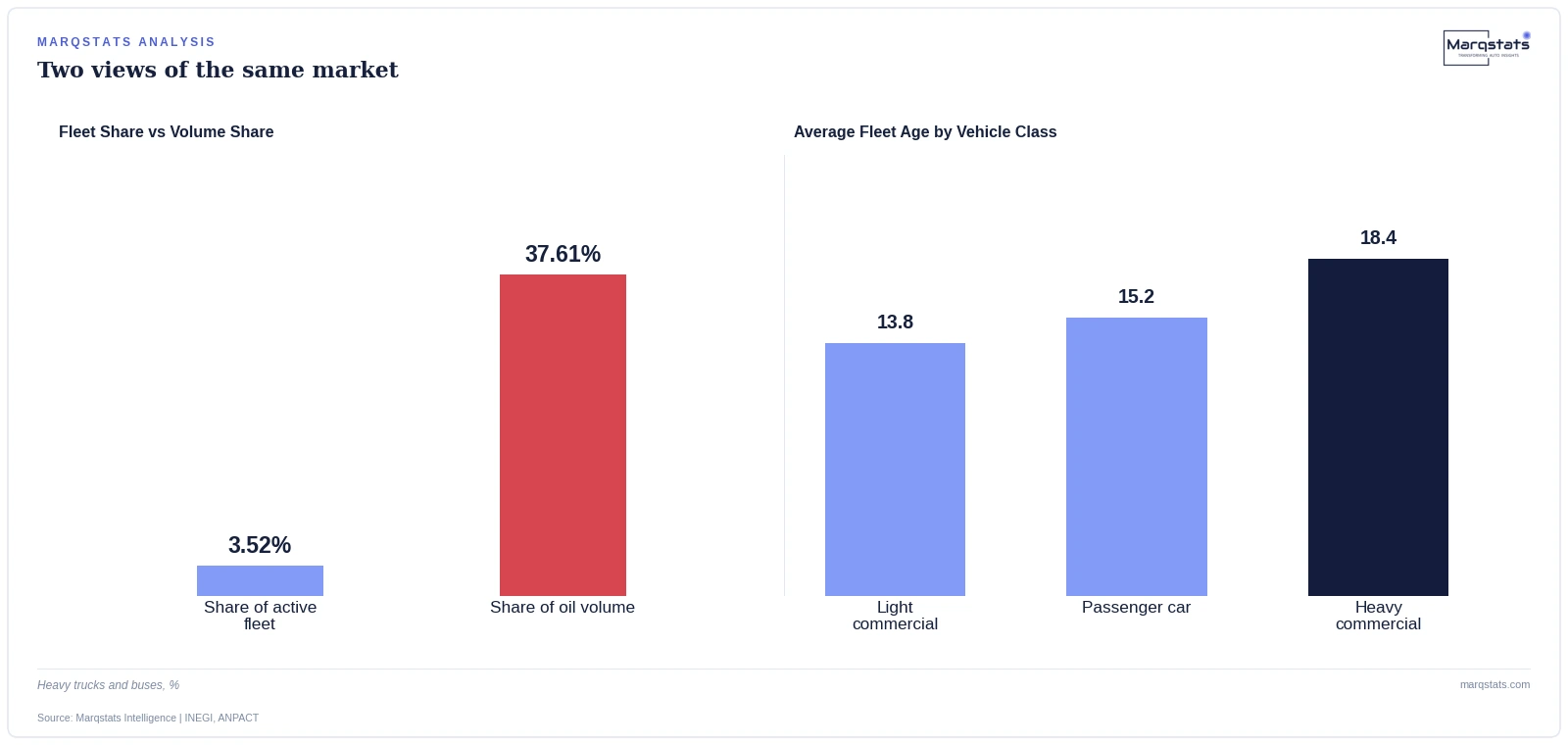
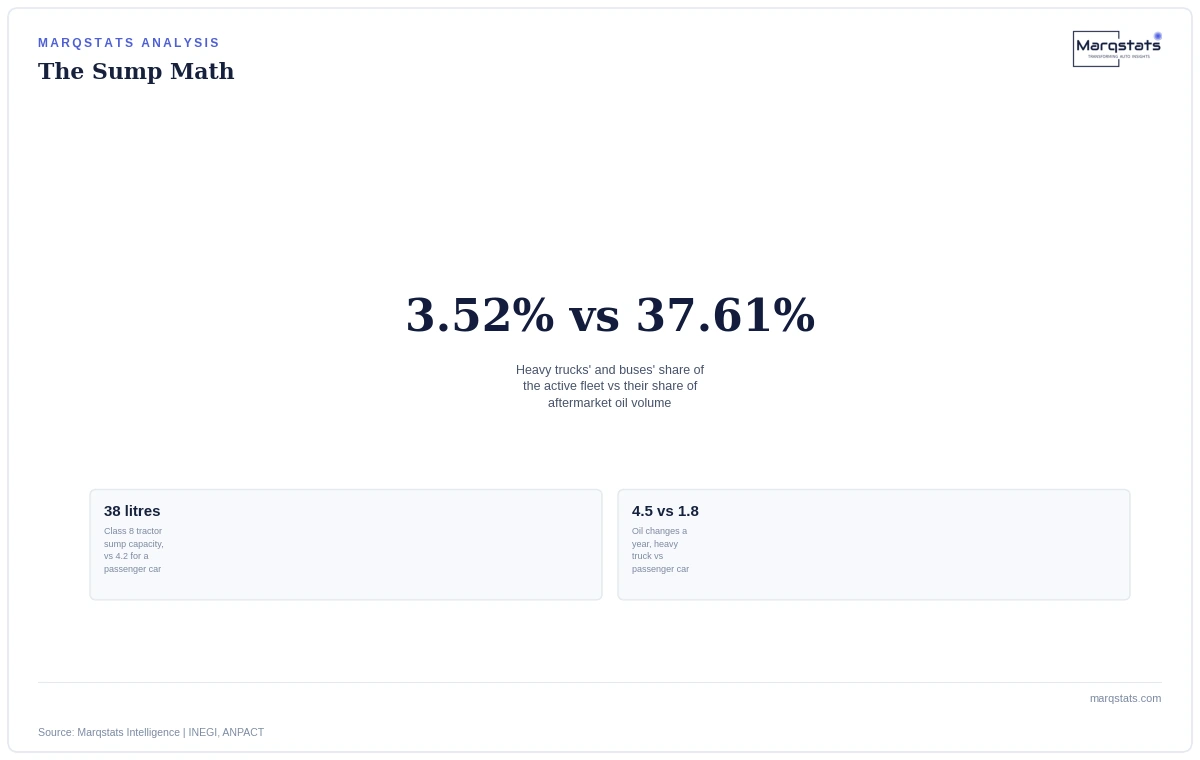
Heavy commercial trucks, Class 6 through 8, and buses together number 1,627,334 units. That is 3.52% of Mexico's 46.23 million active vehicles. The underlying research's own fleet-consumption table puts their combined oil use at 261.99 million litres a year, 37.61% of the country's 696.64 million litre aftermarket.
Where the Leverage Comes From
Two multipliers, not one, explain the gap.
A Class 8 tractor carries up to 38 litres of oil in its sump, against 4.2 litres for a passenger car. It is also drained 4.5 times a year, against 1.8 for a car. Multiply sump size by drain frequency and one truck accounts for roughly the same annual oil volume as more than 20 passenger cars.
A Named Comparison: The Oldest Trucks on the Road
The heavy fleet is not just bigger in sump size. It is older than the rest of the vehicles on Mexican roads.
The average heavy commercial vehicle is 18.4 years old, against 15.2 for a passenger car and 13.8 for a light commercial vehicle. Older engines run looser tolerances and burn more oil between changes, which reinforces the volume the sump-and-interval math already predicts.
Why a 2025 Rule Lands Squarely on This Fleet
Regulation just raised the technical bar for exactly this population.
NOM-044-SEMARNAT-2017 became fully mandatory on 1 January 2025. From that date, Mexico no longer certifies newly manufactured or imported heavy-duty diesel engines meeting only Euro V or EPA 07; Euro VI and EPA 2010 are now the sole standards for new commercial vehicles above 3,857 kg. Those engines carry diesel particulate filters and selective catalytic reduction systems that are poisoned by sulphated ash, phosphorus and sulphur, so the rule pushes fleets toward low-SAPS API CK-4 and FA-4 oils and away from legacy high-ash CI-4 formulations.
The Fuel Problem Undercutting the Rule
The regulation assumes a fuel-quality infrastructure that is not yet uniform.
Industry bodies ANPACT and AMDA report that ultra-low-sulfur diesel is not consistently available on secondary transport routes. Operators fuelling new-generation engines with higher-sulfur diesel on those routes degrade their particulate filters faster and need oils carrying a higher total base number reserve than standard CK-4 formulations provide.
What This Means for Blenders and Fleets
The practical takeaway: blenders should treat heavy-duty low-SAPS formulations as the highest-leverage product line in the Mexican market, and fleet operators running secondary routes should verify local fuel sulphur content before assuming standard CK-4 oil gives adequate protection.