
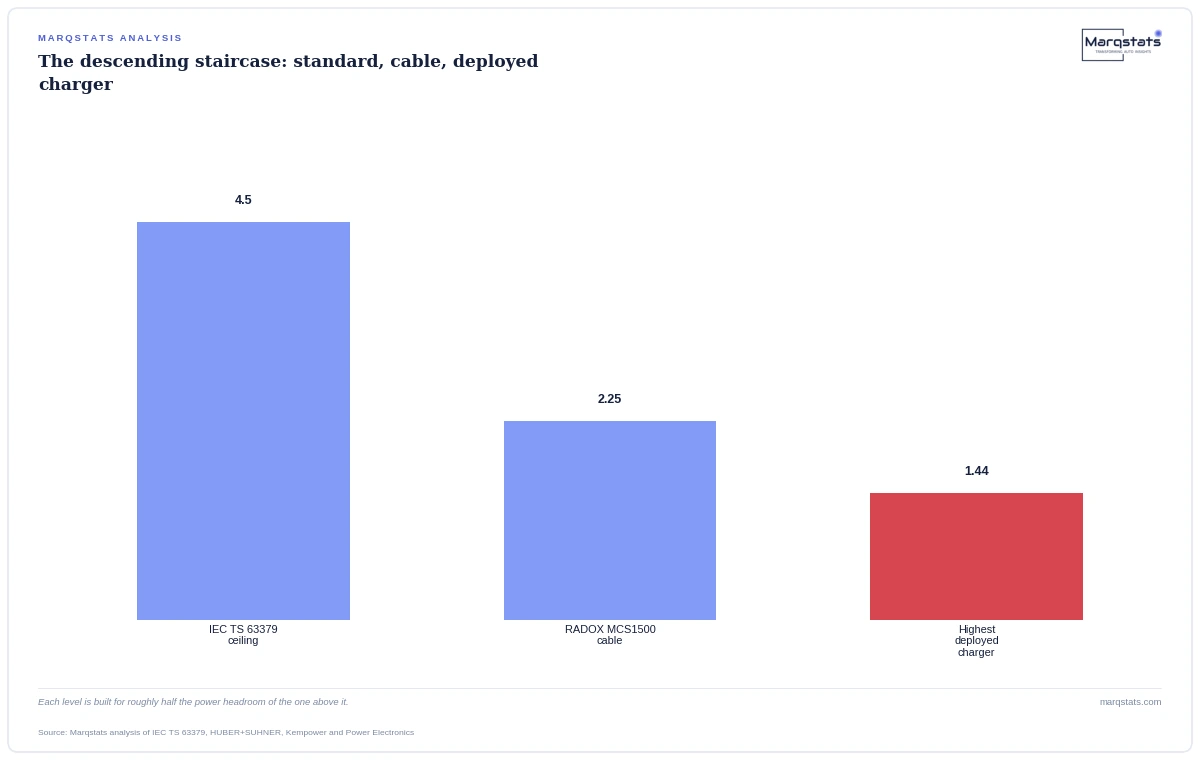
The cable can carry 2.25 megawatts. Nothing plugged into it draws more than 1.44.
HUBER+SUHNER's RADOX MCS1500 cable, the liquid-cooled cable assembly used across several European megawatt charging deployments, is rated to 1,500 amps at 1,500 volts, a theoretical 2.25 MW. The highest-power dispensers actually operating in Europe today, from Kempower and Power Electronics, top out at 1,440 kW. The cable sitting in the dispenser housing can carry 56% more power than the equipment on either end of it will ever ask it to deliver.
This is not a defect. It is a sequencing choice, and it tells you something the market's headline point-count and value figures do not: the constraint on Europe's megawatt charging rollout is not cable technology, and has not been for some time.
The standard was written for a ceiling nobody has approached
IEC TS 63379, the technical specification governing the physical MCS connector, defines a theoretical maximum of 4.5 MW at 1,500 V and 3,000 A. That is more than three times the highest power rating any named European installation has reached. The standards body wrote in headroom for vehicle classes, marine vessels, rail, off-highway equipment, that the current heavy-truck charging market does not use and, on present deployment trajectories, will not need for years.
Put the three numbers together and a pattern emerges. The standard's ceiling (4.5 MW), the cable's rating (2.25 MW) and the highest deployed charger (1.44 MW) form a descending staircase, each roughly half the one above it. Standards and cable manufacturers are building for a future power level; charger manufacturers and site operators are building for today's fleet.
Where the real ceiling actually sits
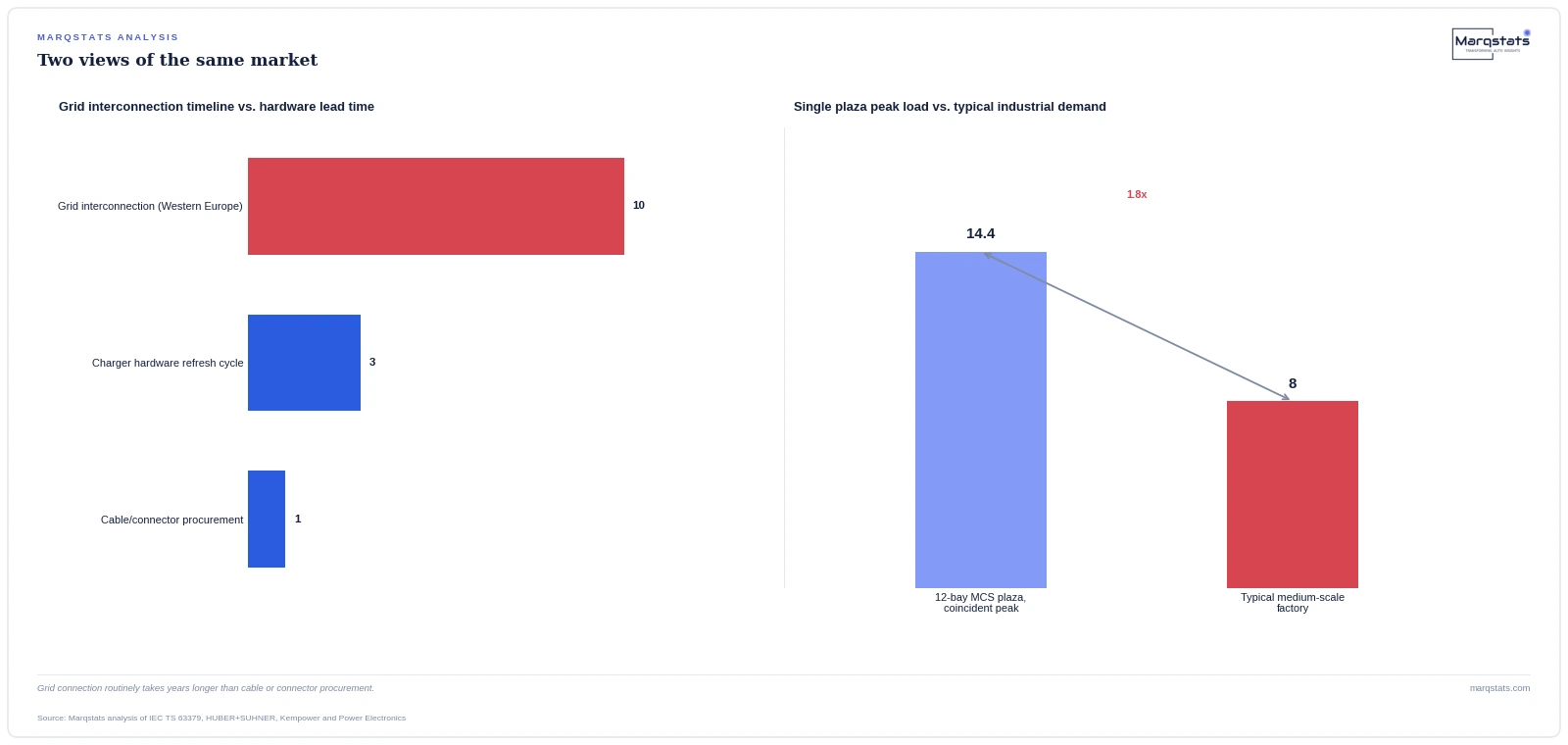
If cables and connectors are not the constraint, what is? This research traced the answer to grid interconnection, not hardware. A single motorway plaza with twelve 1.2 MW dispensers creates a coincident peak load of 14.4 MW, more electrical demand than many medium-scale industrial facilities draw. Utility interconnection procedures for double-digit-megawatt capacity in Western Europe frequently take five to ten years, according to the German auto industry association VDA's own reporting.
That is the actual bottleneck: not the cable in the dispenser housing, but the multi-year process of getting a medium-voltage transformer connected to the grid at a specific rest area or logistics hub. A cable rated to 2.25 MW is a hedge against a future where grid capacity, not connector technology, has caught up, and where a site operator does not want to re-cable a dispenser it just spent years getting connected.
A cable rated for 2.25 megawatts sitting on a 1.44-megawatt charger is not wasted capacity. It is a bet that the grid, not the connector, is what will take years to catch up.
— Marqstats Research
What this means for site operators and equipment buyers
For a charge point operator planning a new site, this reframes what actually gates a project timeline. Cable and connector procurement is not the long lead item; grid interconnection is. An operator that spends a procurement cycle stress-testing cable specifications while treating grid connection as a formality has the sequencing backwards, based on what this research found about where deployment actually slows down.
For equipment buyers evaluating dispenser upgrades, the cable headroom is a genuine asset: a site with RADOX MCS1500 cabling already installed can accept a higher-power converter cabinet later without re-cabling the physical run between cabinet and vehicle. That is a real, if underappreciated, argument for specifying cable capacity ahead of near-term charger power needs, precisely because the cable is cheap to over-spec once and expensive to replace after a multi-year grid connection process concludes.
Grid interconnection timeline, not cable or connector lead time, should anchor project schedules for new MCS sites in Western Europe.
Cable capacity ahead of current charger power is a reasonable hedge, not overengineering, given how much slower grid connection moves than hardware refresh cycles.
IEC TS 63379's 4.5 MW ceiling is a specification for future vehicle classes, not a near-term target, and should not be read as a roadmap for heavy-truck charging power.
The counter-case: cable headroom could still become the constraint
The fair objection here is that cable and connector technology is not static, and today's headroom could compress if converter and grid capacity both scale faster than expected. Silicon carbide semiconductor cost declines are already pulling charger power ratings upward. Fraunhofer ISI's own cost modelling has hardware CAPEX per megawatt falling 13.9% between 2025 and 2030, exactly the kind of trend that could see deployed charger power catch up to cable capacity within the same window this market's point-count forecast covers.
If that happens, a cable rated to 2.25 MW today could become the binding constraint within a normal hardware refresh cycle, rather than remaining comfortably ahead of deployed power for years. We think the grid-interconnection bottleneck is the stronger and more durable explanation for the current gap, given the five-to-ten-year timelines involved, but a buyer specifying cable for a site expected to operate past 2030 should not treat 2.25 MW as an infinite margin.