A Temperature Swing Most Markets Never See
That range alone tells workshop operators something important: a service strategy built around either pure cold-weather expertise or pure heat-related wear will miss half of what actually drives repair demand across a typical Kazakhstani year.
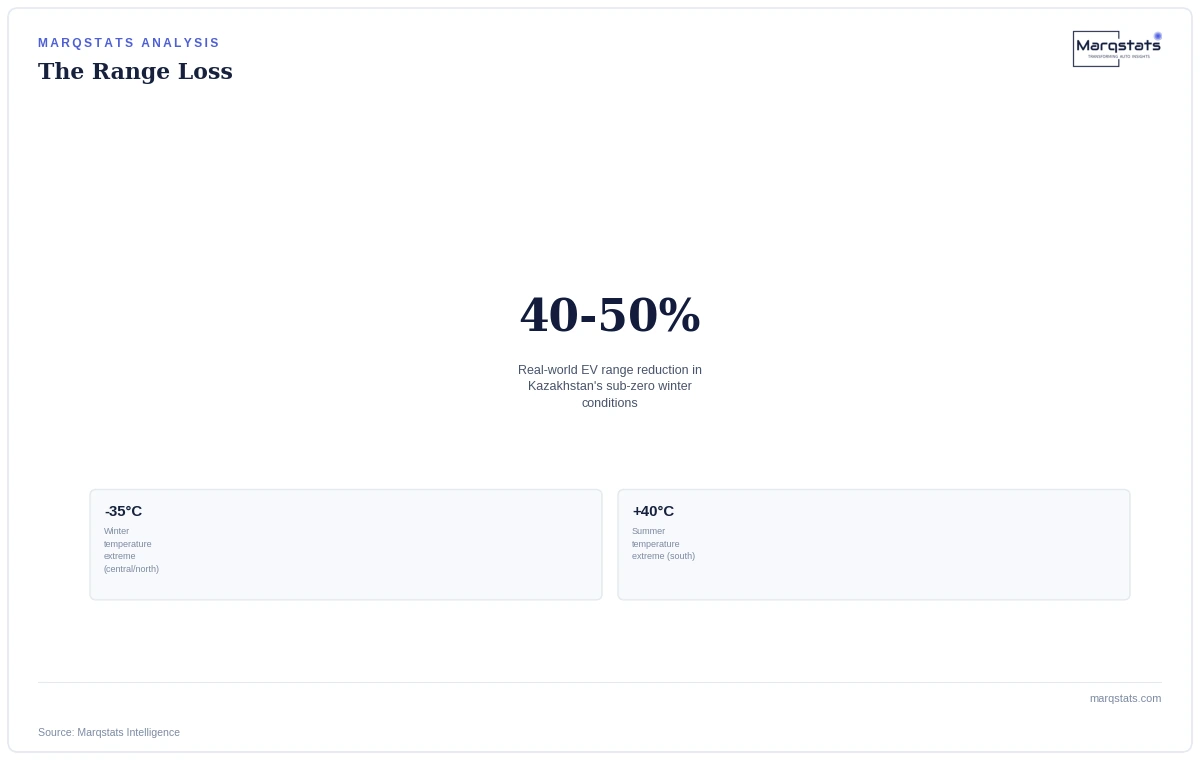
Winter temperatures in central and northern Kazakhstan regularly fall below -35 Celsius. Summer temperatures in the south frequently exceed +40 Celsius. That's a roughly 75-degree annual swing the same battery pack has to survive, year after year.
What Cold Actually Does to a Battery
These effects compound rather than resolve on their own: a battery that has already lost capacity from one harsh winter enters the next cold season with less margin to absorb further degradation, making early diagnostic intervention genuinely valuable rather than a discretionary upsell.
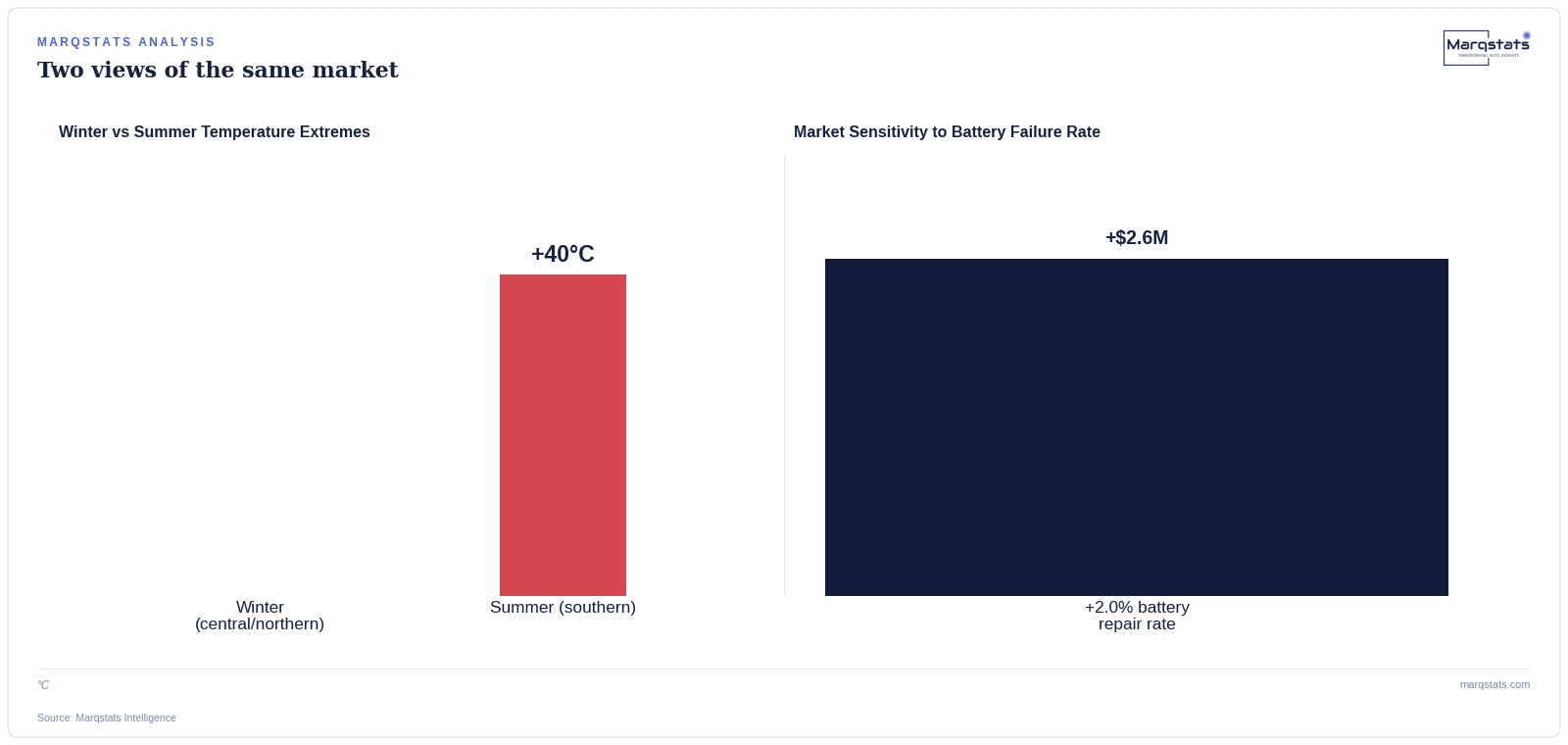
Sub-zero conditions reduce real-world driving range by 40% to 50%, increase failure rates in high-voltage PTC cabin heaters, accelerate 12-volt auxiliary battery degradation, and expose suspension systems to added mechanical shock on frozen surfaces. At the cell level, cold exacerbates capacity degradation and widens the divergence of internal cell resistances — exactly the imbalance that drives demand for diagnostic capacity testing and cell balancing.
Why Summer Isn't a Break From the Stress
It would be easy to assume winter is the only season that matters for EV maintenance planning in Kazakhstan. The data doesn't support that assumption -- both extremes contribute genuinely distinct failure modes across the same annual cycle.
Extreme heat doesn't give the battery a rest either. High summer temperatures place continuous demand on thermal management loops working to keep cells within a safe operating range, and fast-charging along highway corridors — common on Kazakhstan's long intercity routes — further accelerates cell degradation when packs lack active liquid thermal management.
A Named Comparison: Why This Differs From Ordinary Climate Wear
Plenty of markets have cold winters or hot summers. Few combine both extremes on the same national fleet within a single year, the way Kazakhstan does. That combination means workshops here can't specialize narrowly in either cold-weather or heat-related service work the way a technician in a more climatically consistent market might — they need genuine competency across both failure modes.
Why Fast Charging Adds a Third Stress Factor
Kazakhstan's long intercity highway corridors push many EV owners toward frequent DC fast charging, which places its own additional thermal load on packs regardless of season -- meaning the climate stress this market faces isn't purely a matter of ambient temperature, but compounds with charging behavior specific to how people actually drive here.
What This Means for Workshop Investment
The practical takeaway: workshops and component suppliers operating in Kazakhstan should treat thermal management servicing as a year-round revenue category rather than a seasonal one, and should stock dielectric coolants and thermal loop components continuously rather than trying to time inventory around a single expected peak season.