Not the Capital You'd Expect
This isn't a marginal statistical quirk either -- Gifu has topped this ranking for a full decade running, which rules out a one-year fluke or a temporary local incentive program skewing a single data point.
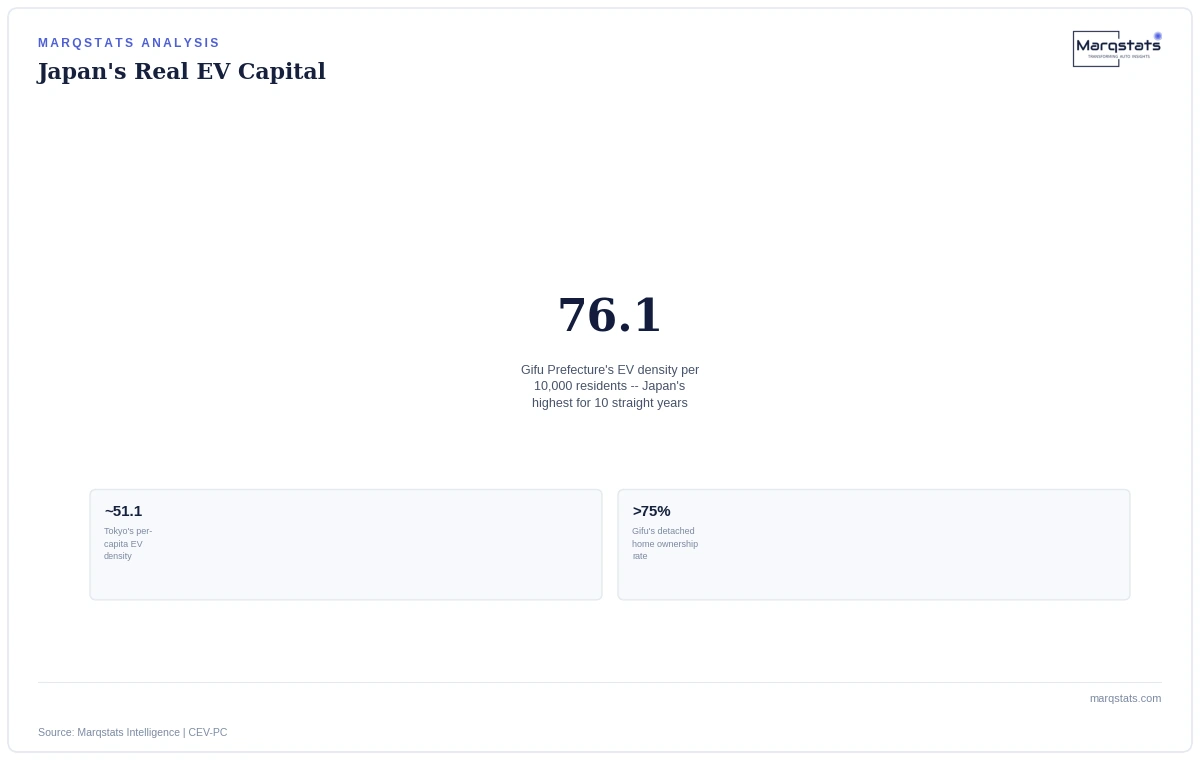
Ask which part of Japan has adopted electric vehicles most enthusiastically, and Tokyo is the obvious guess. The actual answer, measured per capita, is Gifu Prefecture — and it's held that ranking for ten consecutive years.
The Number Behind the Ranking
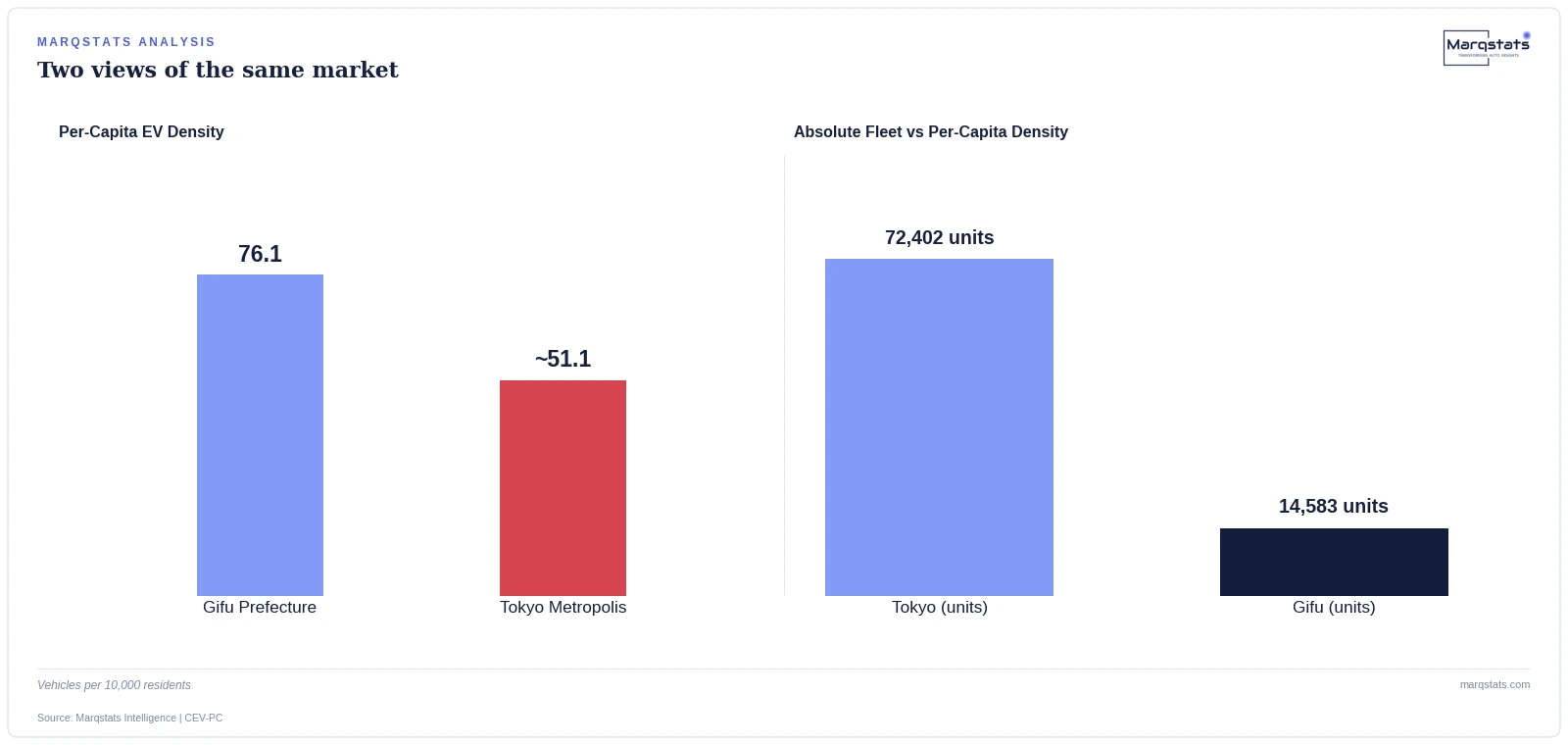
Gifu records 76.1 electric vehicles per 10,000 residents, against roughly 51.1 in Tokyo. Tokyo still has the larger absolute fleet — 72,402 units versus Gifu's 14,583 — but on a per-resident basis, Gifu is genuinely the more EV-adopted place in Japan.
The Housing Difference That Explains It
It would be easy to assume this comes down to income differences between prefectures instead. The underlying data points somewhere more specific than that -- toward physical access to a driveway or garage, not household wealth alone.
The gap traces to a specific, structural difference: home ownership patterns. Gifu has over 75% detached single-family home ownership, letting residents install 200V Level-2 wall chargers without navigating condominium association approval processes. Tokyo's dense multi-family housing stock makes that same installation genuinely difficult for most residents, regardless of how much municipal subsidy money is available.
A Named Comparison: Why Municipal Subsidies Can't Fully Close This Gap
This is a useful case for anyone assuming purchase incentives alone drive EV adoption. Tokyo offers substantial municipal EV subsidies, yet its per-capita adoption still trails Gifu's, because the constraint isn't purchase price — it's whether a resident can actually charge the car at home overnight. No subsidy fixes that specific problem for someone living in a condominium building without dedicated charging infrastructure.
Where Else This Pattern Repeats
Gifu is not an isolated case. Aichi (71.9 per 10,000) and Okayama (63.5 per 10,000) show the same pattern -- favorable climate and housing conditions combined with high reliance on personal vehicles for daily transit, producing per-capita adoption rates well above what their absolute population size alone would predict.
What This Means for Workshop and Charging Infrastructure Planning
The practical implication: aftermarket investment planning based on absolute city size alone will systematically undercount suburban and rural prefectures with high detached-home ownership. Gifu, Aichi and Okayama-style markets deserve more workshop and parts-inventory investment relative to their city size than a pure population-based model would suggest.
Why This Pattern Should Persist
Housing stock changes slowly. Unless Japan's urban condominium associations dramatically streamline charger installation approval, or public charging infrastructure in dense cities closes the convenience gap with home charging, this suburban-over-urban adoption pattern is likely to persist for years, not shift with the next subsidy cycle.