Three Tiers, One Legal Wall
In brief: Italy's CEI 11-27 standard, operationalized under Legislative Decree 81/2008, establishes three distinct professional qualification tiers for anyone working on a vehicle's high-voltage system. No automotive technician can legally open a high-voltage service disconnect, dismantle a battery casing, or connect high-voltage diagnostic tools without holding one of these credentials.
What Each Tier Actually Permits
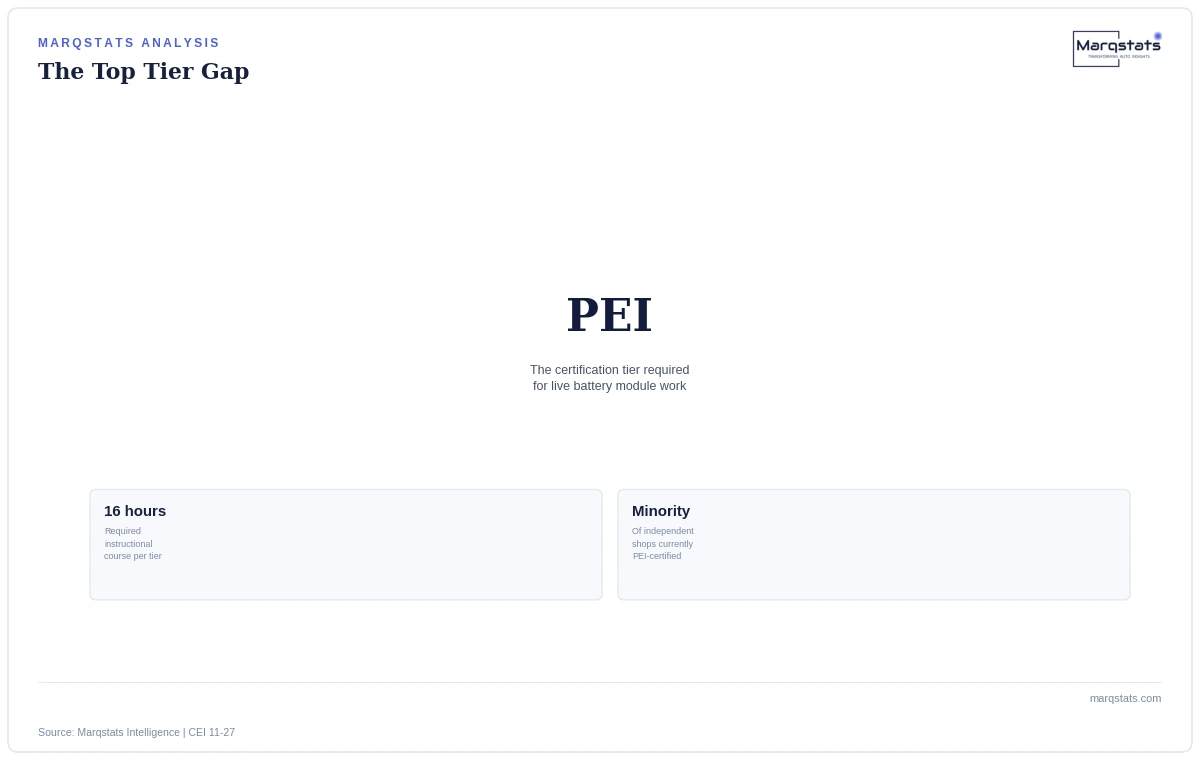
PAV, the entry tier, authorizes work on de-energized high-voltage systems or near exposed components, but only under a PES's direct supervision. PES authorizes independent risk evaluation, circuit analysis, and safe-work permit issuance. PEI, the highest tier, is the only credential permitting live electrical work — including internal battery module testing, live cell voltage measurements, and busbar replacement inside an opened traction battery pack.
Where the System Actually Breaks Down
The law doesn't ban independent shops from EV work. The capital requirement effectively does.
— Marqstats Analyst Team
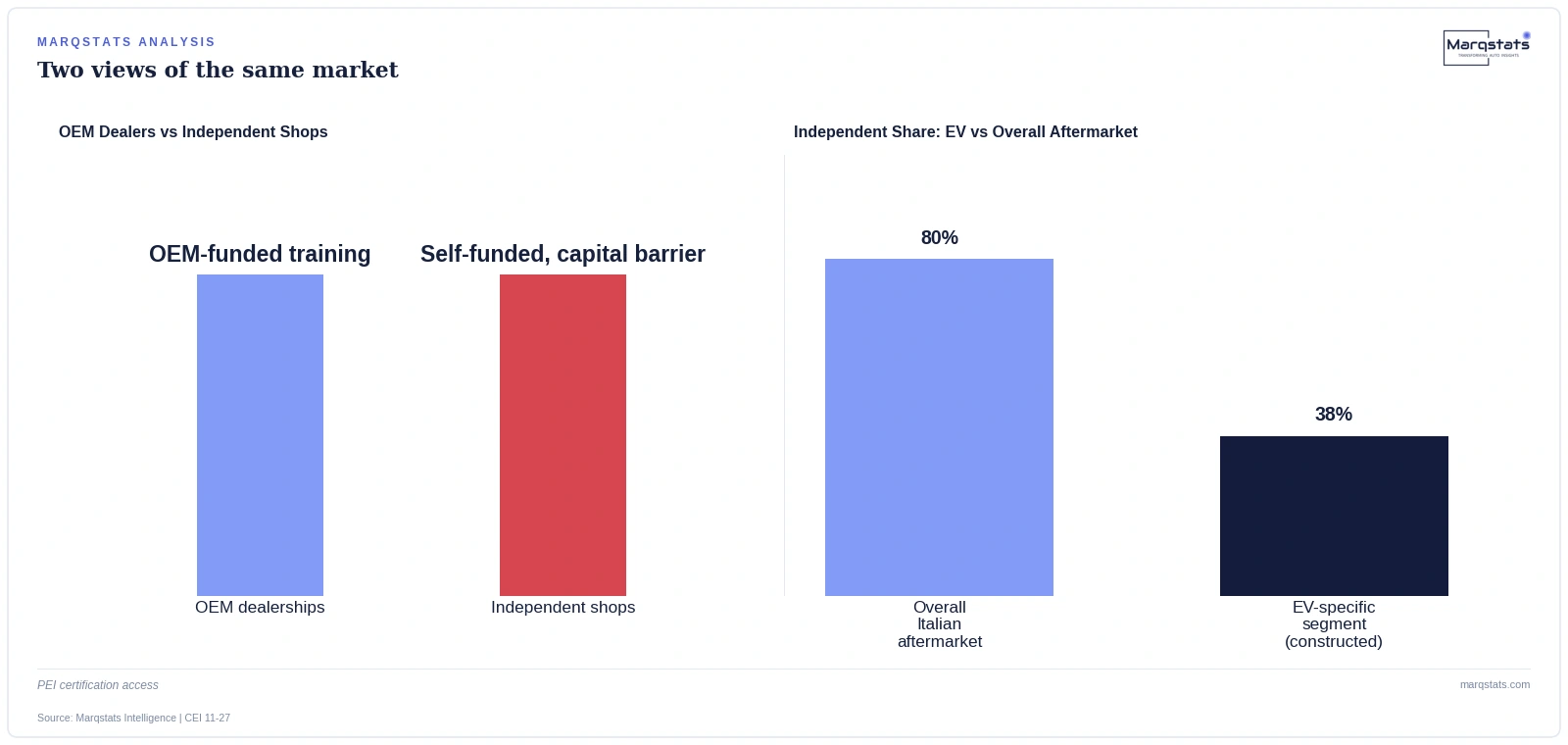
Certified corporate dealerships receive OEM-funded training as a matter of course. Independent repairers must fund the certified 16-hour instructional courses themselves, purchase 1,000V-rated insulated gloves and arc-flash face shields, acquire isolated workshop lifts, and buy high-voltage diagnostic tools out of pocket. That capital requirement has created a genuine skill bottleneck: only a minority of independent repair shops currently hold active PEI certification.
Why This Specifically Protects OEM Dealer Dominance
The consequence is structural, not incidental. Independent repairers are frequently forced to decline complex battery or inverter servicing entirely — not because they lack customers wanting the work, but because they lack the legal standing to perform it. That directly reinforces OEM dealer dominance over exactly the highest-value EV service category, even in a country where independent workshops handle nearly 80% of all automotive service volume across every other powertrain.
A Named Comparison: Why This Differs From a Simple Training Gap
This isn't a case where independent shops are choosing not to invest in training. Bosch Car Service and LKQ/ZF Aftermarket are both actively building dedicated EV training academies specifically to help independent workshops close this gap — the demand for certification exists. What's constraining the pace is the combined capital and time cost of reaching PEI specifically, the tier that actually unlocks the most valuable repair work, not general awareness or willingness to train.
What This Means for Independent Workshops and Their Customers
The practical takeaway: independent workshops evaluating EV capability investment should treat PEI certification specifically, not just baseline PAV or PES qualification, as the genuine strategic target — it's the credential that actually opens the door to the market's highest-value repair category, and franchise programs like Bosch Car Service eXtra offer a concrete path to reach it without each workshop building standalone capability from scratch.