A Century-Old Product Category, Rebuilt From the Wheel Out
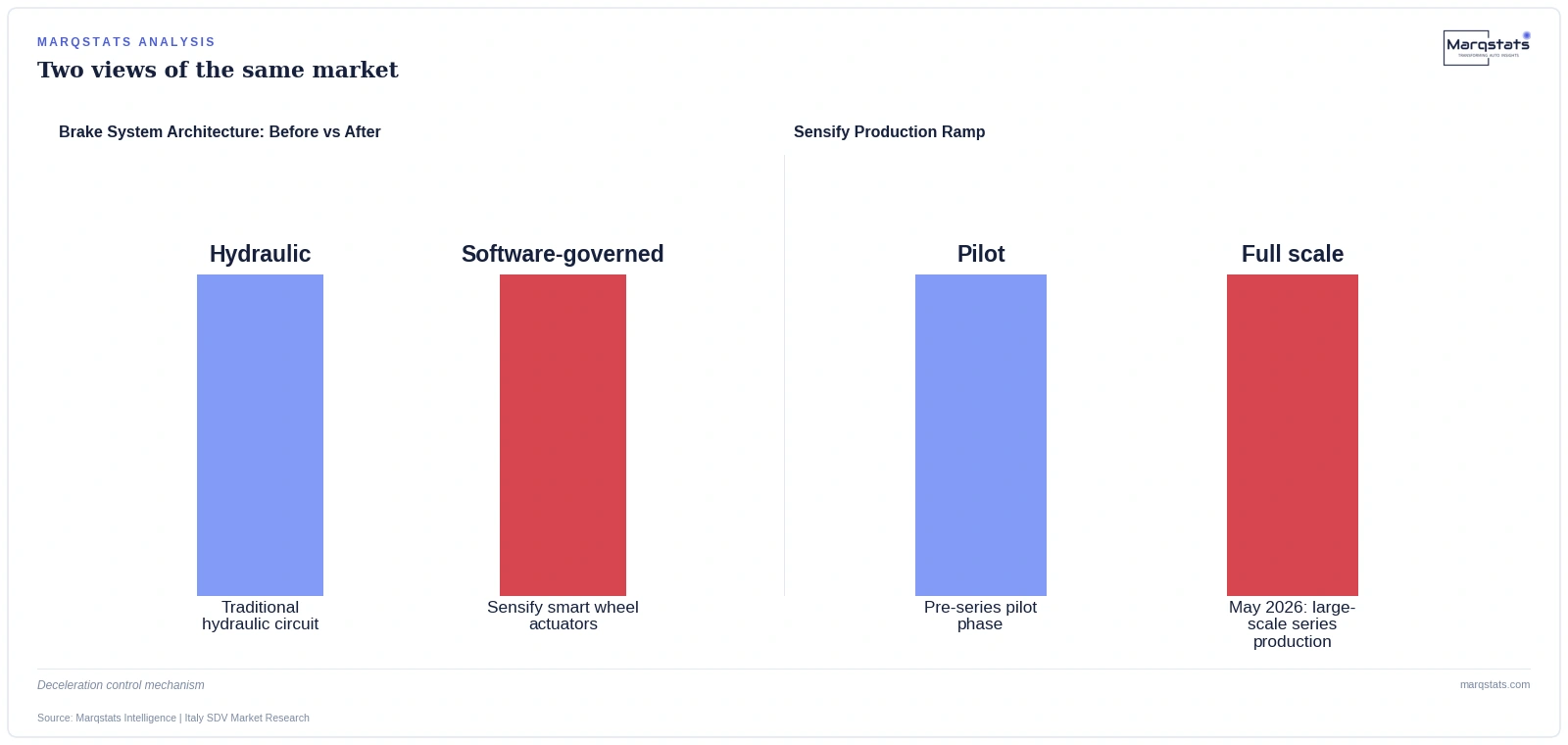
Brembo has built its business on brake calipers, rotors and pads, an unambiguously mechanical product line built on friction, hydraulics and metal. In May 2026, the company announced that its Sensify platform, an electromechanical, fluid-free brake-by-wire system, had entered large-scale series production. This is not an incremental upgrade to an existing product. It is a different category of product wearing the same name.
What Actually Changed
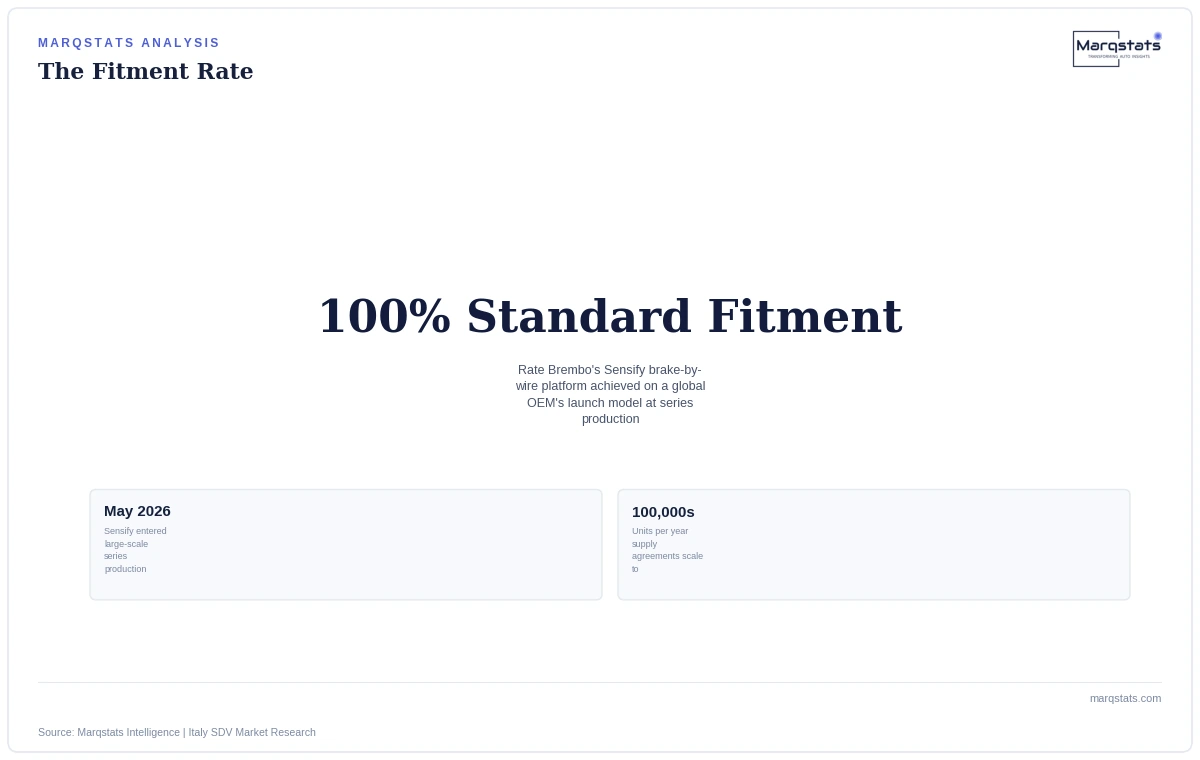
Sensify replaces traditional hydraulic brake circuits with smart wheel actuators governed by independent braking algorithms, decoupling deceleration commands from physical hydraulic lines entirely. When it entered large-scale series production in May 2026, it achieved 100% standard fitment on a global OEM's launch model, with supply agreements scaling to hundreds of thousands of units per year. The mechanical stopping power still comes from a caliper clamping a rotor. But the decision of exactly how, when and how hard to apply that force at each wheel independently is now a software function, not a hydraulic pressure calculation.
Why This Matters Beyond Brembo
The significance here reaches well past one company's product line. Brembo is one of the clearest examples anywhere in the software-defined vehicle transition of a legacy mechanical Tier 1 supplier successfully repositioning itself around software rather than being disrupted by a company that started there. Plenty of SDV market narratives assume the winners will be software-native entrants displacing traditional component makers. Brembo's Sensify trajectory is evidence that an established mechanical supplier, if it moves early and commits to full series production rather than a pilot programme, can make that same transition itself and keep its market position rather than losing it to a newcomer.
What Other Tier 1 Suppliers Should Take From This
The practical lesson for other component manufacturers watching centralized compute reshape their own product categories: the choice isn't necessarily between staying purely mechanical and being replaced, or exiting the business entirely. Brembo's path, replace the physical mechanism's control logic with software while keeping the core competency (in this case, precision braking engineering) intact, is a genuine third option. Any Tier 1 supplier whose product touches a function increasingly governed by centralized vehicle compute should be asking whether their own version of Sensify already exists on a roadmap somewhere, or whether it needs to start now.