A Workforce Number That Looks Reassuring, Until It Isn't
That gap matters specifically because vehicle counts alone can create a misleadingly comfortable picture of service capacity, when the actual constraint sits in a much narrower, harder-to-scale credential most of that broader workforce simply doesn't hold.
India has more than 5 million automotive mechanics nationwide with real, practical experience in mechanical repair and low-voltage electrical systems. On paper, that looks like a workforce more than capable of handling a growing EV fleet.
The Number That Changes the Picture
The comparison is worth stating plainly: fewer than 1% of India's total mechanic workforce currently holds the specific credential the fastest-growing segment of the vehicle fleet actually requires.
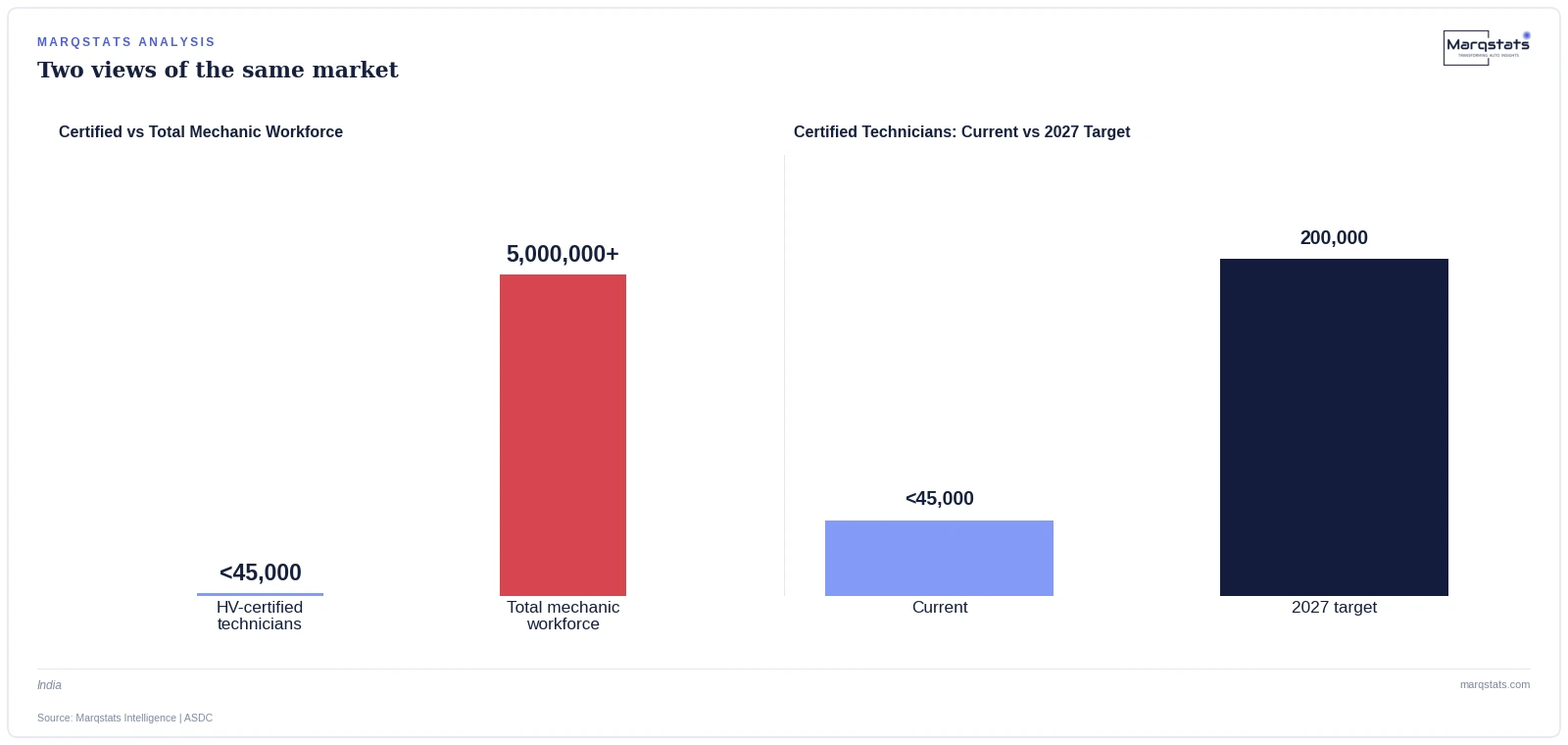
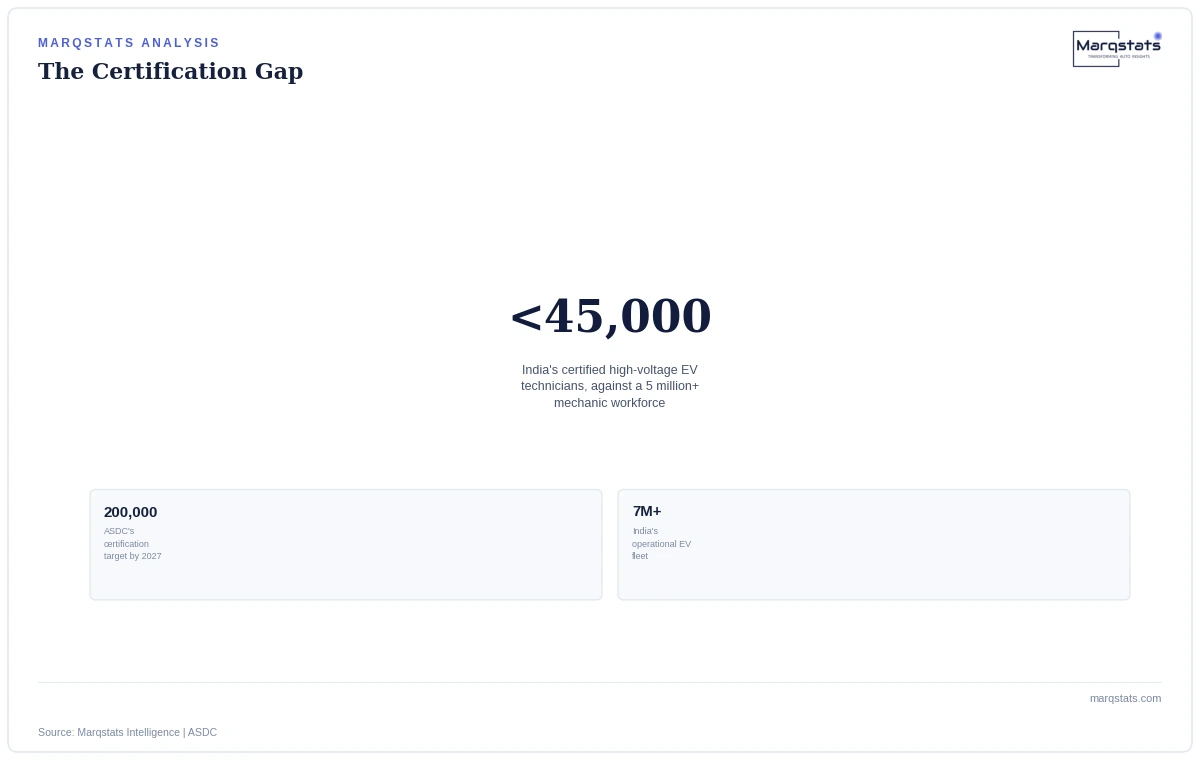
Fewer than 45,000 of those 5 million-plus mechanics hold accredited high-voltage certifications under the Automotive Skills Development Council's Qualification Pack ASC/Q1424 — against an operational EV fleet already exceeding 7 million vehicles.
Why Experience Alone Doesn't Transfer
The distinction matters commercially too: a workshop that markets itself on years of combustion-engine expertise is, in this specific context, marketing a skill set that genuinely does not transfer to the highest-value repair category in the growing EV segment.
Servicing a modern 400-volt passenger vehicle battery pack requires formal competencies that decades of mechanical experience simply don't provide: electrical isolation procedures, high-voltage interlock loop diagnosis, insulation resistance testing, and hazardous chemical mitigation. A mechanic who has rebuilt a thousand combustion engines still needs entirely new, formal training before safely opening a traction battery pack.
A Named Comparison: Why the Target Itself Signals the Scale of the Problem
The Automotive Skills Development Council's own target — 200,000 certified technicians by 2027 — is itself a useful signal. That's roughly 4.4 times the current certified base, needed within a genuinely short window, against a fleet that's already multiplied 1,079% between 2020 and 2024 alone. Even hitting that ambitious target would still leave certified technicians as a small fraction of India's overall mechanic workforce.
How Fast This Gap Could Actually Close
Closing a credential gap this large within a single vocational cycle is genuinely ambitious, even with strong institutional backing -- training capacity, instructor availability, and workshop willingness to release technicians for certification all place real limits on how quickly the numbers can move, regardless of how much funding gets committed on paper.
What This Means for Workshops and Investors
The practical takeaway: institutional investment in high-voltage technician vocational academies, in direct partnership with ASDC, represents a genuine, durable opportunity given how directly this certification gap constrains service capacity expansion across both authorized and independent networks — not a problem the market will simply grow its way out of without deliberate training investment.