The Night That Changed the Regulatory Timeline
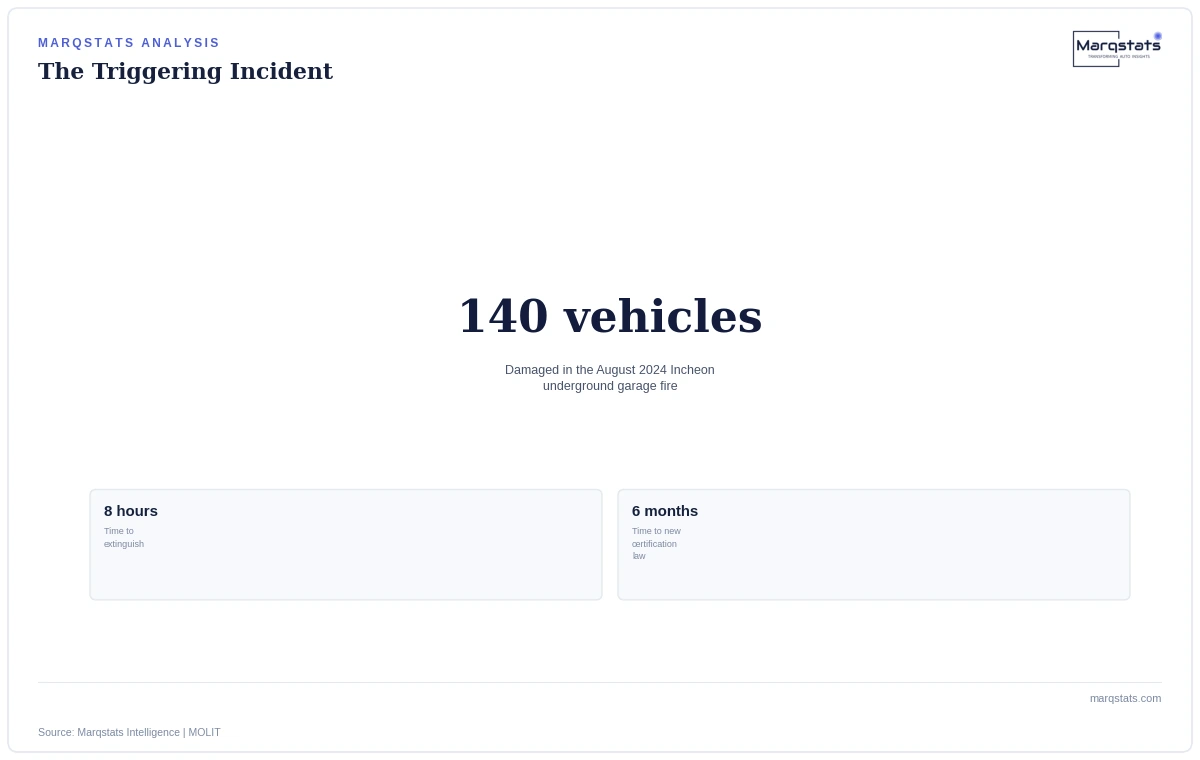
In brief: on August 1, 2024, a Mercedes-Benz EQE caught fire in an underground parking garage in Cheongna, Incheon. The fire damaged 140 vehicles and took 8 hours to extinguish. Within months, that single incident had reshaped South Korea's entire EV battery regulatory framework.
From Incident to Institution
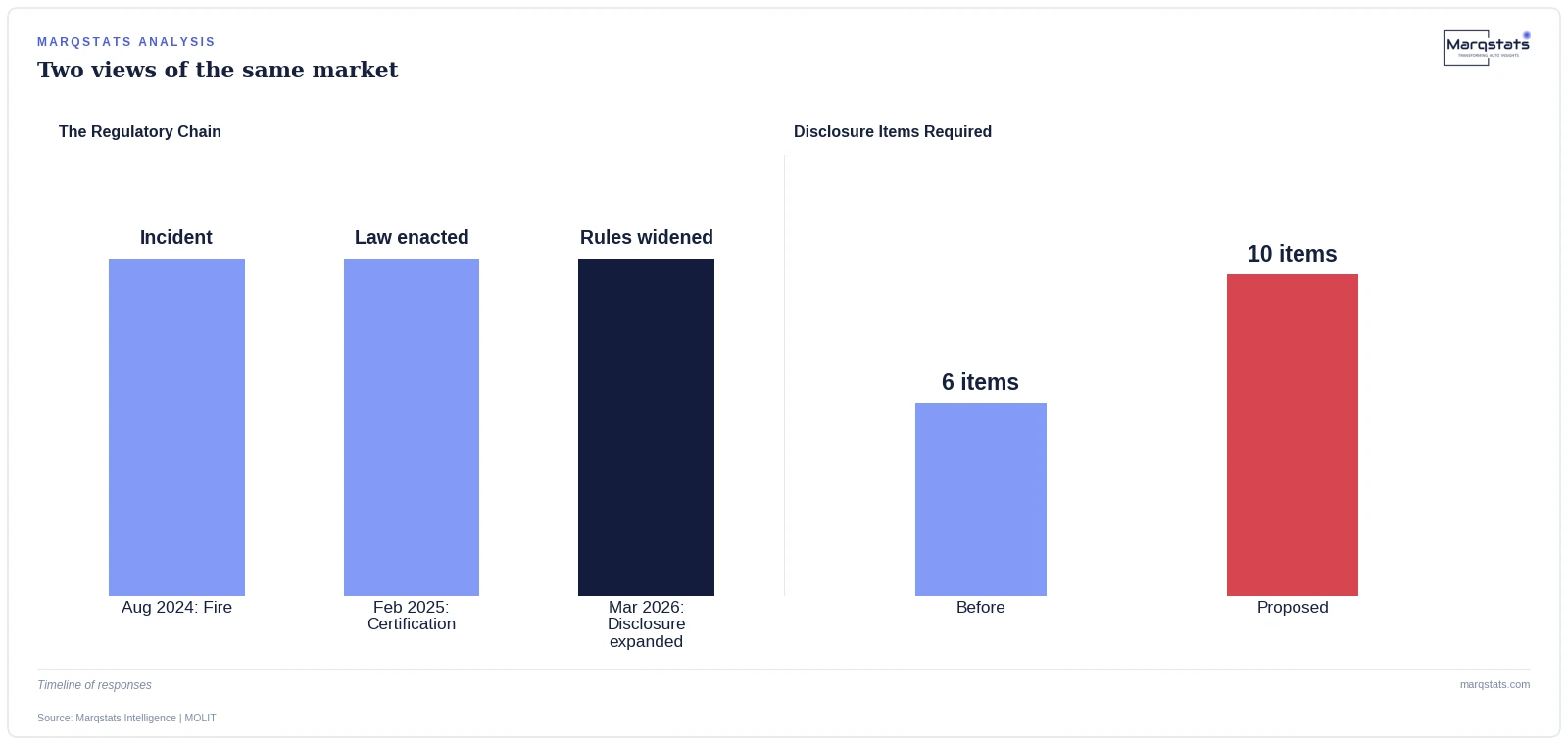
The regulatory chain runs directly from that fire to today's rules. By February 17, 2025, revised Automobile Management Act provisions replaced manufacturer self-certification with mandatory government safety pre-approval for every replacement battery pack sold in South Korea. That's a fundamental shift in who verifies battery safety — from the companies selling the batteries to the state itself.
The Chain Kept Extending
One fire. One government certification mandate. A chain of rules that's still growing two years later.
— Marqstats Analyst Team
The regulatory response didn't stop at certification. By March 2026, MOLIT was proposing further amendments expanding mandatory battery disclosure items from 6 to 10 — adding manufacturing date, country of origin, and product name requirements, backed by fines up to KRW 10 million for non-compliance. By July 2026, mandatory dashboard display requirements for battery health and remaining life metrics took effect. Each new rule traces back, directly or indirectly, to the same underlying safety concern the Incheon fire first exposed publicly.
Why the Speed of This Response Matters
A regulatory shift from industry self-certification to mandatory government pre-approval, implemented within roughly six months of a single triggering incident, is genuinely fast by the standards of automotive safety regulation. That speed reflects how directly and visibly the Incheon fire connected an abstract safety concern (battery thermal runaway) to a concrete, publicly documented consequence (140 damaged vehicles in a residential parking structure).
A Named Comparison: How This Differs From Gradual Regulatory Evolution
Most vehicle safety regulation evolves gradually, through years of incident data accumulation, industry consultation, and incremental rule-making. South Korea's EV battery certification framework instead shows a genuinely event-driven regulatory pattern — a single, well-documented incident compressed what might otherwise have taken years of gradual rule-making into a matter of months.
Why Imported Brands Should Watch This Especially Closely
Foreign OEMs, and Mercedes-Benz specifically given its direct connection to the triggering incident, face a genuinely elevated version of this regulatory attentiveness. Any future safety incident involving an imported brand carries a real risk of triggering brand-specific or import-specific regulatory scrutiny beyond what a purely domestic incident might generate, given the precedent this exact case already set.
What This Means for Anyone Operating in This Market
The practical lesson: South Korea's EV battery regulatory environment has demonstrated it can move quickly in response to a single high-visibility safety incident. Any manufacturer, insurer, or service provider operating in this market should treat regulatory stability as genuinely contingent on continued safety performance, not assume the current rule set represents a settled, slow-moving baseline.