Last of 111, in Germany's Own Data
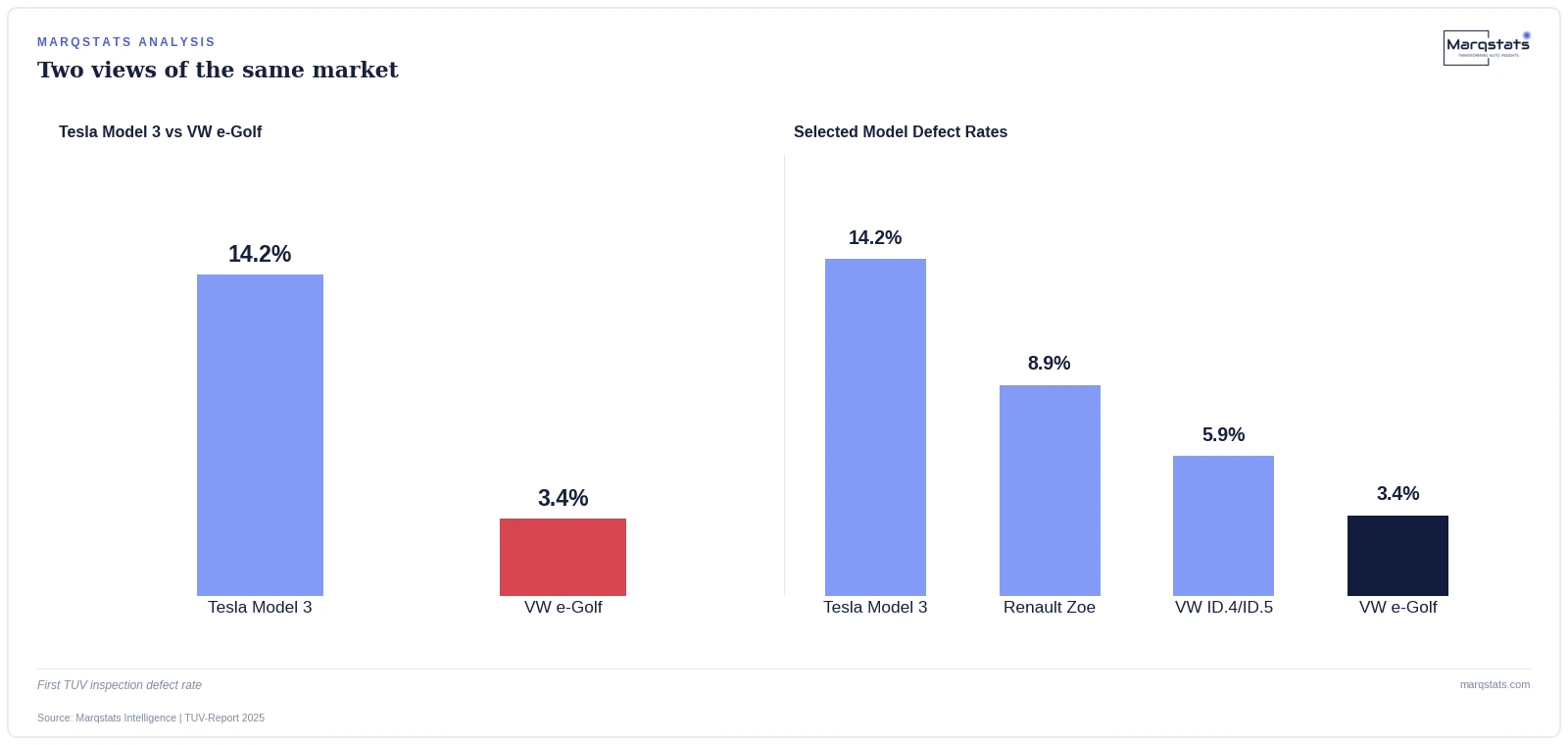
Germany's TUV-Report 2025, evaluating roadworthiness outcomes across millions of statutory inspections, ranked the Tesla Model 3 dead last of 111 evaluated vehicle nameplates. Not last among electric vehicles. Last among every car sold in Germany, regardless of powertrain.
The number behind that ranking is stark, and the explanation isn't what you'd expect.
The Number Itself
A 14.2% significant-defect rate at a vehicle's first inspection cycle, typically at two to three years of age, is a genuinely large number. It would be reasonable to assume it points to an engineering or manufacturing weakness specific to the car.
What the Inspection Engineers Actually Found
The predominant technical failure categories weren't exotic or EV-specific: defective lighting adjusters, rusted brake discs, worn transverse control arm bushings. These are ordinary wear items every vehicle accumulates over time. The inspection engineers' own explanation points somewhere else entirely: Tesla's direct-to-consumer service model relies on condition-based telematics rather than fixed scheduled visits, meaning defects like these simply go uncorrected until the statutory inspection catches them.
The Comparison That Makes the Point
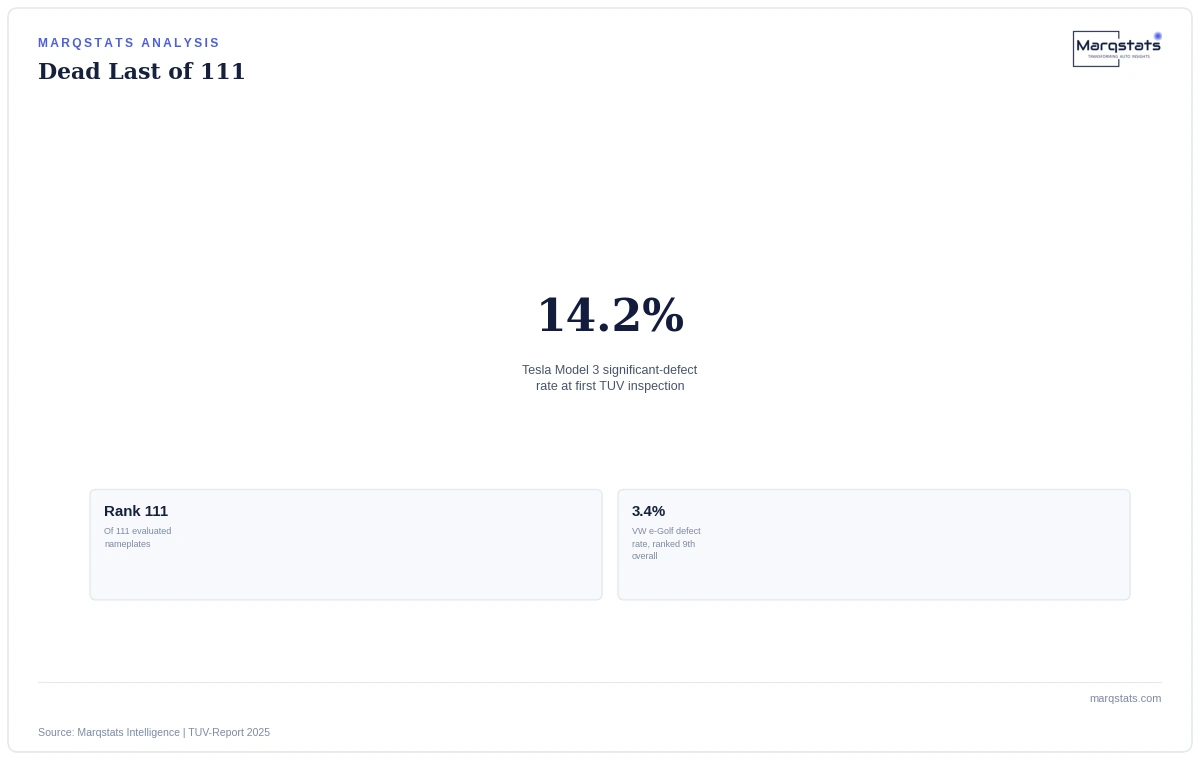
The Volkswagen e-Golf, built on an older, thoroughly proven Golf 7 chassis and serviced through Volkswagen's standard scheduled workshop visit model, recorded a 3.4% defect rate — ranking 9th of 111 nameplates overall, near the top of the entire field. Same country, same regulatory environment, same statutory inspection standard. The gap between 14.2% and 3.4% traces almost entirely to how each manufacturer structures its service visits, not to anything fundamentally different about the vehicles' engineering.
A Named Comparison: Why Condition-Based Service Isn't Automatically Worse
Condition-based, telematics-driven service isn't inherently a flawed approach — in principle, it should catch problems more precisely than a fixed calendar ever could. The issue in Germany specifically is that it removes the forcing function a fixed annual visit provides: a trained technician physically looking over the whole vehicle, not just the specific systems telematics happened to flag. Minor issues that don't trigger a telematics alert — a slightly maladjusted headlight, early-stage rotor surface rust — simply accumulate until the statutory inspection forces the issue.
What This Means for Anyone Reading This Data
The practical takeaway: this isn't a finding about electric vehicles being less reliable than combustion cars — several EVs in the same TUV data, including the Volkswagen e-Golf and Hyundai Kona Elektro, rank among the best-performing vehicles in Germany. It's a finding about service model design, and it's specific enough that manufacturers relying on condition-based service should take it as a direct signal to reconsider whether skipping fixed scheduled visits is actually serving their customers well.