A facility in Inner Mongolia turned nine months of AI training into 11 hours
In August 2022, Chinese EV manufacturer XPeng Motors and Alibaba Cloud switched on a facility called Fuyao in Ulanqab, Inner Mongolia. Its job: process the enormous volumes of driving data autonomous vehicle systems need to learn from. The headline result, independently disclosed and consistent across corporate reporting, is genuinely striking - foundation model training cycles that used to take 276 days now take 11 hours. Both companies have continued to disclose operational details about the facility in subsequent corporate filings and investor communications.
What autonomous driving training actually requires
Training a self-driving car's perception and decision-making systems isn't a one-time exercise - it's a continuous loop. Vehicles on the road encounter edge cases: unusual objects, unexpected pedestrian behavior, confusing road markings. Engineers collect these situations, label what the vehicle should have recognized, and retrain the underlying model to handle the scenario correctly next time. The faster this loop runs, the faster the system improves, and the faster a company can respond to a newly discovered weakness in its driving software.
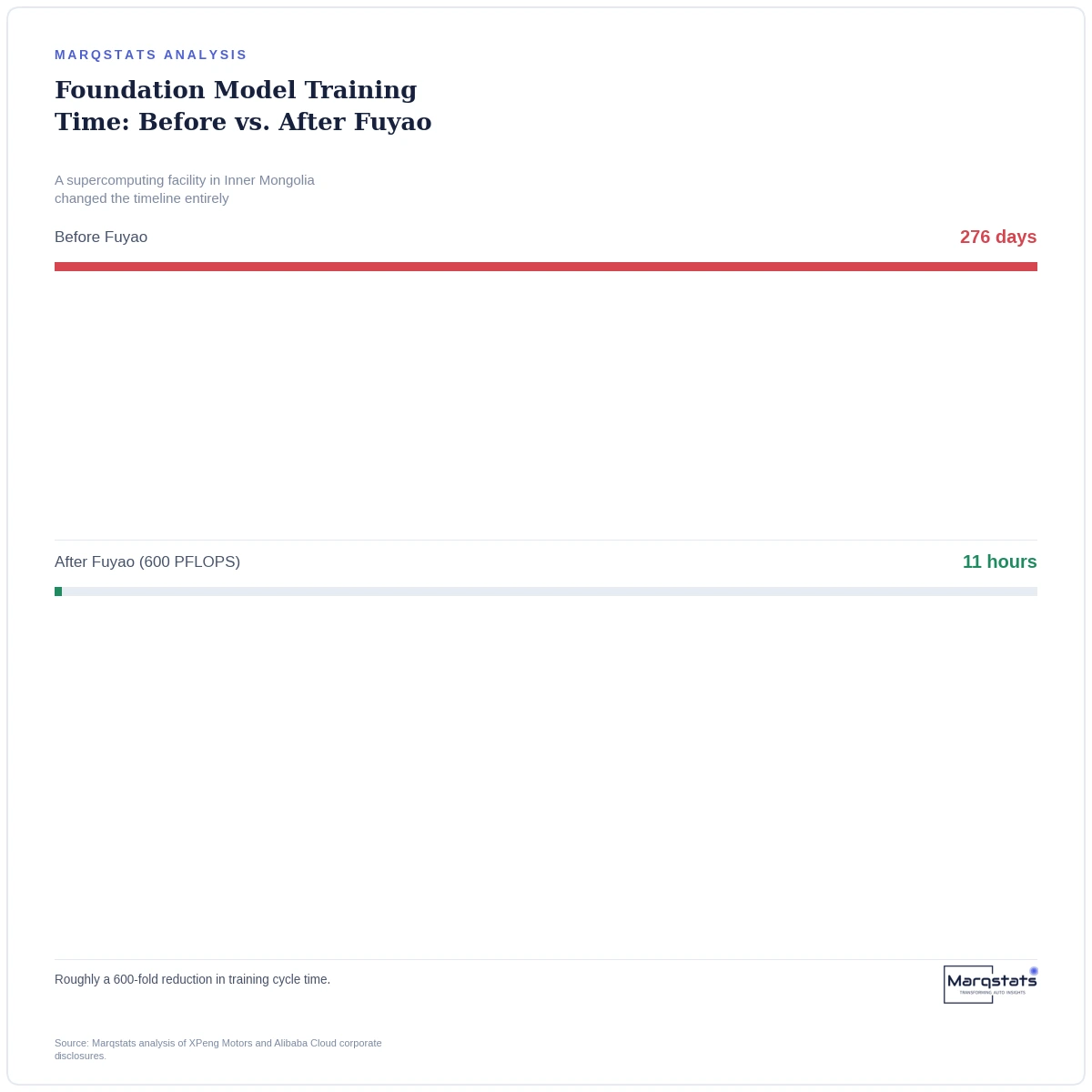
Before facilities like Fuyao existed, running a full training cycle incorporating fresh real-world data took the better part of a year. That's an enormously slow feedback loop for a technology where safety-relevant edge cases can appear at any time and ideally get addressed as quickly as possible.
A training cycle that once took most of a year now finishes before a single workday ends.
— Marqstats Analyst Team
How the acceleration actually happens
The speedup isn't a single trick - it comes from combining raw computing scale with automation at every stage of the pipeline. Fuyao's 600 PFLOPS of dedicated processing power, delivered through Alibaba Cloud's machine-learning infrastructure, provides the raw throughput. But raw compute alone wouldn't get you from 276 days to 11 hours; the facility also automates the data preparation work that used to be a genuine bottleneck.
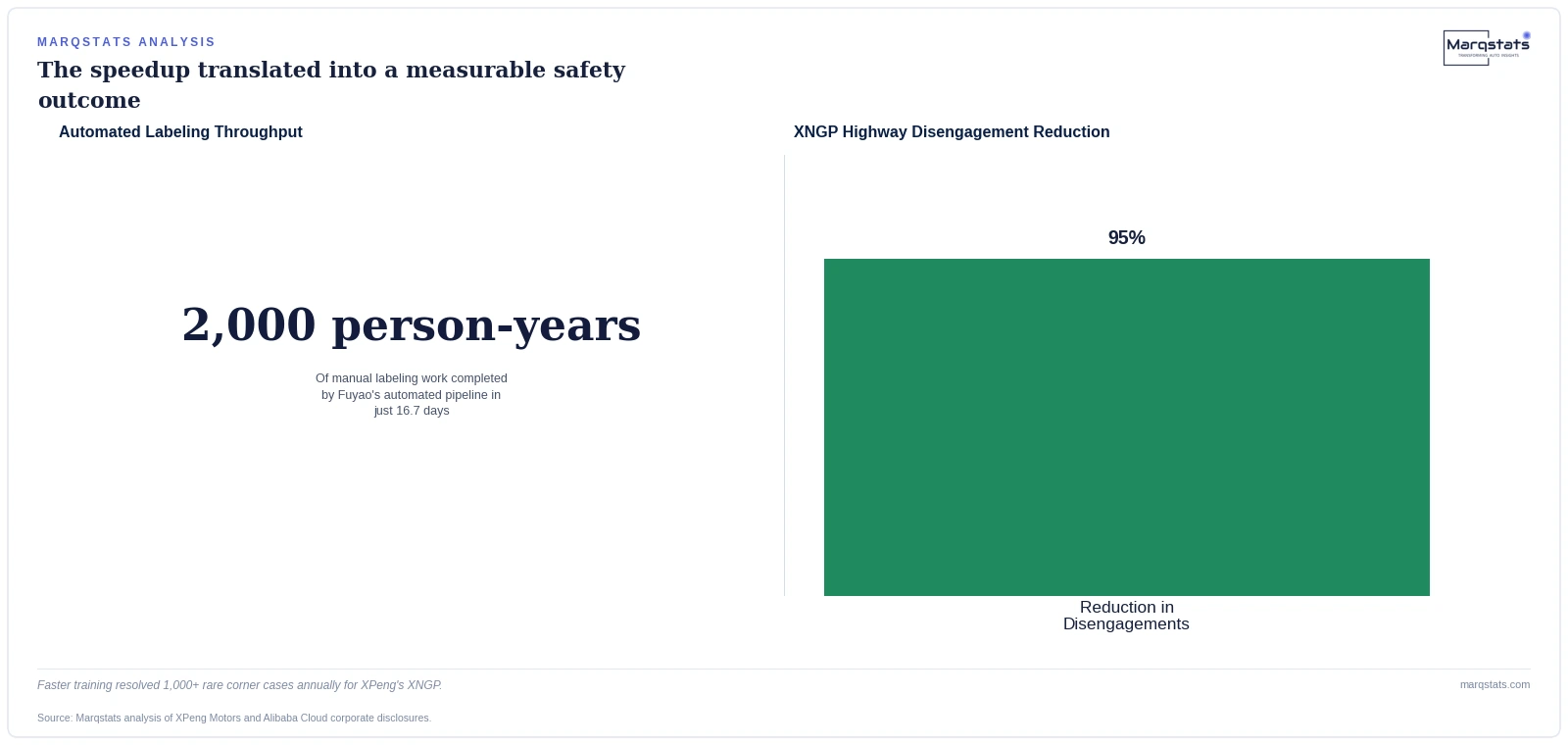
Fuyao's automated labeling pipeline, for instance, annotates raw camera and LiDAR frames at a throughput equivalent to 2,000 person-years of manual labeling work, completed within 16.7 days. Manually reviewing and tagging that volume of sensor footage, identifying every pedestrian, vehicle, lane marking and obstacle in each frame, would have required an enormous human labeling workforce operating for years. Automating that step removes what was previously one of the slowest parts of the entire training loop.
What this compute advantage actually produced
The practical output of this system, according to XPeng's own disclosures, is the resolution of more than 1,000 rare corner cases annually, contributing to a 95% reduction in highway navigation disengagements for its XNGP driver assistance platform. A disengagement is any moment where the system hands control back to the human driver because it can't confidently handle a situation - fewer disengagements generally indicates a more capable, more trustworthy autonomous system. This is a concrete, measurable outcome tracing back to the training infrastructure improvement, not merely a speed claim in isolation.
The counter-argument: does faster training actually mean a better or safer system?
A fair objection is that training speed and system quality are not automatically the same thing - a facility that trains models 600 times faster could, in principle, simply produce more iterations of a flawed approach faster, without necessarily producing a materially safer outcome. This is a real distinction worth holding onto. What makes XPeng's specific case more persuasive than a pure speed claim is the accompanying outcome metric: a 95% reduction in highway disengagements is a measurable safety-adjacent result, not just a training-time statistic. That said, disengagement rate alone doesn't fully capture real-world safety either, and independent verification of XPeng's self-reported figures, rather than accepting corporate disclosure at face value, would strengthen confidence in the underlying safety claim specifically.
What this means for the broader autonomous driving industry
- Companies developing autonomous driving systems without comparable compute infrastructure should expect a genuine competitive disadvantage in iteration speed, not just a cost disadvantage.
- Investors and analysts evaluating autonomous driving safety claims should look for outcome metrics like disengagement rates alongside training infrastructure statistics, rather than treating either alone as sufficient evidence.
- Track whether comparable supercomputing facilities emerge outside China, since the compute-scale advantage Fuyao represents is a replicable infrastructure investment, not a uniquely Chinese technical capability.
Why Inner Mongolia specifically
The facility's location isn't incidental. Ulanqab, in Inner Mongolia, offers a combination of factors that make it a genuinely practical site for a large-scale computing facility: relatively low-cost electricity, a cooler regional climate that reduces the energy needed for data center cooling, and available land for the kind of large physical footprint a supercomputing installation requires. This is a common pattern for large compute facilities generally - the same underlying economics that make Inner Mongolia attractive for AI training infrastructure apply to data centers built for entirely unrelated industries, from cloud gaming to cryptocurrency mining in earlier years, before regulatory changes shifted that particular use case elsewhere.
The choice also reflects a broader pattern in how Chinese automakers and cloud providers have approached AI infrastructure: rather than building compute capacity adjacent to a company's headquarters or engineering centers, facilities like Fuyao are positioned specifically for computing economics, with data and results transmitted to and from engineering teams elsewhere. This decoupling of where the model gets trained from where the engineers actually sit is itself a notable operational choice, made possible by high-bandwidth connectivity between the facility and XPeng's broader development operations.
What this means beyond just XPeng specifically
Fuyao is a joint investment between one automaker and one cloud provider, but its existence signals something broader about the direction Chinese autonomous driving development is heading. Baidu AI Cloud has reported its own GPU Cloud revenue growing 283% year-over-year in the second quarter of 2026, driven specifically by automotive OEMs using its compute infrastructure for driving simulation and digital twin rendering - evidence that dedicated, large-scale AI training infrastructure for autonomous driving is becoming a genuine competitive category across multiple Chinese cloud providers and automakers, not a one-off investment unique to XPeng and Alibaba Cloud alone.
The full market picture
Marqstats' complete Asia-Pacific automotive data management market analysis, including the full autonomous driving infrastructure landscape, is available in the linked report below.
Related reportAsia-Pacific Automotive Data Management Market Size, Share & Forecast 2025 – 2029