The Access Problem SERMI Was Built to Solve
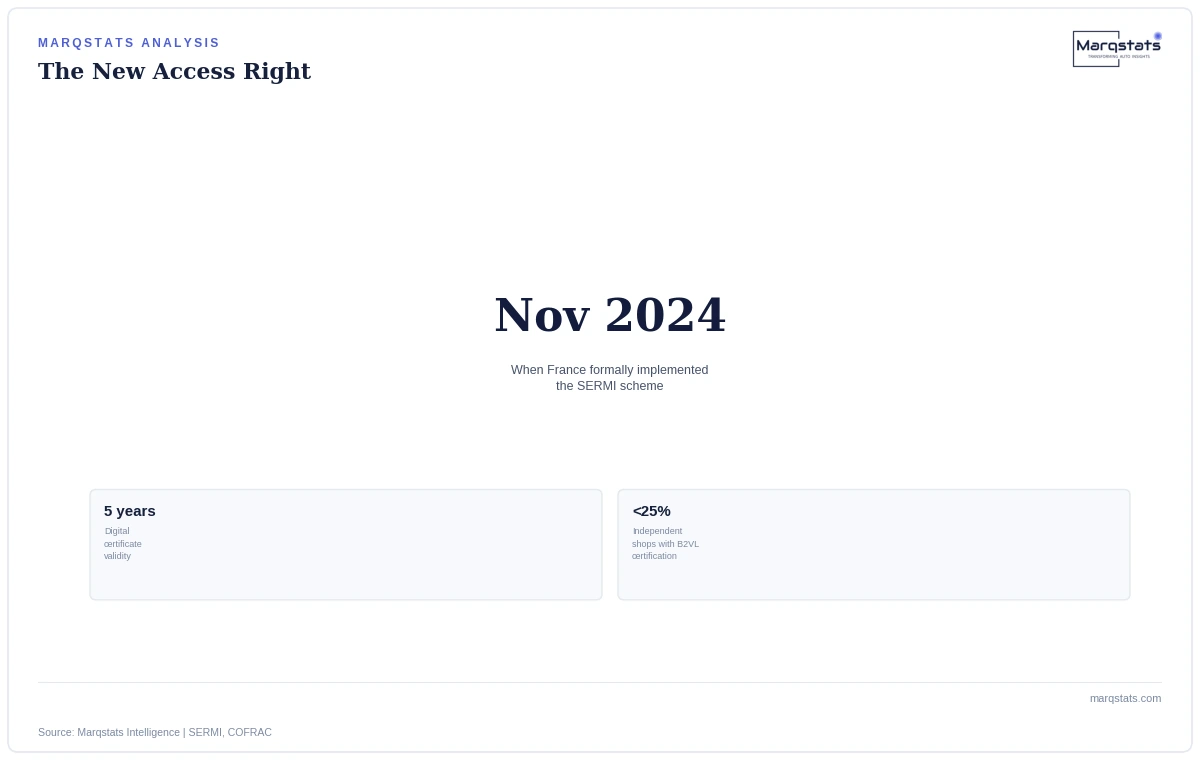
In brief: gaining access to onboard vehicle software, digital service records, and electronic anti-theft systems has long represented a primary competitive hurdle for independent EV repairers. On November 1, 2024, France formally implemented the European SERMI (Security-Related Repair and Maintenance Information) scheme, established under Regulation (EU) 2018/858.
What Actually Changed
Under SERMI, independent workshops and individual mechanics undergo background checks, facility audits, and technical competence validations to obtain an encrypted digital certificate valid for five years. That unified cryptographic token grants immediate access to OEM secure gateway modules, electronic control units, key reprogramming portals, and high-voltage anti-theft interlocks — access previously controlled entirely by manufacturers.
The Delay That Tells Its Own Story
The law arrived. The certification to use it is still catching up.
— Marqstats Analyst Team
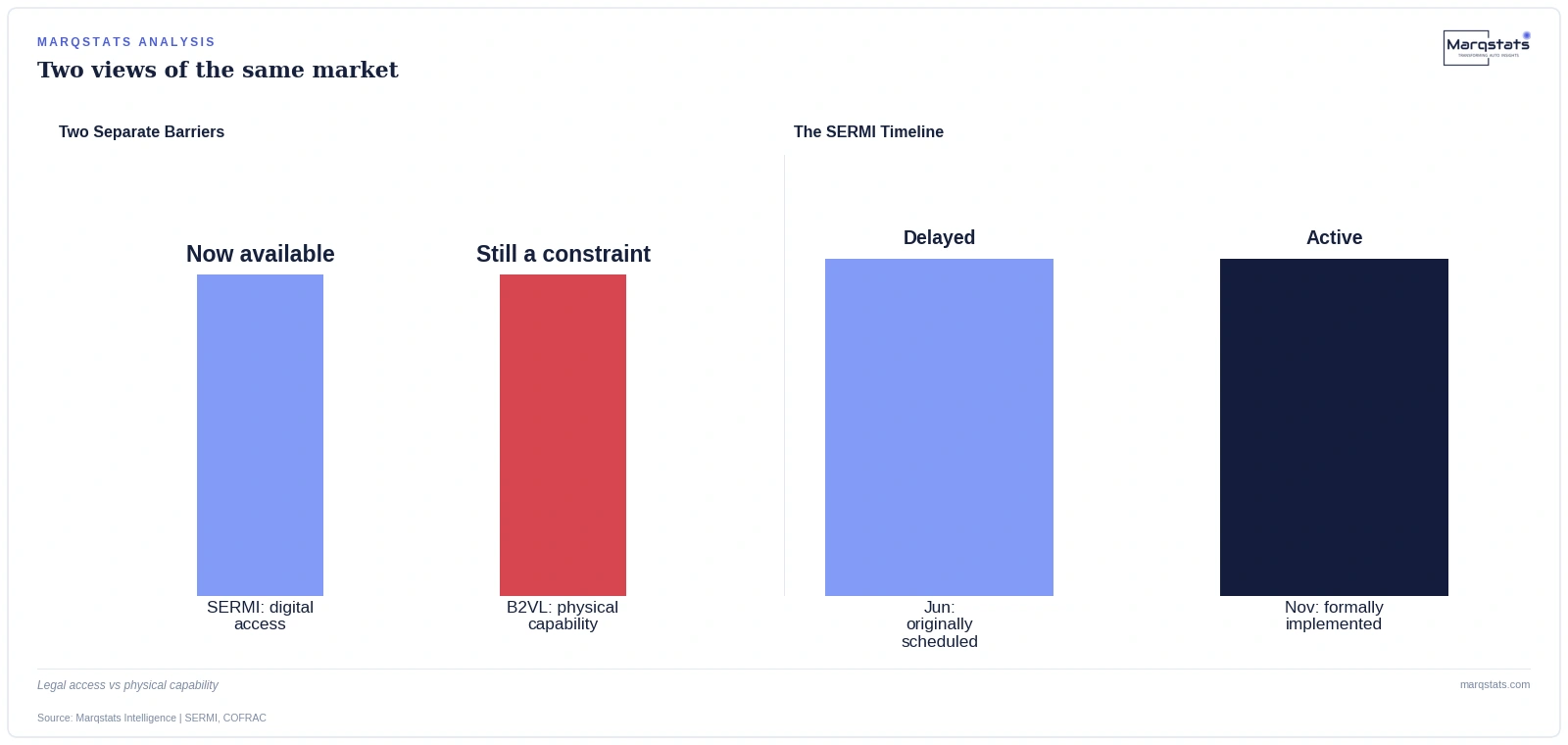
SERMI was originally scheduled for June 2024 but was delayed to allow the French accreditation body COFRAC to approve conformity assessment organizations, with DEKRA Certification becoming the first accredited body authorized to audit workshops. That delay itself is a useful signal: even implementing the access-rights infrastructure took longer than planned, and actually using it requires a separate technical credential entirely.
Why Legal Access Isn't the Same as Practical Capability
Having a SERMI digital certificate solves the software and data access problem. It doesn't solve the physical, hands-on problem: performing invasive high-voltage repairs still requires NF C 18-550 B2VL certification, the credential authorizing technicians to de-energize traction battery packs and work on disconnected high-voltage systems safely. Fewer than 25% of independent French repair facilities currently employ B2VL-certified technicians — meaning most independents still can't fully act on the access rights SERMI now gives them.
A Named Comparison: Two Different Kinds of Barrier
This is worth separating clearly because the two barriers respond to entirely different solutions. SERMI addressed a legal and digital-access barrier — manufacturers controlling encrypted software gateways. B2VL addresses a physical safety-training barrier — mechanics needing hands-on qualification to work safely around high voltage. Solving one doesn't automatically solve the other, and a workshop that has only tackled the first still can't perform the invasive repairs SERMI access theoretically enables.
Why Both Barriers Are Worth Clearing Anyway
None of this makes the SERMI change unimportant. Removing the legal and digital half of the barrier is a genuine precondition for everything that follows -- a workshop still needs SERMI accreditation before B2VL certification becomes commercially useful at all, since software access and physical repair capability have to work together to actually complete a job.
What This Means for Independent Workshops
The practical takeaway: independent repairers evaluating EV service expansion should treat SERMI accreditation and B2VL certification as two separate, both-necessary investments, not a single hurdle that's now been cleared. Prioritizing one without the other leaves a genuine capability gap the new legal framework alone doesn't close.