The adhesive that makes a battery pack lighter is the same adhesive that makes it nearly unrepairable
For most of the past decade, battery pack repair worked the way you'd expect: open a lid, unbolt a bad module, swap in a good one. That's still how most out-of-warranty EV repairs happen today. But it's not how new vehicles are being built, and the reason traces back to a genuinely clever piece of chemistry that solves one problem while creating another.
What the adhesive is actually doing
Modern battery packs increasingly use what's called Cell-to-Pack or Cell-to-Chassis construction, where individual cells are bonded directly to the vehicle's cooling plates and structural floor pan using two-component polyurethane adhesives and expanding potting foams. This isn't decoration or convenience - it's doing three jobs at once. Mechanically, it provides enough rigidity to help the battery pack itself bear part of the vehicle's structural load, eliminating the module brackets and internal wiring harnesses that used to take up space. Thermally and electrically, it conducts heat away from the cells during fast charging while providing enough dielectric isolation to prevent electrical arcing between adjacent cells. And in a worst-case thermal event, the foam is engineered to carbonize and form an insulating barrier that stops a single cell's failure from spreading to its neighbors.
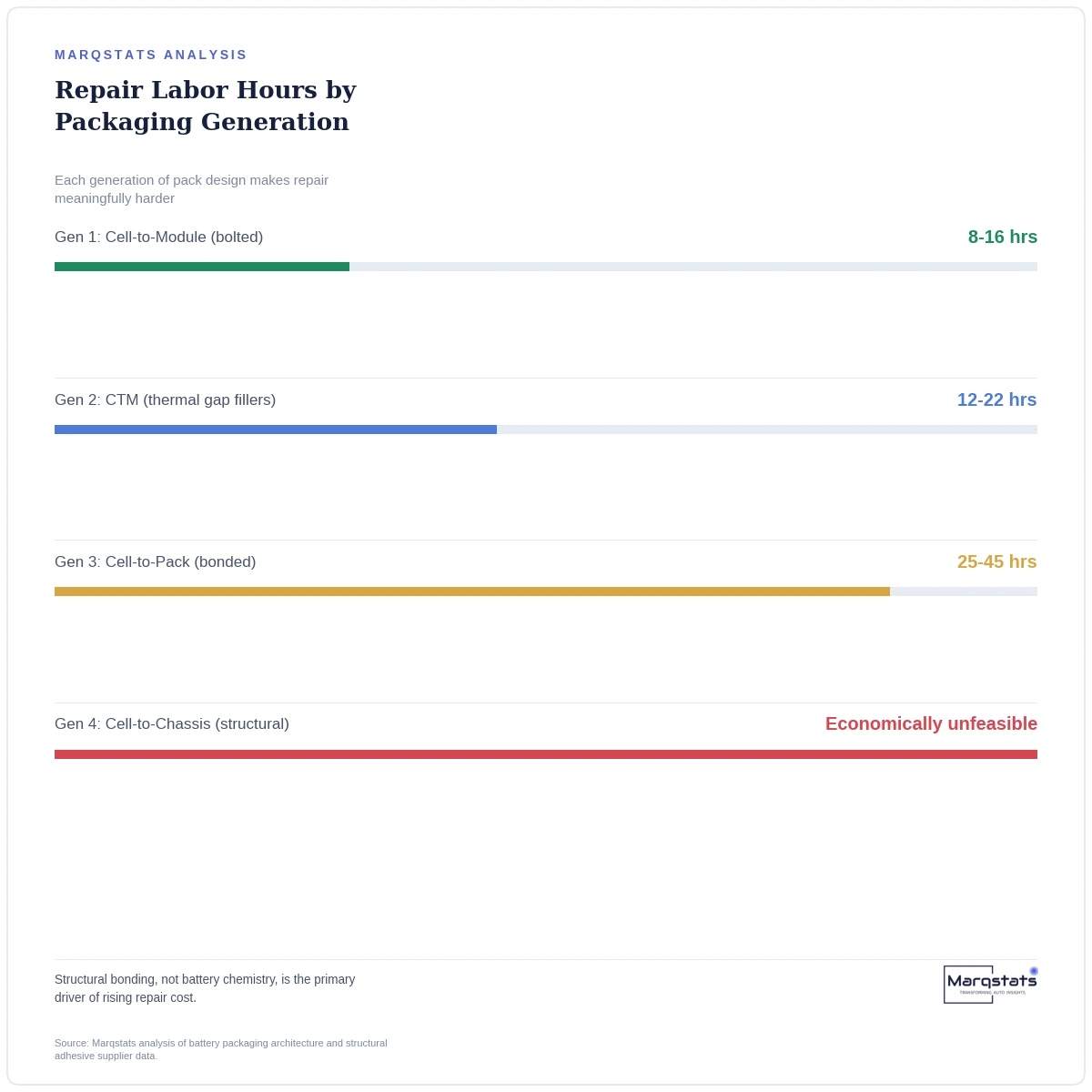
This is why the packaging shift happened: it let automakers increase volumetric energy density from a historical range of 25% to 35% up to 55% to 65%, meaning more battery capacity fits in the same physical space, translating directly into more range or a smaller, lighter pack.
The adhesive isn't a manufacturing shortcut. It's doing the job of parts that used to exist separately.
— Marqstats Analyst Team
Why that same chemistry becomes a repair problem
Once cured, these thermoset polyurethanes cannot be remelted without exceeding the safety thresholds of the cells themselves, which begin degrading above roughly 60 degrees Celsius and risk catastrophic decomposition above 120 degrees. That leaves almost no safe thermal pathway to soften the bond and separate a cell from its cooling plate. Applying mechanical force instead - prying a bonded cell away - frequently breaches the cell's casing or tears its pouch foil, venting flammable electrolyte and potentially triggering the exact thermal runaway event the adhesive was designed to contain.
The practical result is that a pack built this way can only realistically be serviced by facilities with genuinely industrial capability: automated robotic water-jet cutters, computer-vision-guided laser ablation systems, and custom ultrasonic tab cutters designed to strip welds without transmitting mechanical shock into the cell's internal separator layers. That's a fundamentally different capital and expertise threshold than a local independent shop with hand tools and a lift.
The industry's own response: adhesives designed to unglue themselves
Material suppliers have taken notice. Henkel and 3M have both developed specialized debondable structural adhesives and reworkable foam gaskets engineered to release under specific conditions - targeted chemical solvent immersion, or localized radio-frequency heating that can soften just the adhesive without raising the surrounding cell temperature to dangerous levels. These formulations are a genuine engineering answer to a genuine problem, not a marketing claim: if they can match the mechanical, thermal and electrical performance of the current non-reworkable chemistries while adding a controlled release mechanism, they would restore a real independent-repair pathway to the newest generation of battery packs.
The counter-argument: is this actually a repair problem, or an inevitable engineering trade-off?
It's fair to argue that every engineering choice involves trade-offs, and prioritizing structural rigidity, thermal performance and fire safety over field-serviceability is a reasonable choice given how rarely any individual cell actually needs to be swapped versus how often the pack needs to survive a crash or a thermal event without spreading fire to the passenger cabin. This is a legitimate point, and it's likely part of why automakers made this choice in the first place. But it doesn't resolve the practical consequence for the millions of vehicles already on the road with these architectures: as they age out of warranty over the coming decade, a growing share of the fleet will have no independent repair pathway at all, regardless of whether that outcome was a deliberate trade-off or an unintended side effect.
What this means for owners and repairers
- Owners shopping for an EV who value long-term independent repair access should ask specifically about the vehicle's pack architecture (Cell-to-Module versus Cell-to-Pack or Cell-to-Chassis), not just battery capacity or range.
- Independent repairers should treat capital investment in industrial-grade debonding equipment as increasingly necessary to remain relevant on newer platforms, rather than continuing to specialize exclusively in older modular designs.
- Track debondable adhesive commercialization from suppliers including Henkel and 3M specifically, since their adoption timeline is a more direct predictor of future independent repair access than any single piece of right-to-repair legislation.
Four generations of packaging, four very different repair outcomes
The industry has moved through four distinct packaging generations, and each one tells the same story from a different angle. First-generation Cell-to-Module designs, used in the Nissan Leaf, BMW i3 and early Tesla Model S, relied on mechanical brackets and reversible bolted busbars - a technician could open the pack, unbolt a bad module, and slide in a replacement in 8 to 16 labor hours. Second-generation designs, including the Volkswagen ID.3 and ID.4 and the Hyundai Ioniq 5, introduced dispensed thermal gap fillers that made individual cell access harder but still allowed whole-module swapping, typically in 12 to 22 hours.
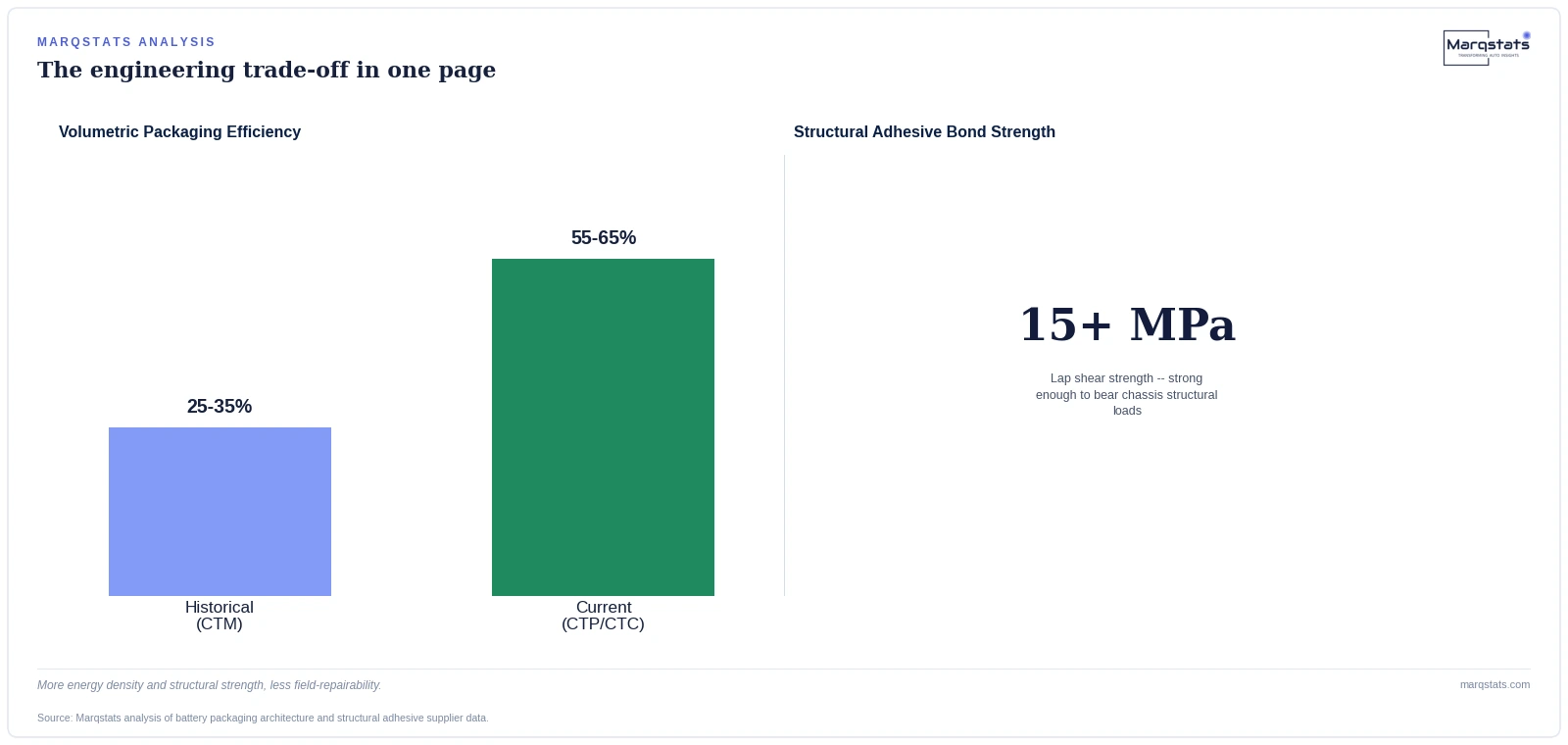
Third-generation Cell-to-Pack designs, exemplified by the BYD Blade Battery and CATL's Qilin platform, introduced the structural 2K polyurethane adhesives this piece focuses on, pushing labor requirements to 25 to 45 hours and requiring specialized rigs most shops simply don't have. Fourth-generation Cell-to-Chassis designs, led by Tesla's Austin-built 4680 structural pack, complete the transition: the source material's own technical assessment describes cell-level repair on these platforms as economically unfeasible, full stop, leaving complete pack replacement as the only realistic path.
What this means for the used-EV market specifically
This packaging trajectory has a consequence that extends well beyond repair shops: it shapes which used EVs retain genuine long-term value. A ten-year-old Cell-to-Module vehicle facing a battery fault has a real, cost-effective repair pathway and can plausibly remain economically viable for years beyond that point. A comparable-age Cell-to-Pack or Cell-to-Chassis vehicle facing the same fault faces a starkly different calculus - either an expensive full pack replacement through the automaker, or scrapping the vehicle entirely if the replacement cost exceeds the car's remaining value. Buyers evaluating a used EV purely on price and range may be underweighting this packaging-architecture distinction, even though it could materially affect the vehicle's usable lifespan and resale value a decade from now.
The full market picture
Marqstats' complete global EV battery remanufacturing market analysis, including the full packaging architecture breakdown and a two-scenario forecast through 2029, is available in the linked report below.
Related reportGlobal Out-of-Warranty EV Battery Cell-Swap and Remanufacturing Market Size, Share & Forecast 2025 – 2029