Your dealer will quote you one number for a battery repair. There are actually four.
When a dealer tells an out-of-warranty EV owner their battery needs replacing, the number they quote is almost always the most expensive option on the table. It's not the only option - it's just the one that requires the least explanation. Three genuinely different, meaningfully cheaper paths exist, each with its own trade-offs.
Option one: brand-new OEM pack
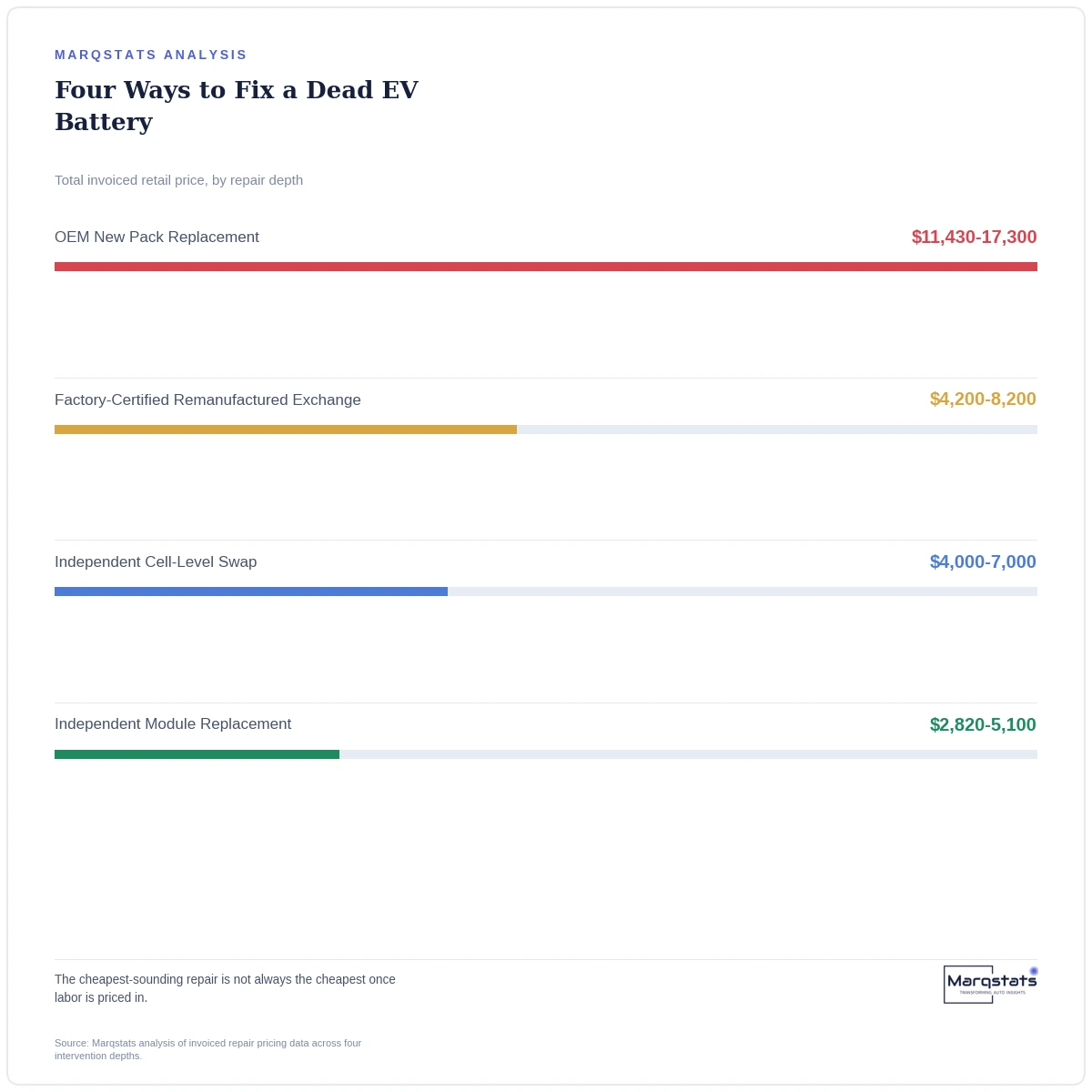
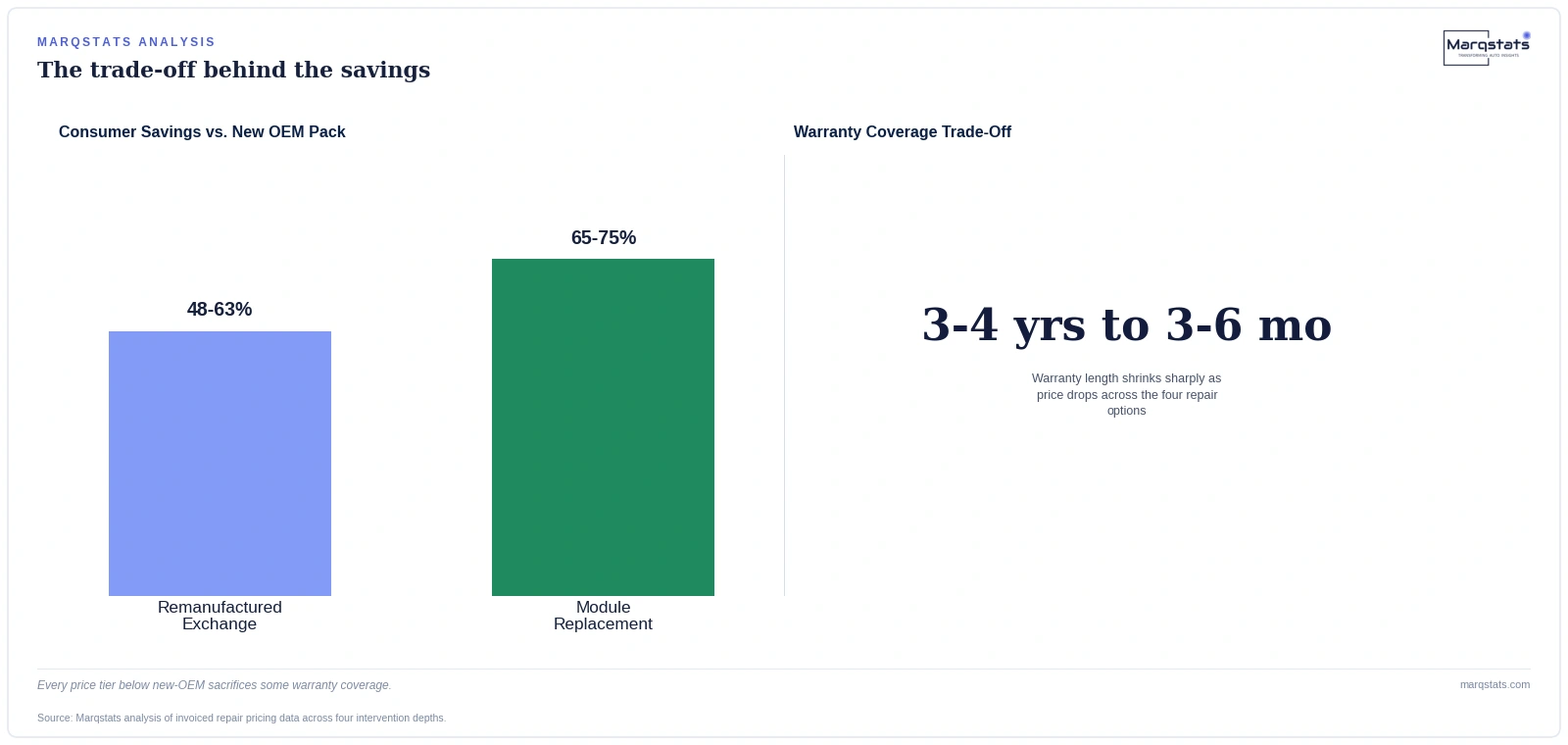
This is the dealer default: a complete, factory-fresh replacement pack with all-new cells, casing, and BMS hardware. It costs $11,430 to $17,300 for a typical 60 to 80 kWh pack, and it comes with the strongest warranty of any option - 3 to 4 years or 50,000 miles. For a vehicle the owner plans to keep for many more years, or one still under some secondary coverage, this is the safest choice. It's also, by a wide margin, the most expensive.
Option two: factory-certified remanufactured exchange
This is where the real savings start. A remanufactured pack uses the original casing and BMS hardware, refurbished and reflashed, with recovered and tested cells replacing only what actually failed. The total cost drops to $4,200 to $8,200 - a 48% to 63% savings versus new - while still carrying a real warranty, typically 1 to 2 years or 25,000 miles. Nissan's 4R Energy joint venture pioneered this model in Japan, offering remanufactured Leaf packs at a documented 53.5% discount to new, and automakers including Stellantis and Renault have since built entire business units around this exact service tier.
The remanufactured option isn't the cheap alternative. It's the one automakers are actually building factories for.
— Marqstats Analyst Team
Option three: independent module replacement
If the vehicle's pack architecture allows it - meaning it's built with individually accessible modules rather than structurally bonded cells - an independent specialist can identify the specific failed module and replace just that one component with a tested donor module. Total cost: $2,820 to $5,100, a 65% to 75% savings versus new, the steepest discount of any repair path. The trade-off is warranty length: typically just 6 to 12 months, and only 12,000 miles of coverage, reflecting that only the swapped module, not the entire pack, has been verified to a like-new standard.
Option four: direct cell-level swap
The most surgical, most labor-intensive option: an independent technician isolates and replaces a single failed cell within a module, rather than swapping the whole module. Material costs are the lowest of any option, but labor runs 25 to 40 hours for the delicate manual work of tab de-welding and cell rebalancing, pushing total cost back up to $4,000 to $7,000 - a 55% to 65% savings versus new, and warranty coverage narrows further still, typically 3 to 6 months with limited scope.
Why option four sometimes costs more than option three
It's worth pausing on something that looks counterintuitive: cell-level repair, the most surgical and skill-intensive option, doesn't always land as the cheapest. The material cost is genuinely lower, but the labor hours required (25 to 40, versus 14 to 20 for module swapping) are high enough that the total invoice can actually exceed module-level replacement. The lesson: the cheapest-sounding repair on paper isn't automatically the cheapest repair in practice once labor is priced in.
The counter-argument: aren't options three and four disappearing anyway?
A fair point is that this entire comparison may become increasingly academic as newer vehicles shift toward Cell-to-Pack and Cell-to-Chassis architectures that make options three and four physically difficult or impossible - meaning the price ladder described here applies mainly to older, modular-architecture vehicles rather than the vehicles being sold today. This is accurate, and it's a genuine structural trend worth taking seriously. But it doesn't make the comparison irrelevant: millions of modular-architecture vehicles remain on the road today and will for years to come, and for those owners specifically, understanding this full price ladder, not just the dealer's default quote, represents real, immediate money.
What this means for owners facing a battery repair quote
- Ask specifically whether a factory-certified remanufactured exchange is available before accepting a new-pack quote, since it delivers substantial savings while retaining a genuine warranty.
- Confirm your vehicle's pack architecture (bolted modules versus bonded cells) before assuming independent module or cell-level repair is even physically possible.
- Weigh warranty length against price explicitly - the cheapest option on paper may not be the best value if it carries only months of coverage versus years.
The full market picture
Marqstats' complete global EV battery remanufacturing market analysis, including the full unit economics breakdown and a two-scenario forecast through 2029, is available in the linked report below.
Related reportGlobal Out-of-Warranty EV Battery Cell-Swap and Remanufacturing Market Size, Share & Forecast 2025 – 2029