Most manufacturer marketing money funds their own website. AI answers barely cite it.
In brief:
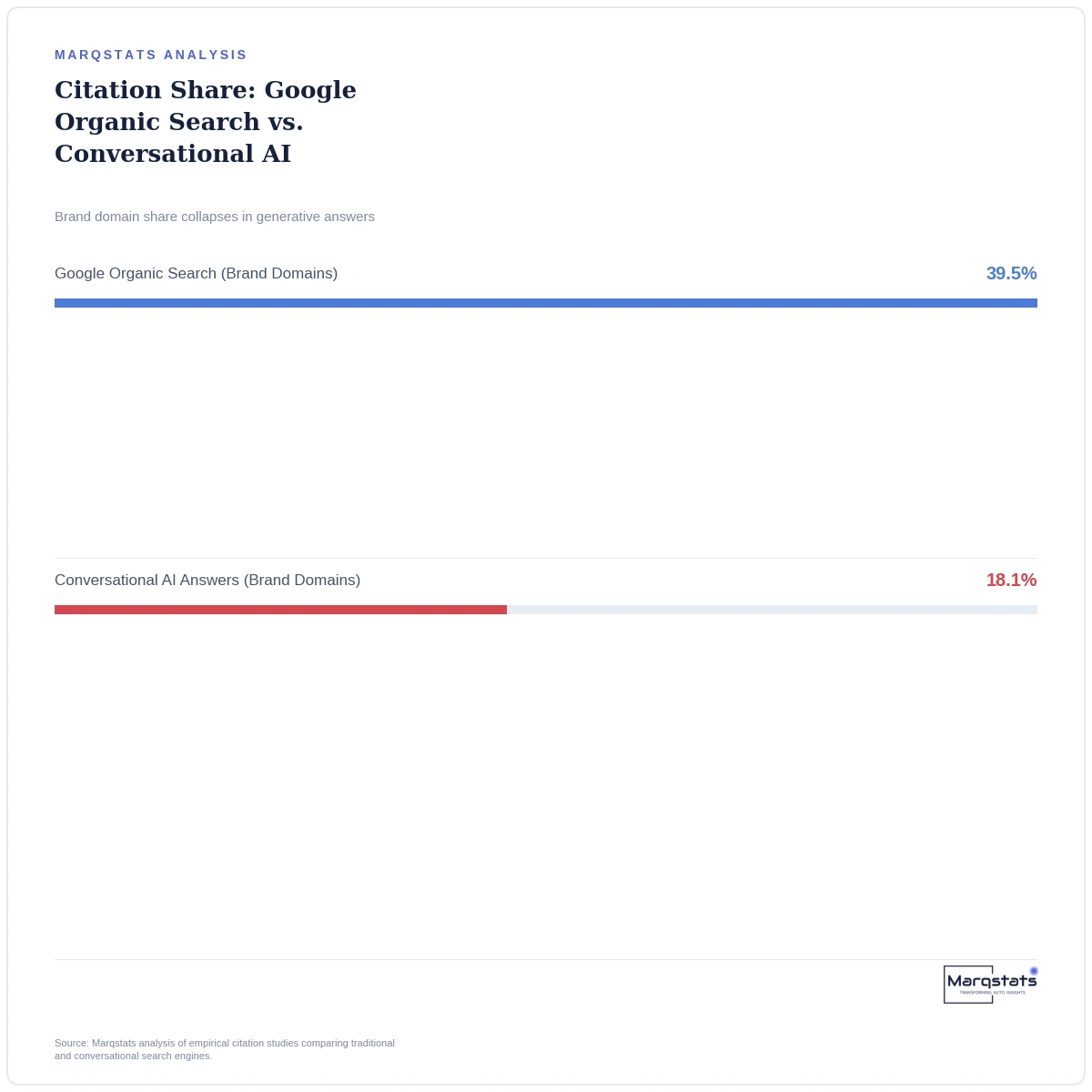
- Google organic search allocates 39.5% of top visibility to brand-owned domains and 45.1% to earned media.
- Conversational AI answer engines allocate just 18.1% of citations to brand domains and 81.9% to earned media.
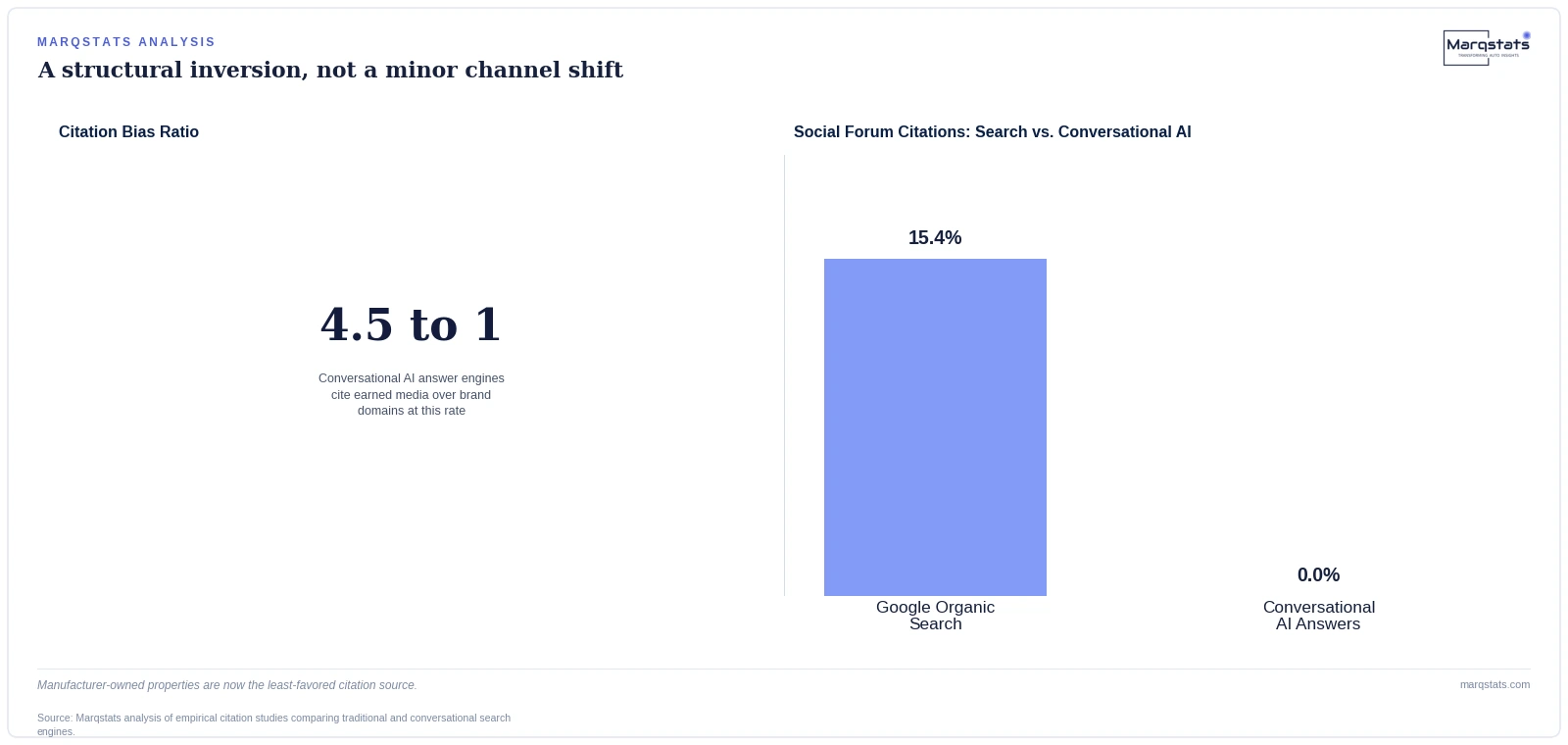
- Social forum citations, which traditional search still credits at 15.4%, drop to 0.0% in conversational AI answers.
For years, a European automotive manufacturer's digital marketing playbook has rested on a straightforward premise: build the best-resourced, most comprehensive brand website, and search engines will reward it with visibility. That premise still holds, imperfectly, inside traditional Google organic results. It breaks down almost entirely once the question shifts to conversational AI answer engines. Billions of euros in cumulative investment went into exactly that strategy across the industry.
What the actual numbers show
The comparison is genuinely stark once laid out side by side. Google's traditional organic search results split top visibility 39.5% to brand-owned domains and 45.1% to earned media, with the remaining share going to sources including social forums, at roughly 15.4%. Conversational AI answer engines redraw that split almost entirely: 81.9% of citations go to earned media, just 18.1% go to brand domains, and social forum citations disappear to 0.0% altogether.
Do the arithmetic on the ratio and the scale of the shift becomes clear: conversational engines cite earned media over brand-owned properties at roughly 4.5 times the rate. A manufacturer's own website, the single channel that has historically absorbed the largest share of automotive digital marketing budgets, is now the least-favored citation source in the channel increasingly shaping vehicle consideration.
The website manufacturers spent the most building is the one AI trusts the least.
— Marqstats Analyst Team
Why this represents a genuine structural problem, not a minor channel shift
It's worth being precise about why this matters more than a routine reallocation between marketing channels. European manufacturers have historically directed over 80% of digital marketing budgets toward brand-owned web properties, treating the manufacturer's own site as the primary, authoritative source of vehicle information consumers should encounter. That strategy made sense when search primarily surfaced ranked links to individual websites, since a well-resourced brand site could reasonably compete for and win top organic positions.
Conversational answer engines don't work that way. They synthesize a single answer drawing from multiple sources simultaneously, and the evidence shows they systematically favor independent, third-party sources over brand-controlled ones when constructing that synthesis. A manufacturer's brand site can be comprehensive, accurate and well-optimized, and still be functionally sidelined in the resulting answer, simply because the underlying system weights independent corroboration more heavily than brand-authored claims. That's a genuinely different competitive game than the one most manufacturer marketing organizations were built to play.
Why generative systems might be built this way
The pattern makes a certain intuitive sense once you consider what a conversational answer engine is actually trying to do: provide a trustworthy, balanced answer to a question, not simply relay whatever a brand says about its own products. A brand's own website is, definitionally, a self-interested source when it comes to evaluating that brand's own vehicles. Independent reviews, comparison sites, and editorial coverage carry an implicit credibility advantage precisely because they're not the party being evaluated. It's a reasonable design principle for a system built to synthesize trustworthy answers - it just happens to be structurally unfavorable to the exact channel manufacturers have spent decades building out.
The counter-argument: could this pattern simply reflect a temporary quirk of current AI systems rather than a durable principle?
A fair objection is that current conversational AI systems are still relatively early in their development, and the specific citation weighting observed today might shift as these systems mature, rather than representing a fixed, durable pattern manufacturers should permanently redesign their strategy around. This is a reasonable caution, and citation weighting algorithms could evolve. What makes the underlying principle more durable than a temporary quirk, though, is that it reflects a sound design logic, favoring independent corroboration over self-interested claims, rather than an arbitrary technical artifact likely to be patched out in a future update. Systems built around synthesizing trustworthy answers have a structural reason to keep favoring independent sources, even as the specific percentages shift over time.
What this means for manufacturer marketing strategy
- Manufacturers should reallocate meaningful digital marketing budget away from brand-owned property investment and toward earned digital public relations, independent review syndication and verified third-party corroboration.
- Marketing teams should track citation share specifically within conversational answer engines as a distinct metric from traditional organic search ranking, since the two channels reward fundamentally different strategies.
- Brand communications teams should prioritize building genuine, substantive relationships with independent automotive editorial and review publications, since these sources now carry disproportionate weight in how vehicles get recommended.
Why even strong organic rankings don't buy the same protection here
It's worth connecting this citation bias finding to a separate, related pattern in generative search: strong traditional organic search ranking doesn't reliably predict generative citation inclusion in the first place. Only 20.1% of AI Overview URLs directly match a page-one organic URL, and 62.0% of generative citation links originate from domains that don't rank in the organic top ten at all. Combine that with the citation bias finding, and a manufacturer brand site faces a genuinely compounded disadvantage: even a brand site that manages a strong traditional organic ranking still faces the separate, additional headwind of being a brand-owned domain competing against a system that structurally favors earned media regardless of ranking position.
This compounding effect is precisely why manufacturers cannot simply extend existing search engine optimization investment into generative visibility and expect proportional results. The two disadvantages, weak citation correlation with organic rank and citation bias against brand ownership, operate independently and stack on top of each other for brand-owned properties specifically.
What earned media actually means in practice for an automotive brand
It's worth being concrete about what earned media actually encompasses in this context, since the term can sound abstract. It spans independent automotive journalism and editorial reviews, third-party comparison and buying-guide content, consumer review platforms, established national trade publications, and verified customer testimonials hosted on platforms the manufacturer doesn't control. What unites these sources is that they're produced or curated by parties with no direct financial stake in a specific purchase decision, which is precisely the characteristic that appears to earn them disproportionate weight in conversational answer synthesis.
This has a direct implication for where manufacturer investment should actually go: not necessarily less total marketing spend, but a genuine shift in where that spend lands, from paid placement and owned-property development toward relationship-building with the independent publications, review platforms and comparison sites that conversational systems draw from most heavily.
The full market picture
Marqstats' complete Europe automotive Generative Engine Optimization market analysis, including the full citation mechanics and regulatory landscape, is available in the linked report below.
Related reportEurope Automotive Generative Engine Optimization Market Size, Share & Forecast 2026 – 2030