A Comparison That Should Settle a Common Assumption
It's easy to talk about EV reliability as a single category. Denmark's own statutory inspection data shows exactly why that framing breaks down once specific platforms are compared head to head.
Because large-scale consumer EV adoption in Denmark began accelerating between 2020 and 2021, significant cohorts of popular electric models faced their first mandatory roadworthiness inspection during 2025 -- four years after initial registration, as Danish law requires. That timing created a genuinely clean natural experiment: same registration year, same test, same regulator.
The Numbers Behind the Gap
These specific figures trace directly to the underlying research's own compiled inspection data, not a rough estimate.
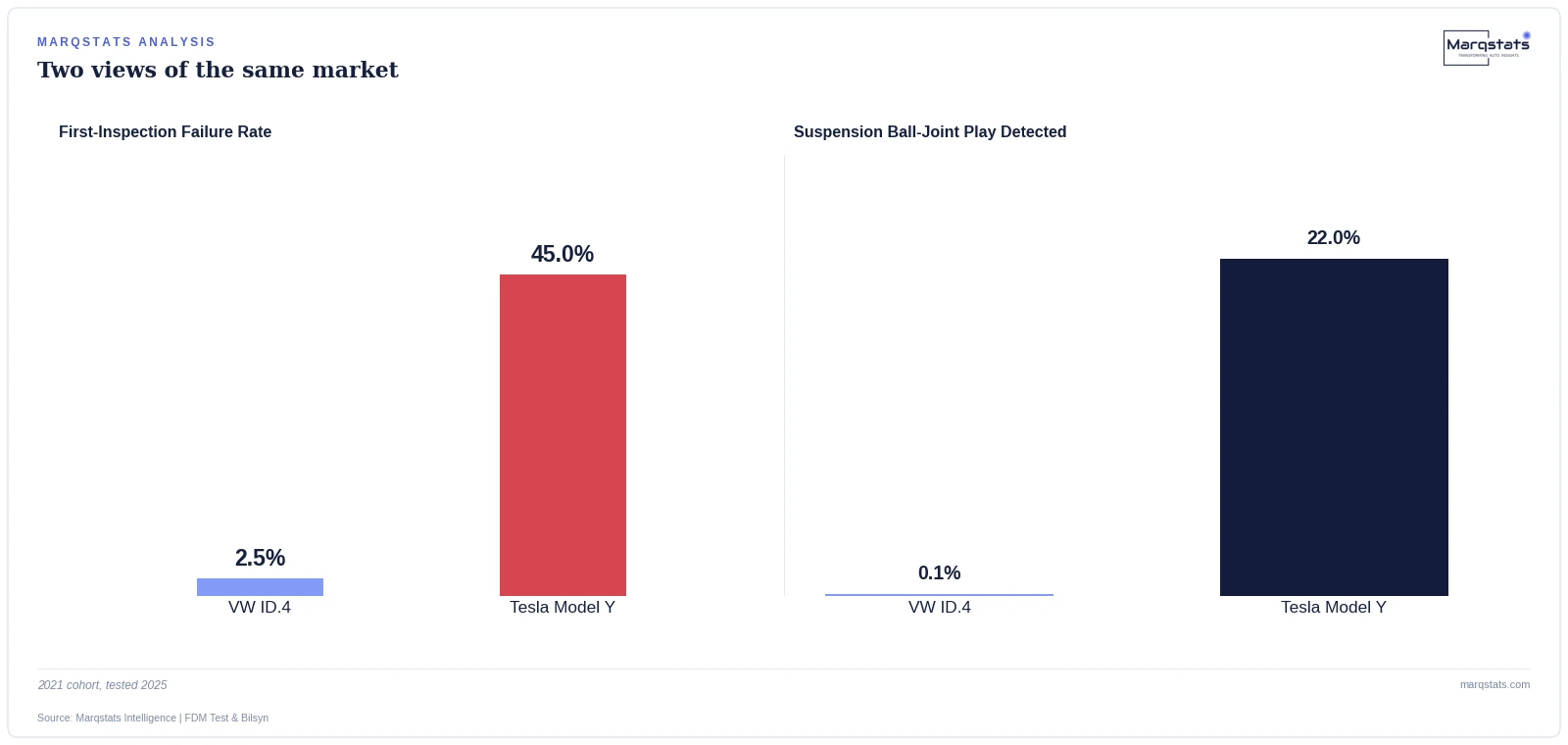
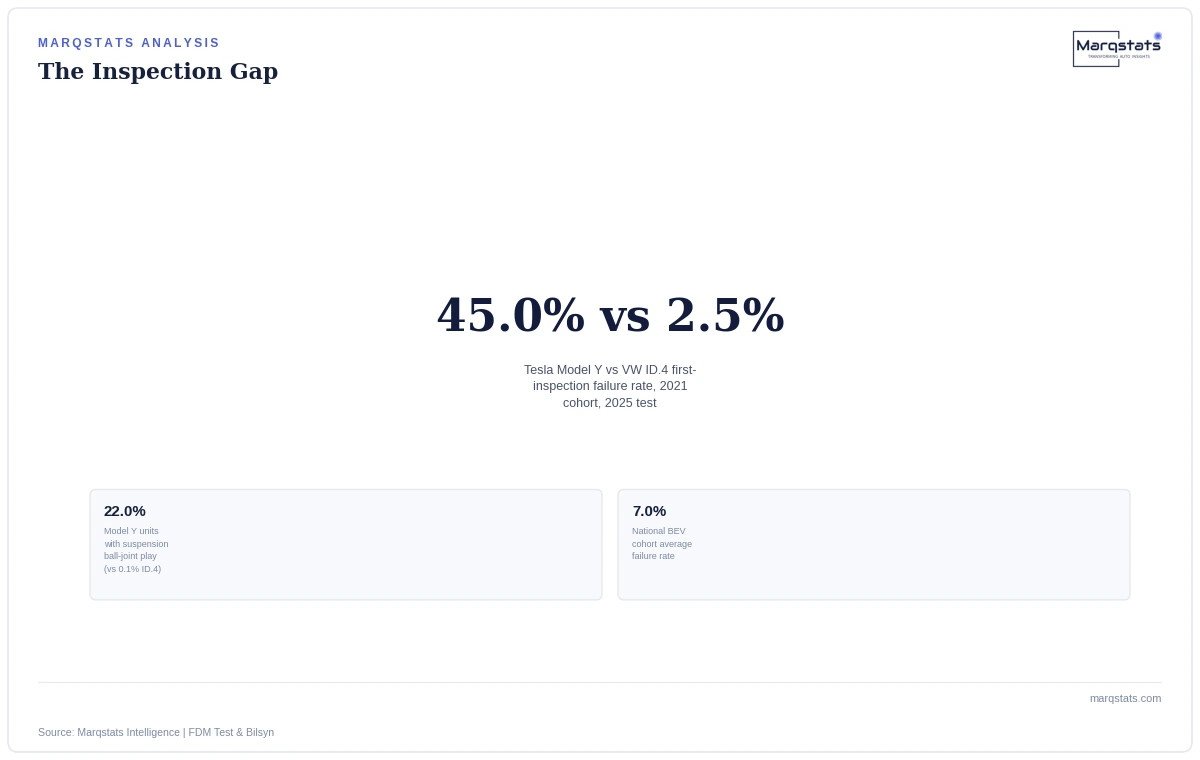
Out of 2,394 Tesla Model Y vehicles from the 2021 cohort inspected in 2025, 1,069 failed -- a 45.0% failure rate. The Volkswagen ID.4, the second most widespread electric vehicle in Denmark, was inspected under identical criteria from the same vintage and failed at just 2.5%, with only 178 failures out of 7,121 inspected units.
Where the Difference Actually Comes From
The gap isn't diffuse across many minor issues -- it concentrates in one specific, documented mechanical category.
Excessive play in suspension ball joints and control arm bushings was identified in 22.0% of all inspected Tesla Model Y units, compared to just 0.1% for the Volkswagen ID.4. Both vehicles carry substantial battery curb weight, and both deliver instant electric motor torque -- the physical inputs that stress suspension components are broadly similar across the category. The outcome is not.
A Named Comparison: Why This Became a Formal Consumer Dispute
This gap didn't stay a statistical curiosity -- it escalated into something with real consumer-protection weight.
The disparity was significant enough that it produced formal consumer disputes, culminating in decisions by the Danish Automotive Appeals Board (Ankenævn for biler) that mandated warranty coverage for premature rear suspension play. That's a regulatory body stepping in specifically because a documented reliability gap between two EVs of the same age had become a genuine consumer-protection issue, not just an academic comparison.
Why This Should Reframe How Buyers Evaluate 'Electric' as a Category
The real lesson here is about the unit of comparison, not about EVs as a technology.
Treating 'electric vehicle' as a single reliability category obscures more than it reveals. The national average BEV cohort failure rate landed at roughly 7.0% -- a figure that would look entirely reasonable in isolation, but that blends a 45.0%-failure platform with a 2.5%-failure platform into one misleadingly moderate number.
What This Means for Fleet Buyers and Workshops
The practical takeaway: fleet managers, leasing companies and independent workshops should evaluate platform-specific inspection and defect history before acquisition or service-capacity planning specifically, since powertrain type alone is a poor proxy for mechanical risk in this market.